Louise Burne: Government making budget promises in age of uncertainty
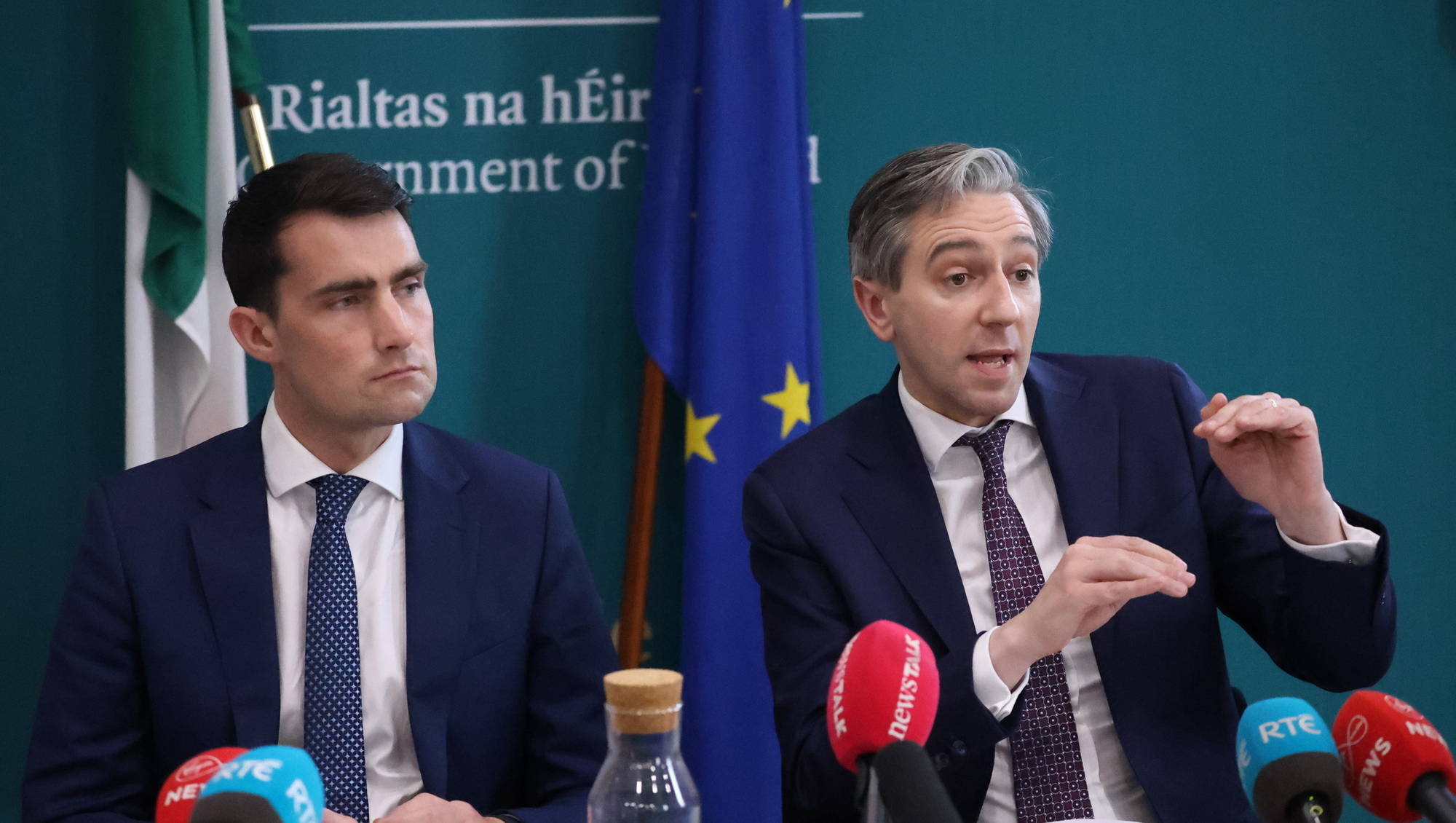
Public expenditure minister Jack Chambers and Tánaiste and finance minister Simon Harris at a press conference on the annual progress report.
For the second year in a row, the money ministers were publishing their annual progress report amid a wave of global uncertainty.
Last year, then finance minister Paschal Donohoe and public expenditure minister Jack Chambers unveiled 2025’s iteration of the document just a month after US president Donald Trump had announced sweeping global tariffs.
At that stage, the mandarins in the Department of Finance were attempting to gameplan the impact these tariffs could have on Irish jobs.
It was estimated at that stage that Ireland could see 25,000 fewer jobs created by the end of 2026.
The department warned that Ireland’s economy would still grow, just more slowly than had been predicted.
One year on, John McCarthy, chief economist at the Department of Finance, conceded that “tariffs may be much less problematic than we had initially thought”.
And, while economic growth is still expected, there could be slower growth for vastly different reasons.
Rather than tariffs driving uncertainty, it is the global oil crisis — triggered by the US war on Iran and the closure of the Strait of Hormuz — that is creating instability, with the duration and long‑term impact unclear.
The nature of the crisis is not the only thing that is different one year on.
With Mr Donohoe now working in Washington DC for the World Bank, Tánaiste Simon Harris has taken up the mantle as finance minister.
“This year's report is once again being published against a backdrop of considerable global uncertainty,” he said on Tuesday.
“In recent weeks, we've seen a significant shock to global energy markets, with over 20m barrels of oil a day being disrupted.
“Of course, even as we sit here now, the situation remains extremely volatile."
Mr Harris said that even in the most positive scenario, the economic effects of recent disruption — particularly on energy markets and supplies — would take time to unwind.
Amid the uncertainty, he asked the Department of Finance to produce three different scenarios and how each would impact the economy.
The 'reference' scenario will be used by the Government to benchmark the scenario, with inflation estimated at 3.4%.
In the 'adverse' scenario, inflation would rise to 4.3% by the end of this year, while in the 'severe' scenario, it would reach 6.5% by year-end, rising further to 6.7% by the start of 2027.
While the economy would continue to grow in all scenarios, the level of growth would differ, depending on how bad the scenario is.
Mr McCarthy offered reassures that in each of the three scenarios, Ireland would not be in “recession territory”.
It means tax cuts for workers are still on the cards as part of Budget 2027, said the money ministers, and energy credits are not being ruled out, either.
Mr Chambers committed to progress being made on commitments in the programme for government.
These commitments were made in 2025, before tariffs and the Strait of Hormuz became part of our everyday vocabulary.
The issue, according to Mr Harris, is that the long-term consequences of the fuel crisis are yet to become clear.
What if the worst-case scenario comes to pass? What if inflation continues to rise across the EU and the European Central Bank once again decides to raise interest rates as a way of curbing it?
What if it is not financially possible to have tax cuts in Budget 2027 because another crisis is coming down the tracks?
It is a brave Government that makes budget promises so far out from October.
It is an even braver Government that makes budget promises so far out from October when so much of the ongoing financial uncertainty is outside of our hands.
Ministers usually baulk when journalists ask budget questions in April.
Now they themselves are making predictions on what may or may not be included when the severity of the crisis remains so uncertain.
As Mr Harris said, his job is to “tell people the truth, and the truth is there's huge economic uncertainty out there”.
He added: “The truth also is that the Irish economy will grow in all scenarios and we're going to get through this.”
While Ireland’s economic outlook looks positive, the path to Budget 2027 is paved with question marks.
The future of excise cuts, which are due to wind up at the end of July, is still uncertain.
Mr Chambers said the budget, going forward, will be about “trade-offs and choices Government must make when working within a binding set of constraints”.
Now they have said it so clearly, the Government will hope it can deliver on some of the budget projections they have already made.
But, for the second year in a row, a wave of global uncertainty threatens to derail the best-laid plans.

CONNECT WITH US TODAY



Be the first to know the latest news and updates