Growth prospects revised down following outbreak of Iran war
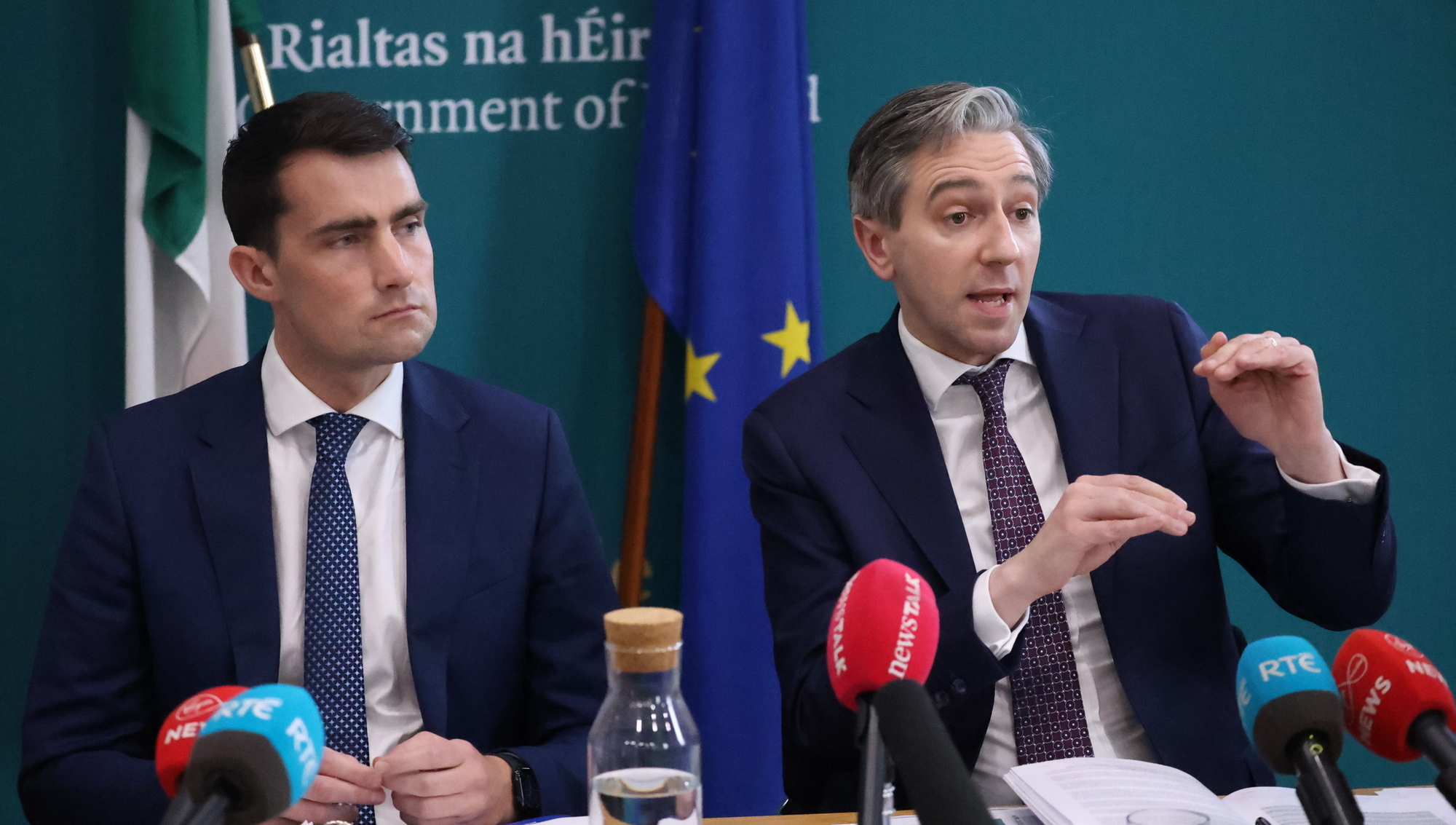
Ministers Jack Chambers and Simon Harris launching the Annual Progress Report at Government buildings.
The Department of Finance has downgraded the country’s growth forecast in light of the fallout from the war in the Middle East, as well as the resulting energy price shock, but even in the most severe projections the economy is expected to grow this year.
However, the Government is now projecting to run a deficit this year, and over the next couple of years, as more money is funneled into the State’s savings funds along with additional money being spent on capital investment.
According to the Government’s latest annual progress report, energy prices are assumed to moderate over the second half of this year should the conflict in the Middle East stay short and “fairly contained” with limited damage to infrastructure energy prices. With that, it is projecting inflation to average around 3.25% this year before moderating to 2.5% next year.
Chief economist at the Department of Finance John McCarthy said before the conflict, notwithstanding headwinds relating to trade policy, the Irish economy was “performing well”. Part of the reason for that was the effective tariff rate on Irish goods was lower than anticipated.
"If there had not been the conflict, we in the department would probably have been revising upwards our forecast for this year,” he said.
"At the time of the budget last autumn we were projecting modified domestic demand (MDD) growth of 2.3% for this year. Had it not been for the conflict, we would have been somewhere in the region 2.5% to 3% for this year,” he said.
MDD is a more accurate measure of the Irish economy as it strips out the impact of the large multinational corporations with operations here. Growth this year is now expected to be 2.1%.
The unemployment rate is expected to remain under 5% over the coming years.
Mr McCarthy said under their projections, even their adverse and severe scenarios, the economy is expected to grow.
Under its adverse scenario, which involves higher prices for energy commodities, with oil prices averaging around $90 per barrel for the rest of this year, inflation was expected to hit 3.7% this year and MDD growth would be 2%.
Under its severe scenario, where oil prices reach $150 per barrel in the second quarter of this year and remain elevated at an average of around $125 next year, inflation could hit 4.6% with MDD growth limited to 1.5%.
Mr McCarthy said:
However, he added that there is still quite a lot of uncertainty as a result of the war.
The report also shows that the Exchequer is expected to run a deficit this year and over the next few years. The deficit is forecast to be €1.2bn this year before increasing to just under €3.4bn next year.
A large part of this is the money already earmarked for the Future Ireland Fund as well as the Infrastructure, Climate and Nature Fund which accounts for €6.5bn.
Income tax receipts are expected to reach €38.9bn this year — up from €36.6bn last year. Corporation tax receipts are expected to reach €35.3bn — up €2.35bn — largely due to tax changes impacting the companies with revenues higher than €750m.
The general Government balance is projected to record a surplus of €9.2bn this year, down from €11.2bn last year.

CONNECT WITH US TODAY



Be the first to know the latest news and updates