Irish charity working to empower Rwandan women
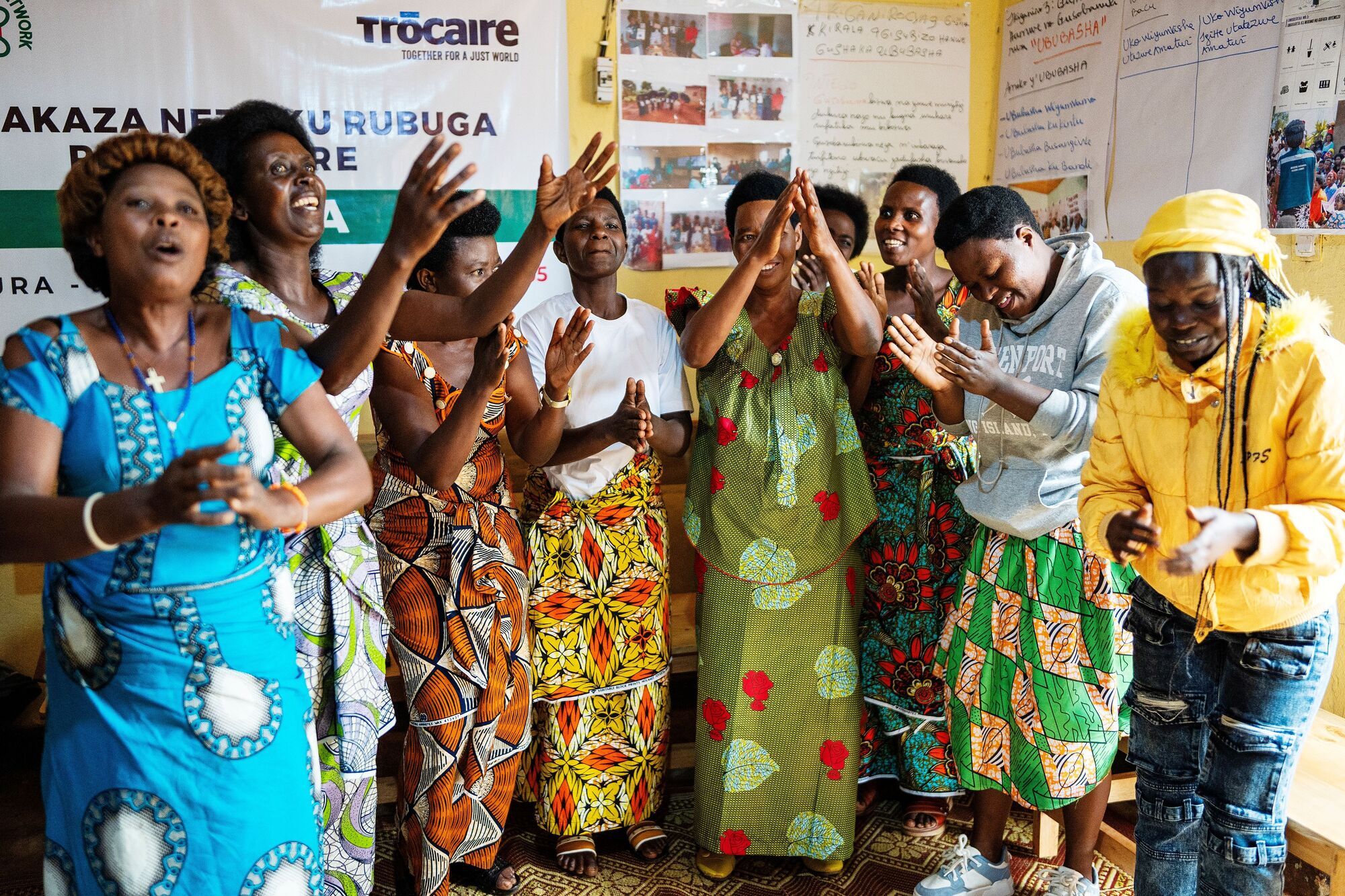
Women dancing at the Rulindo Rwanda Women’s Network building (Brian Lawless/PA)
An Irish charity is helping empower Rwandan women to become voices of change in their communities.
Rwanda has the highest percentage of female representation in its national parliament in the world, but many women still face issues such as gender-based violence, limited influence in household decision making, and a lack of access to financial independence.
These challenges are exacerbated by the climate crisis, with communities at risk from extreme weather events like floods and landslides, while changing weather patterns can threaten crop yields for subsistence farmers or decrease job availability for insecure workers.

Rwandan women – particularly pregnant women – are disproportionately affected as they often work longer hours for less, face worse health outcomes and gender-based violence (GBV), and carry the burden of demanding farming tasks in their households.
Irish charity Trocaire has partnered with Rwandan non-governmental organisations (NGOs) to support programmes that champion women and their wider communities.
One group, the Rwanda Women’s Network (RWN), has established more than 24 women’s spaces across the country since it was established after the genocide to support women overcome the traumas they experienced.
Stella Maris Murekeyisoni, a project co-ordinator with RWN, told the Press Association: ”These are more than physical places, they are places of healing, belonging and also trust.
“Normally, the women we serve, when they come they are facing trauma, GBV, financial dependency, but when they come they find other women and can build trust and also solidarity.”
Rwanda is the focus country for Trocaire’s lenten box fundraising campaign for 2026.

In the Rulindo district, about an hour’s drive north of the capital Kigali, an RWN hub caters for women who have sought help for reasons including support with teenage pregnancy, experiences with GBV, and financial dependency.
Emilia Placide Mubyeyi, RWN field co-ordinator in Rulindo, said the Trocaire-supported centre is designed around building’s women confidence, their capacity to take part in decisions that affect their lives, and economic empowerment, as well as GBV awareness and prevention.
She said: “We help women to be mentally stable by healing their traumas, through having conversations like therapy stations, and other supports.”
The centre also has a playroom for women who take their children with them, and a safe space including a bed where they can sleep.
The RWN uses a 13-session Masidama programme on women’s empowerment which involves advice on financial stability and investing as well as training on agriculture work and other income generation.
Asked about some of the success stories, Ms Murekeyisoni said some of the women could not even attend local community meetings before the programme but now all 190 who have completed the Masidama course in the Rulindo centre are attending and influencing decisions.

In collaboration with Rwandan women-led NGO Duterimbere, participants also get financial literacy training and access to savings and loans groups, which has helped the establishment of businesses.
The Rulindo centre has seen success with the women their winning a competition for their business acumen.
The hub has a small agricultural space for crops and livestock, a private consultation room for counselling, and a sewing room.
Murore Marie Goretti, a 35-year-old mother-of-three, said she used to be a “woman with self-stigma” and lack of confidence, but added: “I am now a facilitator training other women to be self-confident and to not be where I used to be: behind the doors in our homes and instead being part of the decision making.”
At a small store next to the main RWN building, Geraldine Uwimana said the Masidama curriculum helped her gain confidence and more financial self-dependence.
She said: “I learned that a woman cannot have a voice if she doesn’t have money, that’s the reason I’m here.”

Ms Uwimana is involved in running the shop and said: “I learned necessary skills around running a business including record keeping and stock projections.”
Amid shelves of cereals, beans, rice, flour, hygiene products, cooking materials and stationery, she added: “Before coming here, I used to be a housewife whereby I was just doing farming activities in my home and cooking for the family.
“But after joining this team, I become confident. I now get money.”
Wearing a green dress, she added: “And before, I couldn’t get clothes like this one without asking money from my husband, but currently myself, I go to the market and I buy such clothes without any help from my husband.”
Asked for her advice to other women in her previous situation, she said: “I want you to be confident because you cannot sit there and hope and wait to get each and every thing from your husband.
“Because you are capable, you are able to get where I am, you just have to be confident enough and everything will be all right.”
Trocaire’s country director in Rwanda said the charity’s approach is focused on making sure “communities are empowered themselves” and “much more resilient” by mitigating risks and ensuring incomes come from different sources.

Marleen Masclee said: “We do that empowerment not only at the household level, but we lift it up at the community level.”
Ms Masclee said the work around social norms is also “community up” and not “top down”.
“We listen to the women, we listen to their fears, we listen to their challenges, and we work together with their husbands, with their families, in making sure that everyone has a dignified role within the family, and that families can prosper in a harmonious way – instead of having violence in the household, instead of having women’s voices being repressed.
“And we do that through enabling women to raise their voices, to be able to find the inner empowerment, to be able to speak out, but also for the husbands to be able to allow such a change happening.
“Because instead of it causing friction in a family, we want to do this carefully. We want to accompany the process so that, in the end, you have very strong family units that respect one another and that can really work together for the benefit of the families.”
Reflecting on her time at the RWN, Ms Goretti said: “It’s obvious, you can tell from looking at us – we are proud of ourselves.”


CONNECT WITH US TODAY



Be the first to know the latest news and updates