ASTI calls for protective measures as teachers' concerns around AI grow
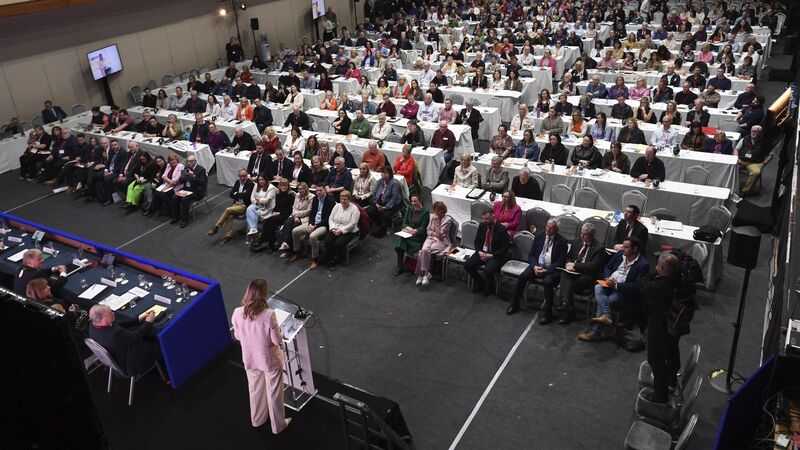
Minister for Education Helen McEntee addressing delegates at the ASTI annual conference. She said equality is a fundamental priority of the educational system. Picture: Don MacMonagle
Teachers are calling for indemnification against any legal cases taken by students if their results are withheld due to suspected cheating with artificial intelligence (AI).
A motion supporting the new protection was passed at the Association of Secondary Teachers of Ireland (ASTI) annual conference in Killarney on Tuesday.
Concern about cheating has become an increasing concern with the advent of generative AI.
And a historic move to a new senior cycle syllabus from September, for which some 40% of marks will be drawn from project work in some subjects, has sparked further concern.
Education minister Helen McEntee, who has been in the role from some 12 weeks, said that there will be “more guidance and clarity in the months ahead” on AI in schools, although AI guidance was issued by the State Exams Commission in 2023.
“The issue of artificial intelligence is a concern that has been raised directly by teachers,” Ms McEntee said.
“AI is here to stay and we need to know how our students can use it so that they're still learning but also the teachers are equipped to be able to support them on that as well.
AI was raised as a major concern at the 103rd ASTI conference attended by some 500 delegates.
Multiple teachers said that AI has already become so sophisticated that it can increasingly conceal plagiarism.
AI is now driving other jurisdictions to reduce the amount of project-based work in State exams because they cannot accurately test their students, Dungarvan-based teacher Michael McGrath said.
People teaching the baccalaureate, a French equivalent to a Leaving Certificate State exam, are reducing the percentage of marks derived from project work due to concerns with AI, he said.
“They have 20% practical assessment in their science subjects [in the baccalaureate]. They already see cheating happening and they are going back to 10% and probably back to 0% for the written exam,” Mr McGrath said.
But the education minister said that having an element of continuous assessment in the senior cycle was important.
“I think the focus on exams at the end of the two years places a huge burden and a huge amount of stress on students and we are unlike many other European countries where we have such a focus on exams at the end of the year," Ms McEntee said.
The ASTI had been calling for a pause in the implementation of the new senior cycle model, which it says has been too rushed.
Intensive talks between the teaching unions and the Department of Education about have been underway since early April, after the minister stated that the proposed senior cycle reforms will go ahead as planned.
Unions had sought a one-year pause in order to ensure "adequate time and resources" for the implementation of the changes, amongst other concerns.
The new reforms, the most significant in over a century, would see the manner in which the Leaving Certificate swing towards project work as opposed to straight exams at the end of a student’s final year, with that non-exam work set to account for at least 40% of final marks in certain subjects.
Teachers are retiring early to avoid teaching the new senior cycle redevelopment, Mr McGrath said.
He himself now plans to retire because he said that he cannot stand over the redeveloped syllabus and does not know how to teach students how to achieve top marks because it does not yet seem to be known by anyone.
Inequality in the new syllabus is another deep concern, he said.
A past pupil who had holes in his jumper in school because he could not afford a new uniform got 625 points in his Leaving Cert and went on to study in Harvard, Mr McGrath said.
But he fears this will be impossible under the new system and only those whose parents have money will be able to buy their way into higher grades through schools with adequate facilities and AI which will secure them places in the top universities.
“And we're going to see a situation here where if you're not in a private school you're not going to get the high achievers in college, the physiotherapy, the medicine, all the high points, they'll be going to private schools.”
One private school is already renovating a disused assembly hall into a state-of-the-art science lab with two lab technicians to prepare for the new senior cycle, Mr McGrath said.
“That's not coming cheap, that's coming at a price.”
Poorer schools will not be able to afford to build new labs and buy new equipment, or to pay for sophisticated AI to generate graphs and work that cannot be picked up by correctors in project work, Mr McGrath said.
But Ms McEntee said that equality is a fundamental priority of the educational system.
“Education has the potential to ignite something in all of us,” she said.
“No matter what your background or your ability, education has the capacity to lift people out of poverty and disadvantage. It has the capacity to break down barriers and to ensure that everyone can fulfil their full potential in life. It is at the centre of all our ambitions as a country.”

CONNECT WITH US TODAY



Be the first to know the latest news and updates