Government monitoring risks to Irish troops amid Middle East escalation
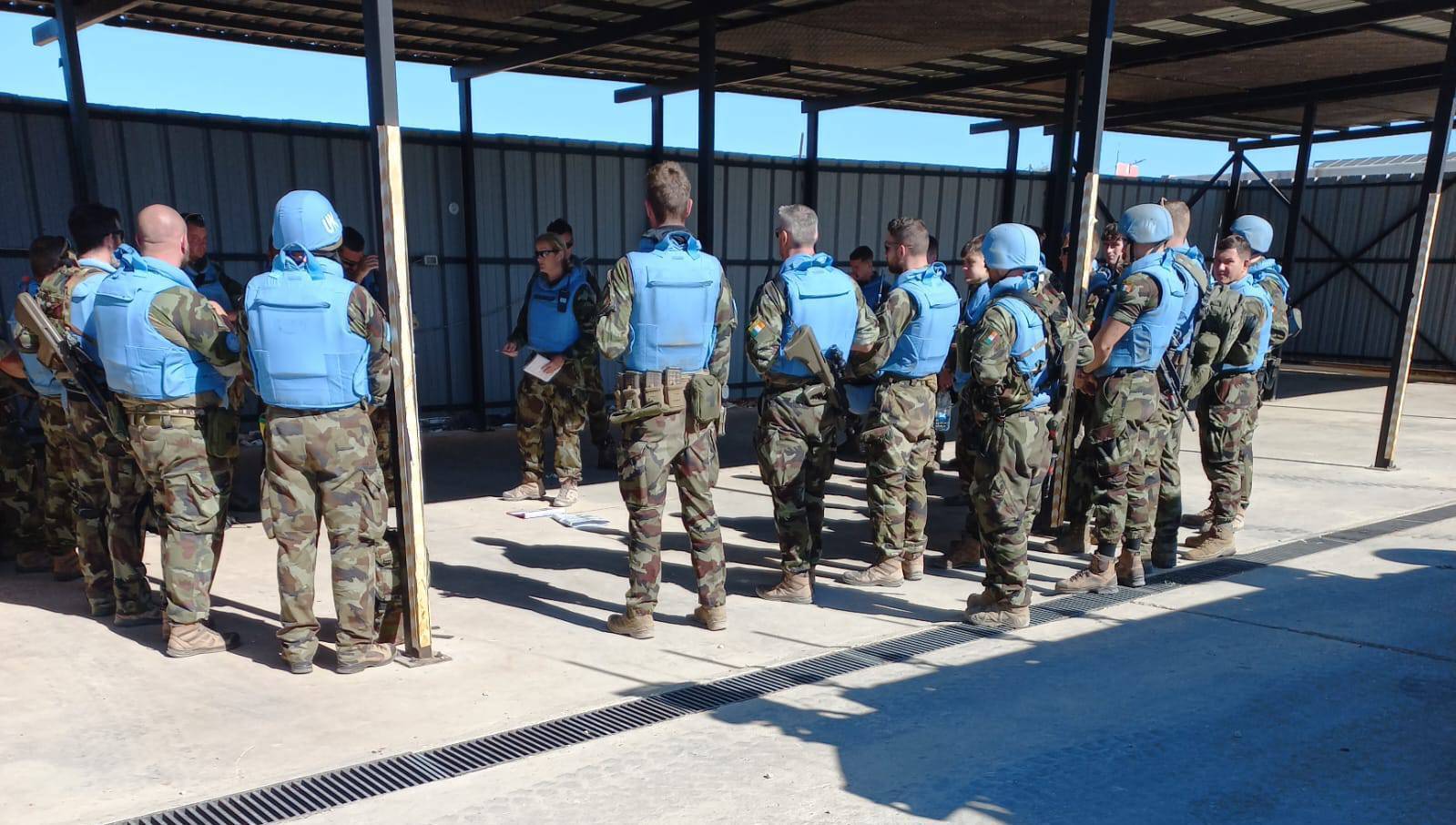
Potential retaliatory strikes by Iran, including rocket attacks on Israel by Iranian-backed Hezbollah, could place the approximately 360 Irish personnel attached to UN missions in Lebanon in the crossfire. Picture: Defence Forces
The Government is monitoring the emerging impact on Irish soldiers and citizens in the Middle East following the start of what could become sustained military action by the US and Israel against Iran.
Potential retaliatory strikes by Iran, including rocket attacks on Israel by Iranian-backed Hezbollah, could place the approximately 360 Irish personnel attached to UN missions in Lebanon in the crossfire.
In a clear statement outlining political objectives for the military assault, US president Donald Trump called on the Iranian people to “take over your government”.
Taoiseach Micheál Martin has said he is deeply concerned after the strikes on Iran urging dialogue to avoid a wider conflict in the Middle East.
"I strongly urge all parties to exercise restraint and to work to avoid that outcome.
"Ireland has always believed that conflict should be resolved through diplomacy and negotiation, in line with the principles of the UN Charter and international law. That must apply in this situation as much as in any other.
"The protection of civilian life in Iran, in Israel and in all neighbouring countries must now be paramount."
Foreign affairs minister Helen McEntee echoed the Taoiseach's concerns on the military actions including their impact on a “small number” of Irish citizens in Iran, most of whom have lived there for many years.
She said official advice for Irish citizens in the region is to take “shelter”. The minister urged Irish citizens not to travel to Iran and also advised against travel to Israel.
The Irish embassy in the United Arab Emirates issued this post on social media: “Given the deterioration of the security situation in the UAE, Qatar, and Kuwait, Irish citizens are advised to shelter in place, avoid unnecessary movement. follow the advice of the local authorities. Irish citizens are advised to avoid military and security force installations.
“The Embassy is also aware that UAE, Kuwaiti, and Qatari airspace has been temporarily closed. Citizens affected are advised to liaise directly with their airlines and follow the guidance provided. We will share any updates as more information becomes available.”
Some 362 Irish Defence Forces personnel are currently serving in UNIFIL – the UN peacekeeping mission in south Lebanon.
An additional 15 personnel serve in associated UN missions in Lebanon.
A social media post issued by the Defence Forces said: “Óglaigh na hÉireann can confirm that Defence Forces personnel in missions across the Middle East, UNDOF, UNIFIL and UNTSO, are well and accounted for. We are continuing to monitor the situation across the region and our personnel remain committed to completing their mandated tasks.”
Retired Brigadier General David Dignam, who first served as a platoon commander in UNIFIL in 1987 and last served as battalion commander in 2013, said Hezbollah’s military strength in its traditional base in south Lebanon has reduced significantly in recent years.
The Israel-Hezbollah conflict ended in a ceasefire in November 2024, leaving the military-political organisation in a depleted state.
Reports this morning indicated fresh Israeli strikes in south Lebanon aimed at what Israel claimed was Hezbollah infrastructure.
“The ability of Hezbollah to launch a sustained campaign is very significantly diminished, but that doesn’t mean they won’t try,” Mr Dignam said. “But if they do strike Israel, Israel has made clear they will pulverise South Lebanon.”
He told the this would mean UNIFIL troops, as they did over a year ago, would “bunker down” in their three bases, two run by Irish troops and one by Polish troops.
“There’s always the risk of collateral damage in the cross-fire, if Hezbollah launch rockets and Israel return artillery fire. UNIFIL could be caught in the middle.”
However, he said troops would remain protected in their bunkers and have good supplies of food and water.
“Bar a direct hit they should be fairly safe,” Mr Dignam said.
Mike O’Sullivan, author of 'The Levelling' and an economist who spent much of his career in the US, said: “This is the most open-ended risk that Trump has taken - embroilment in a regional conflict, with consequences for US allies across the region, amidst an unclear path to regime change, represents a big challenge.
“However, if it occurs, less repressive Irian would be a huge reward for the Iranian people, and would help catalyse a broad economic recovery across the region.”
Professor of European Politics at Maynooth University John O’Brennan said the responses of EU leaders were worrying: “It has been interesting to read the comments of Ursula von Der Leyen [EU Commissioner] and Kaja Kallas. They are completely asinine.
"To a very large extent they reflect the US-Israeli line about the danger Iran [EU chief diplomat] poses to the world. Indirectly, these comments link the European Union to this new assault on Iran.”
He said this “cannot be good” for the EU, which, he said, should condemn the new attack in the strongest possible terms.
“How can you claim to be a staunch supporter of the rules based international order and of international law when you fail to condemn this new episode in Israeli-US lawless imperialism?” he asked.
Prof O'Brennan said the response created the impression that Brussels “is now a supplicant” of the United States and refuses even to attempt an independent position.
“European leaders saw this week (once again) that the Trump regime cannot be trusted,” he said. “Trump and his officials kept up the pretence that the talks with the Iranians in Geneva constituted a real negotiation. They weren't. They were a mere fig leaf designed to disguise the intent to attack Iran.
“There are real lessons here for Ukraine and Europe - the United States simply cannot be trusted as an arbiter and is now wholly gone over to the side of authoritarian imperialism, determined to crush the last vestiges of international law and geopolitical balance.”
Mark Mellett, former Chief of Staff of the Defence Forces, said: “Legitimacy matters in war, because it shapes the prospects for peace. If there is no clearly articulated end-state and no credible pathway to a political settlement, military action risks becoming a trigger for wider regional instability.
"The danger is escalation, and the gradual erosion of the rules and restraints that have limited the use of force since 1945.”
CONNECT WITH US TODAY



Be the first to know the latest news and updates