Most teachers think schools should not prepare pupils for church sacraments, survey finds
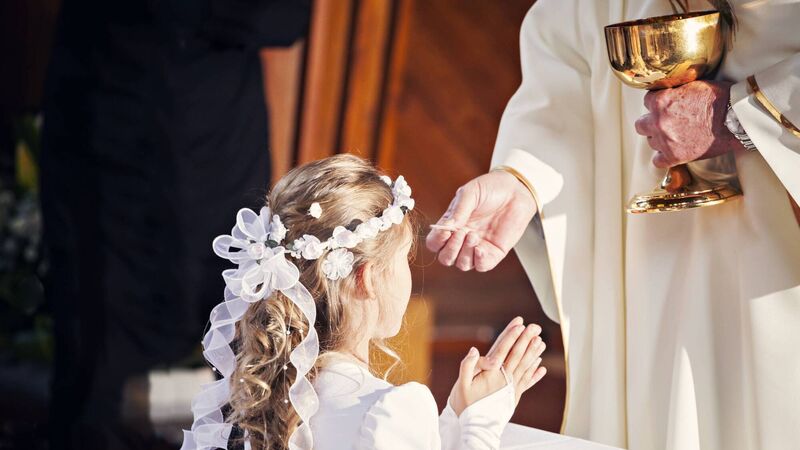
When asked if ‘faith formation’ should take place in primary schools, a majority (57%) said it should not.
Most primary school teachers believe it should not be a school’s responsibility to prepare children for communions, confirmations and first confessions.
The finding is included in a major survey of primary school teachers, the majority of whom (88%) are working in schools under the patronage of the Catholic Church.
Despite government commitments to increasing diversity, 88.3% of primary schools remain under Catholic patronage, while less than 6% have a multi-denominational ethos.
However, a new major survey published by the Irish National Teachers’ Organisation (INTO) has found a majority of teachers believe schools should have secular patrons.
The study saw more than 1,000 primary school teachers asked their views on religion in schools.
When asked if ‘faith formation’ should take place in primary schools, a majority (57%) said it should not.
Faith formation includes developing a child’s understanding of and with the Catholic faith and includes preparation for the sacraments as well as the Catholic ethos permeating the whole school day.
Just 4% of the teachers surveyed thought preparing children for the sacraments should be a school’s responsibility, compared to 47% who believe the family should be responsible.
A further 30% said it should be a parish's responsibility, and 18% said it should be both parents and parish.
The study also found “wide variation” in the level of parental involvement with preparing children for the sacraments.
Teachers reported that some parents are involved through parish programs, specific preparation masses, and helping their children learn prayers and hymns.
However, the extent of some parents' involvement only extends to attending the sacramental ceremonies or "minimally" participating in the preparation process.
Several teachers also highlighted how “parents often have limited or no involvement in sacramental preparation”.
The patronage survey published by the INTO also found:
- Almost half (49%) of teachers surveyed said they believed a qualification for teaching religion should not be a requirement;
- 80% said that preparation for the sacraments takes up additional class time beyond religion;
- 46% of those taking part believe that religion should not be taught by a class teacher.
A further 63% of the teachers surveyed said they believed that primary schools in Ireland should have secular patrons, while 37% supported religious patrons.
An “overwhelming majority” also indicated that there are children attending their denominational school who are not of the faith of the school.
In open responses, the survey also captured a number of contrasting views on the teaching of religion in schools.
Some teachers “expressed strong personal beliefs” about feeling conflicted with the religious content they are required to teach, leading to “feelings of discomfort and disillusionment”.
One respondent highlighted the challenge of teaching religion “in an environment where many families do not reinforce and or practice their faith at home”.
Some teachers are also happy to teach religion, even if they do not personally practice the faith by trying to make religion “more relevant to their pupils lives” or to integrate religion into the broader curriculum.
“A few teachers, particularly those in schools with a strong religious ethos, feel that teaching religion is essential for preparing students for sacraments and maintaining the school's religious ethos.”
However, the survey also found there is a “consensus” that the primary responsibility for religious education "should be shared with families whose level of involvement determines the efficiency of faith formation".
A further 33% of the teachers surveyed said they teach religion willingly, while 19.5% said they would prefer not to teach it.
Another 11% said they are not opposed to teaching religion, while 10% said they see it as just another subject they have to teach.
The INTO annual congress to due to debate a motion on Wednesday that if passed will see the union campaign to remove single-faith religious education from the school day in State-funded schools.
This will begin with the requirement for teachers to conduct sacramental preparation, while also urging a ban on religious teaching qualifications, and strengthening protections against religious discrimination, amongst other measures.

CONNECT WITH US TODAY



Be the first to know the latest news and updates