'Time now to be on the right side of history': Ireland to provide €100m in aid to Ukraine
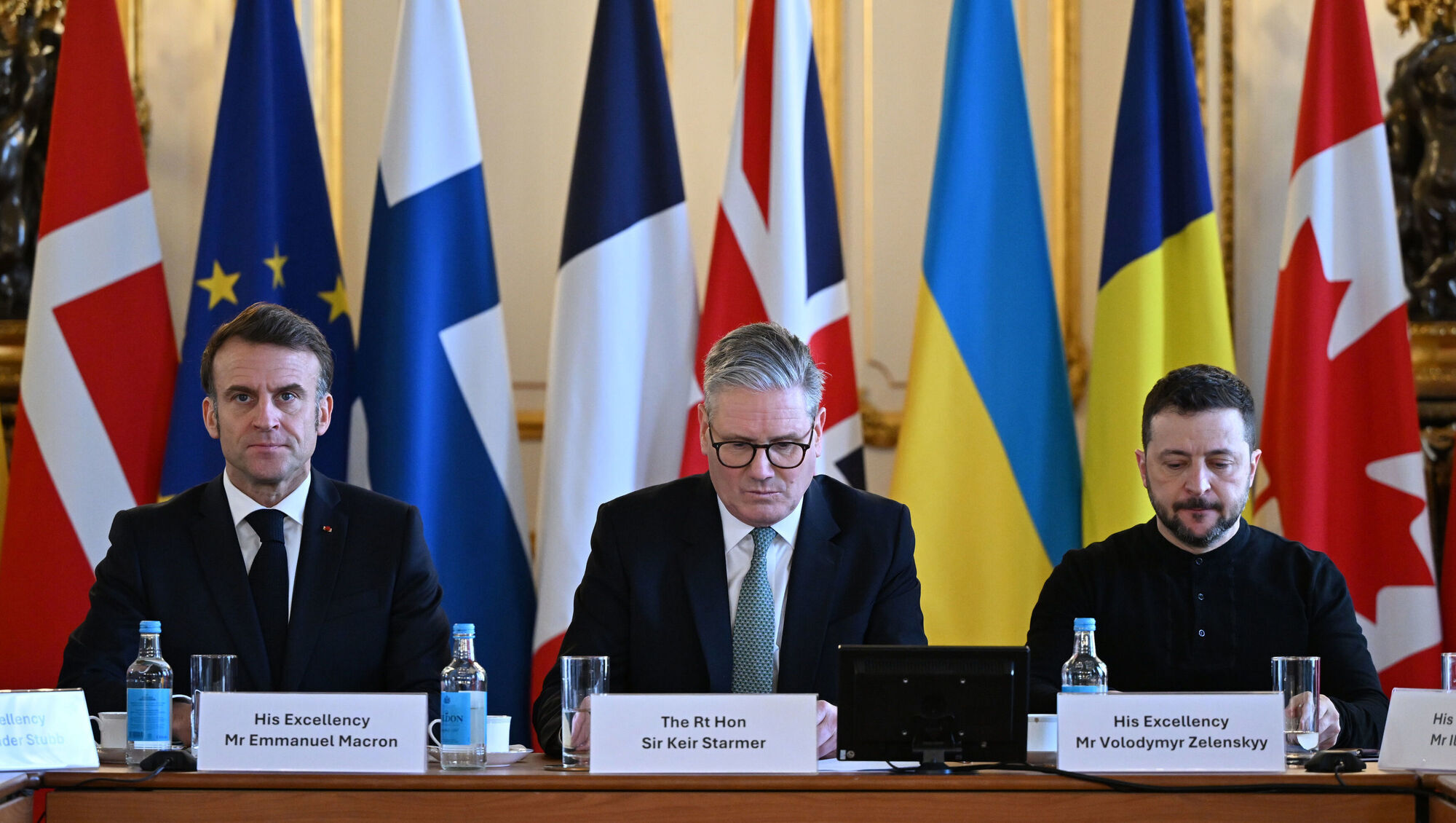
French president Emmanuel Macron, British prime minister Keir Starmer, and Ukrainian president Volodymyr Zelensky, during a European leaders' summit on the situation in Ukraine at Lancaster House, London. Picture: Justin Tallis/PA
Ireland is to provide hundreds of millions of euro to Ukraine with the Tánaiste warning a failure to do will have a much more devastating cost on European security.
It comes as British prime minister Keir Starmer told leaders at an emergency defence summit that they must step up to what is a "once in a generation moment".
Mr Starmer also announced a £1.6bn (€1.93bn) air missiles package for Ukraine during the summit at Lancaster House, which was attended by European heads of state and Canadian prime minster Justin Trudeau.
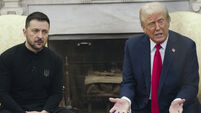
They welcomed Ukrainian president Volodymyr Zelenskyy, just two days after an explosive meeting with US president Donald Trump.
Leaders agreed a four-point plan including a pledge to maintain military aid and a commitment to establish a "coalition of the willing" to accelerate a peace plan.
A number of countries agreed to join the UK and France in sending peacekeepers to defend Ukraine and deter any future invasion by Russia in the event that a peace deal is secured.
Calling for further increases in defence spending, European Commission president Ursula von der Leyen said Europe must "urgently" rearm, adding that Ukraine has to be given the resources to turn it into "a steel porcupine that is indigestible for potential invaders".
Describing the meeting as "very good", Nato’s secretary general Mark Rutte said European countries are now “stepping up,” both in terms of their own spending, and in support for Ukraine.
He said allies want to “make sure that Putin will never, ever again, try to attack Ukraine,” which he said will mean "that you will have Europeans active in Ukraine, to make sure that that peace is kept, that it’s sustainable, that it is enduring, lasting”.
Tánaiste and foreign affairs minister Simon Harris has confirmed that Ireland is to provide a significant volume of further funding, starting with a €100m package for non-lethal military support, which he will bring to cabinet on Tuesday.
"That would basically involve providing money that will be used to purchase things like armoured vehicles that can assist in demining and cyber protection measures, non-lethal use of military equipment," he said.
However, Ireland will commit to a much larger tranche of financial aid, which could extend to well over €700m, as part of a wider package due to be agreed by EU leaders when they meet in Brussels on Thursday.
Mr Harris said: "Ireland has to pay a little over 2% of the total pot decided by the European Council. So roughly speaking, if €20bn was the figure, it would mean Ireland would have to pay just over €400m. You'd have to go up to €30bn, I think, to see a figure of around €750m, so we need to await the outcome of that.
"But can I say this, whatever the cost is, the cost of not paying it is much more significant in terms of the security of the European Union, in terms of the defence of a sovereign country, the largest country on the continent, in Europe.
"This is a time now to be on the right side of history and to actually stand up for the UN Charter, stand up for freedom.
"I can tell you from from engaging intensively with counterparts in the last few days, the consequences of this are well beyond Ukraine, a bad deal, a bad outcome for Ukraine is not just one for Ukraine, it's one for European security," he told RTÉ's programme.
Mr Harris accepted that a "gulf" has now emerged between the US and EU on the issue of Ukraine.
He said this was seen both in the Oval office last week, but also at the UN General Assembly, where the US voted with Belarus, Russia, and North Korea, and "not with their European allies".
"I think that does give you a sign of the gulf in terms of approach that has developed."
He described the encounter between Mr Trump and Mr Zelenskyy in the Oval Office, after which the Ukrainian president was escorted from the White House, as "deeply unsettling".
CONNECT WITH US TODAY



Be the first to know the latest news and updates