Irish citizens could be evacuated from Lebanon on new Defence Forces planes if tensions escalate
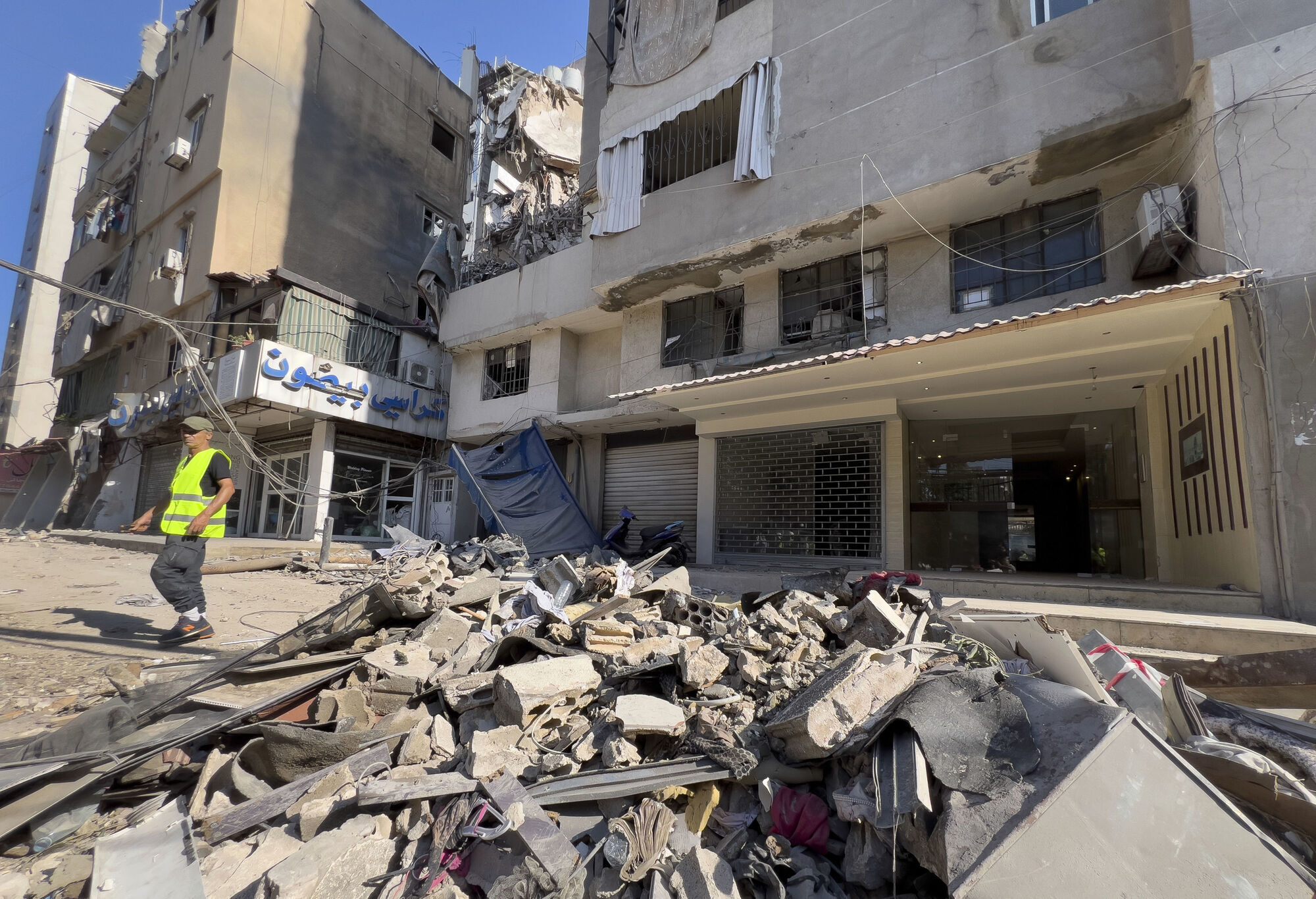
Debris of damaged buildings that were hit by an Israeli airstrike on Tuesday evening in the southern suburbs of Beirut, Lebanon. Pictures: AP /Hussein Malla
The Defence Forces has the capacity to evacuate 40 Irish citizens from Lebanon on its two new maritime surveillance planes if the Government makes the order, it has been confirmed.
The Airbus C295, which has a limited range, would need to stop for refuelling on its flight from Baldonnel Airport to Beirut and back.
It comes as the Department of Foreign Affairs “strongly advises” citizens “not to rely on evacuation options” if commercial flights out are available.
The department said it was establishing contact with all Irish citizens in Lebanon and so far, is in “regular contact with over 100 registered citizens”.
There are over 330 Irish soldiers in Southern Lebanon, where they are serving with the UN peacekeeping mission Unifil.
Military tensions are cranking up in the region, with a spate of retaliatory attacks now engulfing Israel, Lebanon and Iran.
The department said it had undertaken “significant contingency planning” to prepare for a possible consular crisis and was working closely with EU and UK colleagues.
The statement said: “Any evacuation scenario would need to be a coordinated international effort and require extensive cooperation with key partners. Any evacuation of civilians, including Irish citizens, from Lebanon is likely to be a complex and difficult operation.
It added: “The department would strongly advise citizens that they should not rely on evacuation options being possible if commercial options become unavailable. If the security situation deteriorates, the Irish Government, and all international partners, may be very limited in the assistance we can provide.”
The asked the Defence Forces if the Airbus C295 planes — delivered in June and October 2023 at a total cost of €230m — could be adapted to evacuate Irish citizens.
The aircrafts were configured as maritime patrol aircraft, primarily to be used for surveillance in Irish-controlled waters, but the specifications include personnel transport.
A Defence Forces statement said: “The Airbus C295 MW primary role is maritime defence and security Operations within the Irish Exclusive Economic Zone. Secondary tasks include personnel transport. For this, the aircraft can be configured to carry 20 passengers in standard airline-type seating, or 31 troops in a military configuration.

“Range in these configurations will vary dependent on loading and additional cargo vs fuel carried etc.”
The range, with a normal payload, is 1,555km.
The flight to Beirut is about 3,900km, so refuelling would be required — Cyprus is often used.
The Government has ordered a further C-295W, to be specifically used for troop and cargo transport. It has a range of about 4,500km. Delivery is expected in mid-2025.
Professor Raymond Murphy of the Irish Human Rights Centre at University of Galway said there was a “real danger” of hostilities escalating and engulfing the region.
“The situation for Irish troops part of Unifil is worrying,” Prof Murphy said. “They could well find themselves caught up in hostilities between Israeli forces and Hezbollah in Lebanon.
He said the Department of Foreign Affairs had given “ample warnings” to individuals to leave Lebanon: “Nevertheless, given the volatility of the situation in Lebanon, it would be wise to consider a contingency plan for evacuation.”
Israeli authorities blamed the Lebanese militant group Hezbollah for a missile strike on a football field, killing 12 children, in Israeli-annexed territories on Saturday.
On Tuesday an Israeli missile killed Hezbollah military commander Fuad Shukr in Beirut. On Wednesday, another missile killed Ismail Haniyeh, the political leader of Hamas, in Iran.