Cannon balls, human remains, and ancient weapons among finds reported by public to National Museum
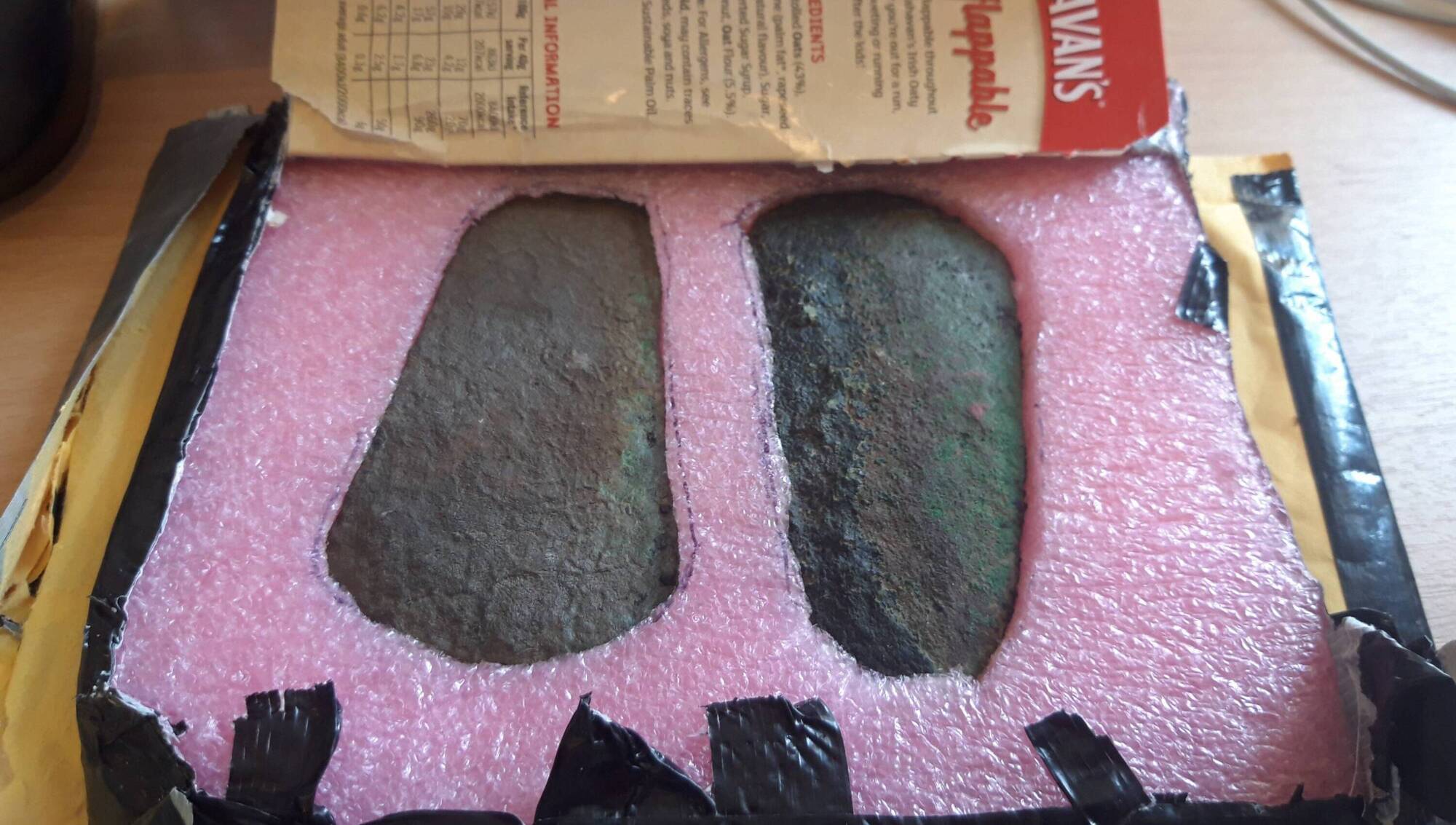
The two Early Bronze Age axeheads (2150-2000 BC) posted anonymously to the National Museum of Ireland in June. Picture National Museum of Ireland
Cannon balls, human remains, rock art, and ancient weapons are among the archaeological discoveries by members of the public reported to the National Museum — with about 10 finds per month being reported.
Over a 13-month period, 137 discoveries were reported to the museum with more than 40% of them concerning objects that were found in Leinster.
On at least 10 occasions, the discoveries were of human remains, skeletons, or bones, although not all will have ended up of archaeological significance.
Finds reported to the National Museum last year included agricultural objects in Roscommon, a crucible in Galway, a cannonball in Sligo, and a mace-head in Wicklow.
Archaeological discoveries have hit the headlines in recent weeks after two Bronze Age axe-heads were sent anonymously in the post to the museum carefully packed in foam inside a porridge box.
The Co Westmeath farmer who discovered them later came forward saying he was “shocked” after he found them while cutting silage in a field on his family’s land.
An inventory of public discoveries from June 2022 to early July of 2023 reveals that Ireland’s Midlands have been a rich source of historic artifacts in recent times.
In May 2022, a decorated slab was found in Offaly, while a sword was unearthed in the same county in autumn of that year.
January of 2023 saw the discovery of an ancient “scraper” in Co Westmeath while in the same month two axe-heads were located in separate finds in Laois and Offaly.
Of the 137 archaeological finds reported by the public over a thirteen-month period, 58 of them were in Leinster, 37 in Connacht, and 23 in Munster.
There were also nine objects discovered in Ulster while in ten cases, the origin of what was found was not provided or known by the National Museum.
Other discoveries listed in the inventory included rock art in Donegal, bullets and bullet casing fragments in Sligo, and a cross pendant in Mayo.
Musket-balls were found in Meath, a brooch in Mayo, an anchor in Kerry, and an “object with excised cross motifs” in Cork.
The National Museum fiercely resisted disclosure of any significant detail of what archaeological discoveries had been reported by the public.
At first, they refused to give any information whatsoever on finds and after a review under Freedom of Information (FOI) laws, released a list giving only a date, a province, and that an object — with no further detail provided — had been discovered.
The case was later appealed to the Information Commissioner and a further request under FOI laws finally resulted in disclosure of a more detailed, but still heavily redacted, list of discoveries.
A spokesperson for the National Museum (NMI) said that members of the public who find archaeological objects are legally obliged to report their discoveries.
They said it was important that the museum understood exactly where items were found as that greatly contributed to understanding of their provenance, value, and history.
The spokesperson added: “Information relating to the exact locations where archaeological objects are found is treated in confidence by the NMI, for a number of reasons.
“Publishing these details may, for example, lead to interference with a findspot including, but not limited to, the removal of archaeological objects which have not yet been investigated by NMI or discovered.
“Secondly, from extensive experience of liaising with finders, NMI also knows that the release of such information makes people reluctant about reporting finds.”


CONNECT WITH US TODAY



Be the first to know the latest news and updates