Stardust inquests: Unlawful killing verdict will give dignity back to victims, jury told
Stardust inquests: Unlawful killing verdict will give dignity back to victims, jury told

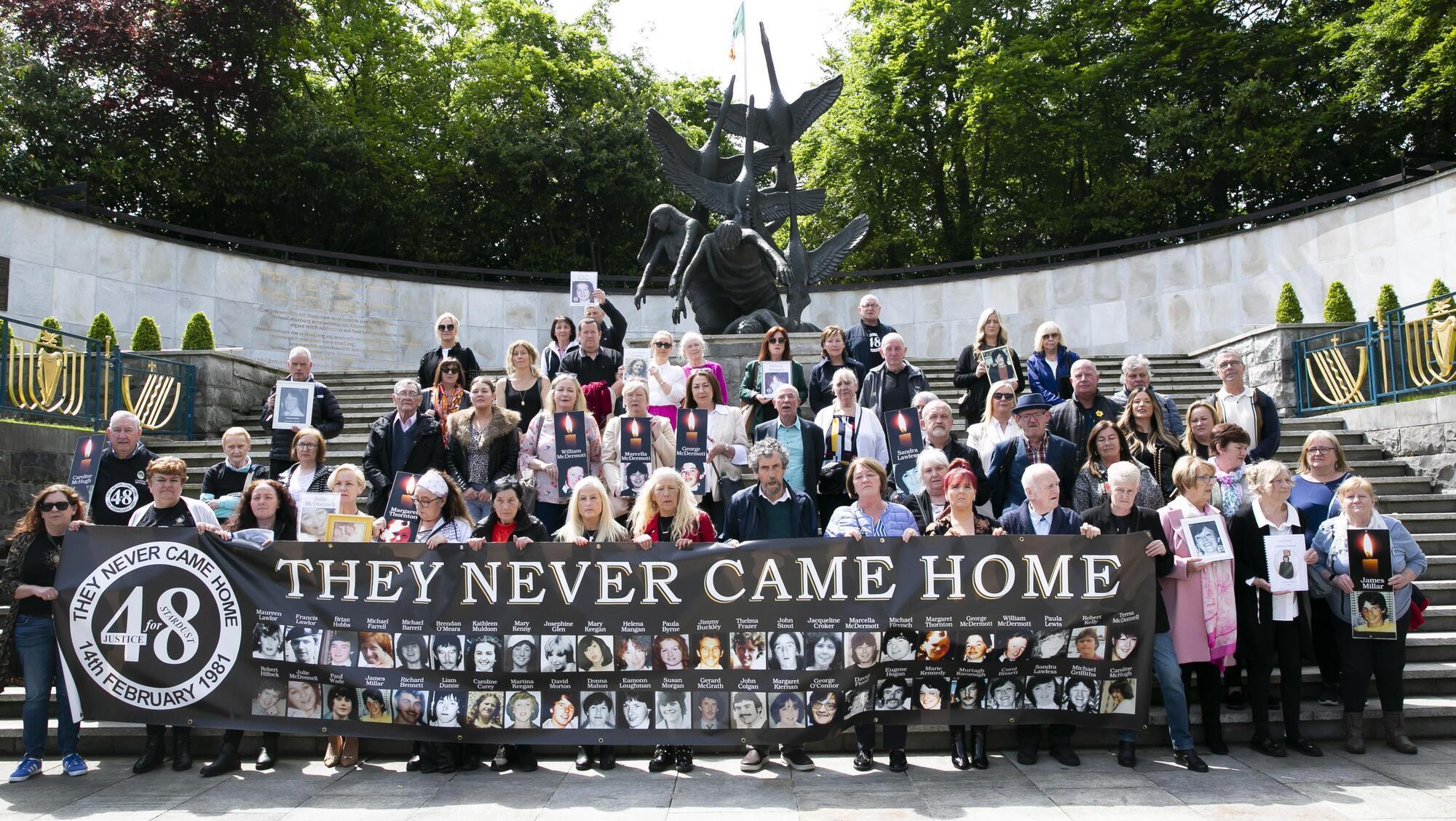
The fresh inquests into the deaths of the 48 people in the Stardust were ordered, after a long campaign from families, because the Attorney General ruled there had been an “insufficiency of inquiry” as to how their deaths had occurred at the original inquests. File photo: Gareth Chaney/ Collins Photos

A jury has been urged to return a verdict of unlawful killing for the 48 people who died in the Stardust fire disaster of 1981, after hearing the north Dublin nightclub was turned into a “fortress” beforehand and the evidence of its manager was “shredded beyond redemption”.

Michael O’Higgins SC, representing some of the families of victims, said there was a “huge conflict” between the evidence of Stardust manager Eamon Butterly at the inquests regarding the state of the exit doors on the night and those of the patrons who described desperately trying to escape the club while it was ablaze.

“If you look at the evidence, the verdict of unlawful killing is available to you,” Mr O'Higgins said.

The inquests, which have been ongoing for almost one year, are now in the final stages with counsel for the various parties represented making their closing submissions for the jury.

It has been examining afresh the circumstances around the devastating fire that ripped through the popular venue in the early hours of February 14, 1981, where hundreds of young people had gathered for a disco dancing competition.

As emphasised by Dublin City Coroner Dr Myra Cullinane, Mr O’Higgins and Des Fahy KC, also for the families, on Thursday, the inquests are a “fact-finding mission” and not a situation where someone can be blamed or exonerated.

The fresh inquests into the deaths of the 48 people in the Stardust were ordered, after a long campaign from families, because the Attorney General ruled there had been an “insufficiency of inquiry” as to how their deaths had occurred at the original inquests.

Mr O’Higgins began his submission by acknowledging it’s been a “long road” to get this far.

“On April 18th last, you were empanelled as jurors in this inquest,” he said. “Soon you will retire to consider your verdict. There will be lots of questions to address. Central to the verdict you will render, it’s important I’ll be emphasising this, is you’ll be addressing how the deceased died.

But first, I’d like to reflect on not just why we’re here but why we are here 43 years later. How is that? The answer is, ladies and gentlemen, is quite simple. Women. Mothers, daughters, siblings. Women possessed of indomitable spirit.

Mr O’Higgins paid tribute to the late Christine Keegan and her daughter Antoinette. Antoinette Keegan had attended the Stardust that night with her sisters Mary and Martina, who both died in the fire.

He paid tribute to 87-year-old Bridget McDermott, who lost daughter Marcella and sons Willie and George in the fire, whose “will and resolve were undimmed” all these years later.

And he paid tribute to Gertrude Barrett, the first person to take to the podium at these inquests last April to deliver a pen portrait of her late son Michael. “I remember looking at her, and I actually felt sorry for her,” Mr O’Higgins said.

“Here she was in a packed auditorium, speaking on a difficult subject. She didn’t have a single note. She spoke cogently, clearly with great insight... the unbending clarity of it.” 

He then proceeded to read out her words, as she had given a powerful account of the “unimaginable grief and sorrow” that she and her family endured.

The senior counsel then discussed the task that lies before the jury. He said that if they were return a verdict of unlawful killing, a test would apply.

He said that, looking at all the evidence, they’d have to determine if there had been “a failure — to a very high degree — to observe such a course of action as experience shows it to be necessary” to avoid substantial injuries. Furthermore, the jury would have to be satisfied if such failure in the deaths of each person was “such that it was a substantial cause of the death”.

Exit doors

Mr O’Higgins turned to the evidence given at the trial, and said that between the accounts of locking or “mock-locking” the doors by draping the chains on the bars and through erecting metal bars on the toilet windows a few weeks before the fire, it was “almost turning [the Stardust] into a fortress”.

He said that to do this in response to claims that people were letting their friends in for free through the doors, or passing in drink through the windows, was an “overreaction”.

On the issue of the state of the exit doors on the night, and who ordered the policy of keeping them locked for a time while the public were on the premises, Mr O’Higgins pointed to what Eamon Butterly had told the jury at these inquests and what he had told the gardaí and a tribunal in the aftermath of the fire in 1981.

In 1981, he said it was his policy. However, at the inquests, he said it was his head doorman Tom Kennan had decided on the policy, Mr O'Higgins said.

“If you look at that questions and answers, his credibility is shredded beyond redemption,” Mr O’Higgins said. “The account from the various people [trying to get out these exits] is far more credible than what Mr Butterly is saying.” 

Stardust doormen testimony

Following him, Des Fahy KC began his closing submission which focused primarily on the evidence from the Stardust doormen on the state of the exit doors.

“A cloud of half-truths and confusion hangs over what happens in relation to those exit doors,” he told the jury. “Before these inquests, little had been done to lift that cloud of uncertainty. But, the light always has a way of getting through.” 

He went in-depth through the evidence of many of the doormen and other senior staff and pointed to inconsistencies in accounts over whether the emergency exit doors had been unlocked on the night and who had done so.

Mr Fahy said evidence shows it was some of the doormen who were actually letting people in without paying and the suggestion that it was patrons letting their friends in the side doors is “in tatters”.

“The locking of doors and what flowed from that runs through the culture of the Stardust like the rainbow colours through a stick of rock,” he said, adding that just under half of the bodies of people who died were recovered right by exit doors he said were locked, chained or obstructed on the night.

“You’ve all the evidence you need,” Mr Fahy told the jury.

“Your duty now is to consider the verdicts, that evidence that these 48 victims deserve. Those verdicts, we say, are that each and every one of them was unlawfully killed. These 48 people lost their dignity because of the cruel and inhumane way in which they died. You can start the process of giving them that dignity back.”

More in this section

Lunchtime News

Newsletter

Keep up with stories of the day with our lunchtime news wrap and important breaking news alerts.

Cookie Policy Privacy Policy Brand Safety FAQ Help Contact Us Terms and Conditions

© Examiner Echo Group Limited