EU data on Ireland emissions 'does not look good'
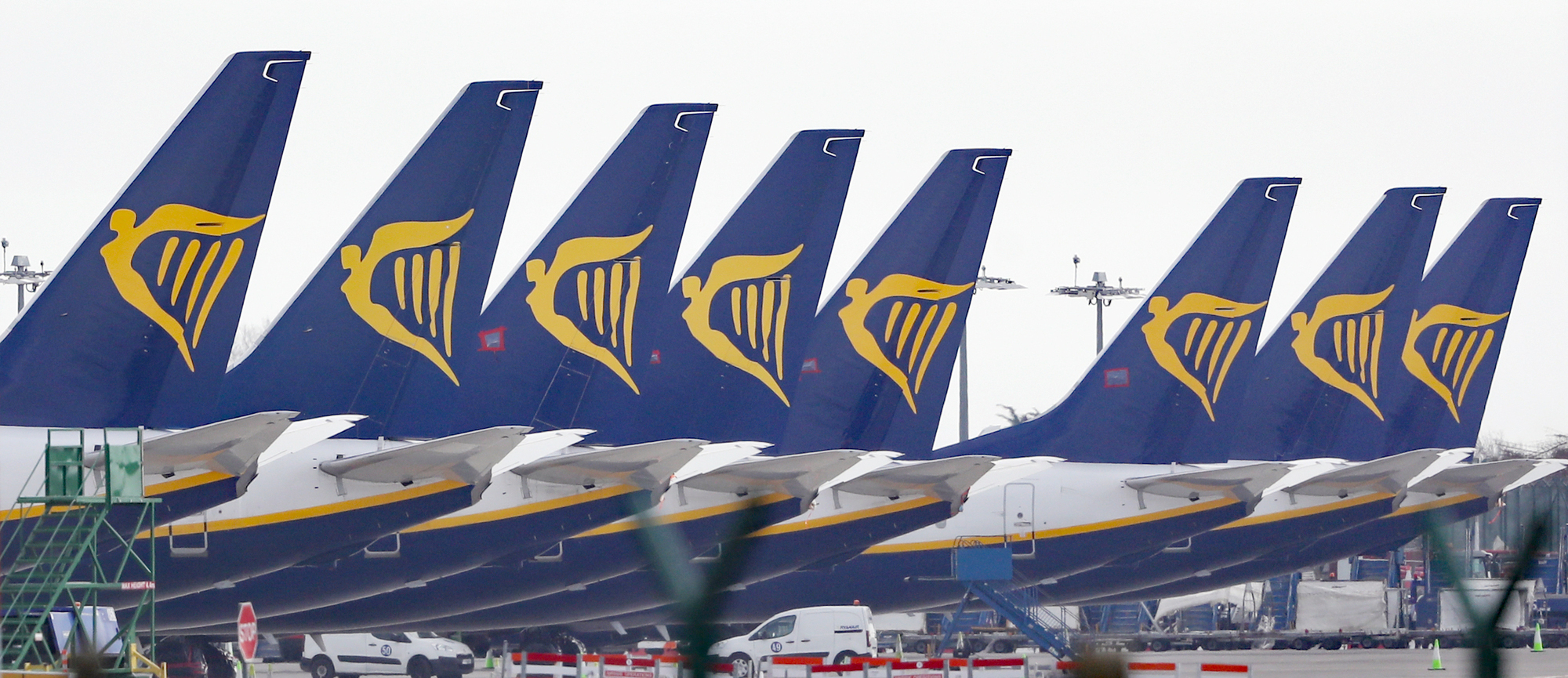
Under Eurostat's calculations, Ryanair flights from countries like Poland or Slovakia to other European countries are counted as Irish emissions as the airline is Irish. File picture
A transport expert has cast doubt over some European data which shows Ireland is the worst performer in the European Union when it comes to emissions.
Figures from the European Commission's data analysis wing Eurostat show while emissions in the EU fell just under 3% in the first quarter of this year compared to the same period last year, Ireland's rose more than 9%.
However, Eurostat said: "By far the main driver for the Irish greenhouse gas emission increase between the first quarter of 2022 and the first quarter of 2023 is the Irish air transport industry."
The Department of Environment, the independent Climate Change Advisory Council, and the Environmental Protection Agency (EPA) all use different methodology to Eurostat, which provides a less stark picture.
Under Eurostat's calculations, Ryanair flights from countries like Poland or Slovakia to other European countries are counted as Irish emissions as the airline is Irish.
CLIMATE & SUSTAINABILITY HUB
Trinity College Dublin (TCD) professor in the Department of Civil, Structural, and Environmental Engineering, Brian Caulfield, said that despite Eurostat's data not showing the full context, it did show some worrying trends for Ireland when it comes to its emissions profile.
"While this set of data is based upon different metrics, which are outside of what the national emissions inventories would use, any data from the EU that shows Ireland is at the top of the worst in class list does not look good.
"From a transport perspective, data collected by Transport Infrastructure Ireland (TII) does demonstrate that the weekly average traffic volumes in the first quarter of this year are back at levels we saw pre-pandemic. This, coupled with the reported 6% increase in transport emissions between 2021 and 2022, demonstrates how far we have to come in the transport sector."
Transport will be the hardest conundrum to solve, he warned. "Of all of the sectors in which we need to reduce, our transport emissions will be one of the most difficult.
#GreenhouseGas emissions in Q1 2023 decreased in almost all EU countries (21) when compared with the same quarter of 2022, except for:
— EU_Eurostat (@EU_Eurostat) August 16, 2023
🇮🇪Ireland (+9.1%)
🇱🇻Latvia (+7.5%)
🇸🇰Slovakia (+1.9%)
🇩🇰Denmark (+1.7%)
🇸🇪Sweden (+ 1.6%) and
🇫🇮Finland (+0.3%)
👉https://t.co/Gc3v1QLjV8 pic.twitter.com/MTwTg9Ih88
"This is due to a number of reasons, the large lead time in the construction of public transport projects, the fact that changing travel behavior can take several years, and the need for more urgency at the highest levels of government in the delivery of these major infrastructure projects," he said.
The Climate Change Advisory Council said that to monitor Ireland’s emissions in line with international obligations, UN rules are used. Under the UN method, each country is required to produce annual inventory reports which in Ireland are prepared by the Environmental Protection Agency (EPA). Eurostat's methodology differs.
A spokesman for the Climate Council said: "Eurostat acknowledges that a main methodological difference is an attribution to individual countries of international transport and the corresponding air emissions.
"Notwithstanding these observations, the Council noted in its annual review that actions to reduce our emissions are not taking place at the speed required to meet our own legal targets.
“Urgent action is needed to meet our carbon budgets and we must see emissions fall consistently if we are to meet our national and EU legal obligations in full and on time.”