Specialised Garda units 'too stretched' to investigate domestic abuse cases
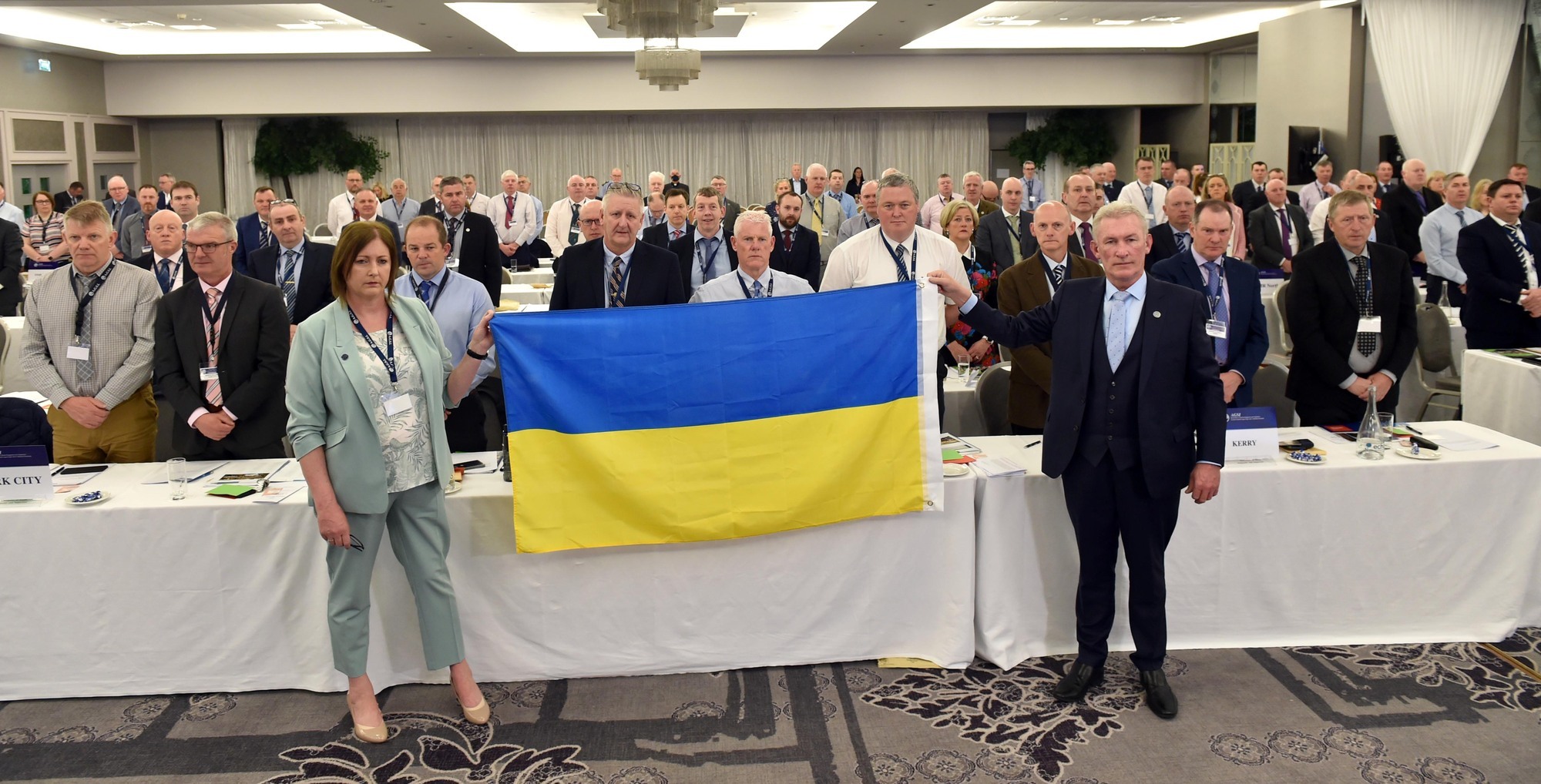
AGSI general secretary Antoinette Cunningham and AGSI president Paul Curran show their support to the Ukrainian police force with a standing ovation at the AGSI conference in the Great Southern Hotel, Killarney, on Tuesday. Picture: Don MacMonagle
Garda units that were established specifically to deal with domestic abuse and sexual crimes are so overstretched that they cannot investigate domestic abuse unless it involves rape.
Detective Inspector Brian Downey said that he wanted “to correct” figures given by Deputy Garda Commissioner Shawna Coxon, that more than 300 gardaí are now working on domestic violence cases through divisional protective services units (DPSUs).
Det Insp Downey, who is a senior investigating officer in the Dublin Metropolitan Region North, said that the DPSU there was only established over one year ago. During a review of the service in the last three weeks, it emerged that the DPSU was dealing with no domestic abuse cases.
“DPSU in DMR North are not investigating domestic abuse cases. They are not responding to domestic abuse cases because at the moment they have 300 plus sexual offence investigations on their books which are getting priority. And I wish people... would know that, that DPSUs are not delivering that service because we don’t have capacity.
“Because before the DPSU was set up we had child protection units and they were all the sexual investigations in relation to children. When DPSU was set up, all of those cases went to DPSU. So they simply do not have the capacity to investigate domestic abuse or respond to domestic abuse.
“They’re investigating all the child sexual abuse cases, all of the rape cases, and the only domestic abuse cases they’ll take is a case maybe involving a rape within the domestic arena. But then that becomes a rape investigation.
“All of the crimes in relation to domestic abuse, coercive control, an awful lot of rapes, historical rapes, are now being sent back from DPSU to the detective units."
He said that there is only one other senior investigating officer in his unit, which should have six.
And he is covering investigations in three districts as the senior investigating officer, with 42 investigations. The UK model the services are based on recommends that a senior investigating officer should only have eight investigations.
Det Insp Downey was speaking at the Annual Delegate Conference of the Association of Garda Sergeants and Inspectors (AGSI) in Killarney.
The room of gardaí told Deputy Commissioner Coxon that the problem of DPSUs being unable to respond to domestic abuse was nationwide.
The deputy commissioner admitted that the lack of senior investigating officers “has been dire”.
“It should be corrected with the new promotional process,” she said.
“But I do know that it’s about capacity and what you can do. So if it’s about a name change that isn’t working functionally we need to look at that,” she said.
Industrial action was also threatened at the conference by the AGSI unless 12-hour shift rosters, introduced as an emergency measure during Covid, are reversed or changed.
“We did receive a mandate this morning from our delegates that in the event of the commissioner imposing a roster on the AGSI that they would call a special delegate conference with a view to taking any and all kinds of industrial action," said Antoinette Cunningham, general secretary of the AGSI.
"We’re not at the point of industrial action yet. Our desire is to reach an agreement on roster," she said.
But if a roster is imposed on the AGSI without agreement, industrial action would be very possible, she said.
She said that AGSI members' major concern at the moment is rosters "and uncertainty around rosters leads to a demoralised workforce".
The wearing of beards was recently allowed in An Garda Síochána under the new dress code, but they must be neatly trimmed and between 0.5cm and 2cm in bulk.
Ms Cunningham criticised the move, saying that the AGSI should have been consulted before beards were allowed in the new dress code.
“We weren't allowed to have an input into their policy. And the policy was introduced without consultation with the staff associations.
“I think the introduction of a policy without seeking the viewpoint of the staff associations is not a very wise thing to do. That doesn't mean that we're against the wearing of beards, but we would have liked the opportunity to have a discussion on it at the very least."
A minute’s silence was held in solidarity with police officers in Ukraine at the AGSI conference.
Ms Cunningham said that policemen and women there have had to leave their families and deal with terrible situations on a daily basis.
Speaking about concerns closer to home, she said that the 1% pay increase due in October would go ahead.
But fears that wage increases would not keep pace with inflation in 2022 and 2023 would have to be tackled, ideally by a new, short-term pay agreement, she said.
Annual leave was increased from 34 to 35 days for gardaí in 2021 and 2022 after unions fought for it. Now that a new bank holiday, St Brigid’s Day, has been introduced, Ms Cunningham said that they would push for this extra day to be extended beyond this year.
She also encouraged gardaí to apply for annual leave, even when they didn’t expect to be granted it, so that any future audit would return a realistic result on annual leave requests and needs.


CONNECT WITH US TODAY



Be the first to know the latest news and updates