'We need to stand together': From driving a truck in Laois to manning Ukraine's frontline
Maksym Savych (right) is among a wave of young Irish Ukrainians who returned to their native country in the days after the Russian invasion began
It's less than two weeks since he was driving a truck around Portlaoise - but today, Ukrainian Maksym Savych is a platoon commander armed with an assault rifle, who wears combat fatigues and a bulletproof vest, as he bunkers down in his nation’s capital preparing to defend the city and the country’s freedom.
Max, as he is known to his friends, is among a wave of young Irish Ukrainians who returned to their native country in the days after the Russian invasion began.
They are among an estimated 68,000 Ukrainians abroad who returned home to volunteer in a territorial defence unit which is now working with the Ukrainian police and its armed forces in the war with Russia.

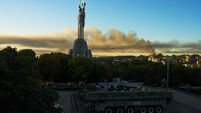
Max, who has basic military training, was made a platoon commander in charge of a group of 40 men who are all now based in the northern suburbs of Kyiv, close to where the state TV tower was destroyed by a missile last week.
Although he was born in the Zhytomyr region in northern Ukraine, Max spent several years living in Kyiv before moving to Ireland, and he knows the streets of the Ukrainian capital well.
They have been providing security in the northern area of the capital and offering what help and support they can to the remaining local population. They have intelligence to suggest some Russian troops are less than 20km to the north.Â

They can hear the bombs and see smoke rising in the distance.
But they know they could be the first to encounter Russian soldiers once they move to take Kyiv. And they expect to come under intense fire. In broken English, Max insists: “We are ready for them.”Â
One of the men in his platoon, Oleksii Tkachenko, a political and social science graduate, has fluent English, and does most of the talking for Max. Oleksii has basic military training and says he has taken up arms to defend his country against “Russian aggression”.
He says he, Max and thousands of other Ukrainians are staying to fight not just for their country and their freedom, but for every democratic country in the world.
He says his native city was occupied in 2014 when Russia-backed rebels seized government buildings in the Donetsk and Luhansk regions and proclaimed the creation of “people’s republics”.Â
Ukrainian troops and volunteer battalions fought for a while before a ceasefire was negotiated and Oleksii moved to Kyiv to start a new life. He described life in his native city after the Russian occupation as like a military dictatorship.

“Life under Putin was almost impossible - you couldn’t have free and fair elections, you couldn’t choose your vote, you couldn’t leave the country without the permission of the authorities. It was impossible to normally live,” he says.
“I lost some of my property and some of my choices in my native city before I moved to Kyiv and made a new life. But now the Russian Federation wants to take this life from me and I can’t move out again - I need to fight.
“Millions of ordinary Ukrainians have been standing defiantly and with dignity against the Russian forces to prevent them taking our country, from creating another Russian puppet state. In the last two weeks, we have seen missiles being shot down by the Ukraine air defence system.Â
“We also worry about the nuclear threat which now hangs over Europe, threatening the security of the whole world. Honestly sometimes I am scared, but this is normal. But it is important not to be scared facing these Russian military forces.
“It is important to overcome your fears, to face it and to support the organisation of security of our state. It is absolutely normal to think about your life. Personally, I want to save my life. But in some situations, sometimes it is necessary to be ready to sacrifice your life for your state.
“Our normal life would be impossible after occupation by the Russian Federation.”Â

Max says he and his men are aware of the huge humanitarian response from Ireland but he says Nato and the western governments must do more to help.
“This is not just a risk for Ukraine but for the whole world, for every sovereign state in the world,” he says.
“Putin has challenged the sovereignty and democracy in Ukraine. If our state, the Ukrainian state, disappears, other countries in Nato and in the West will be next.
“We need to stand together to prevent this and to stop the Russian Federation. If this goes nuclear, every state will disappear.”