Tony Holohan 'hopeful' Covid restrictions will be removed by Christmas
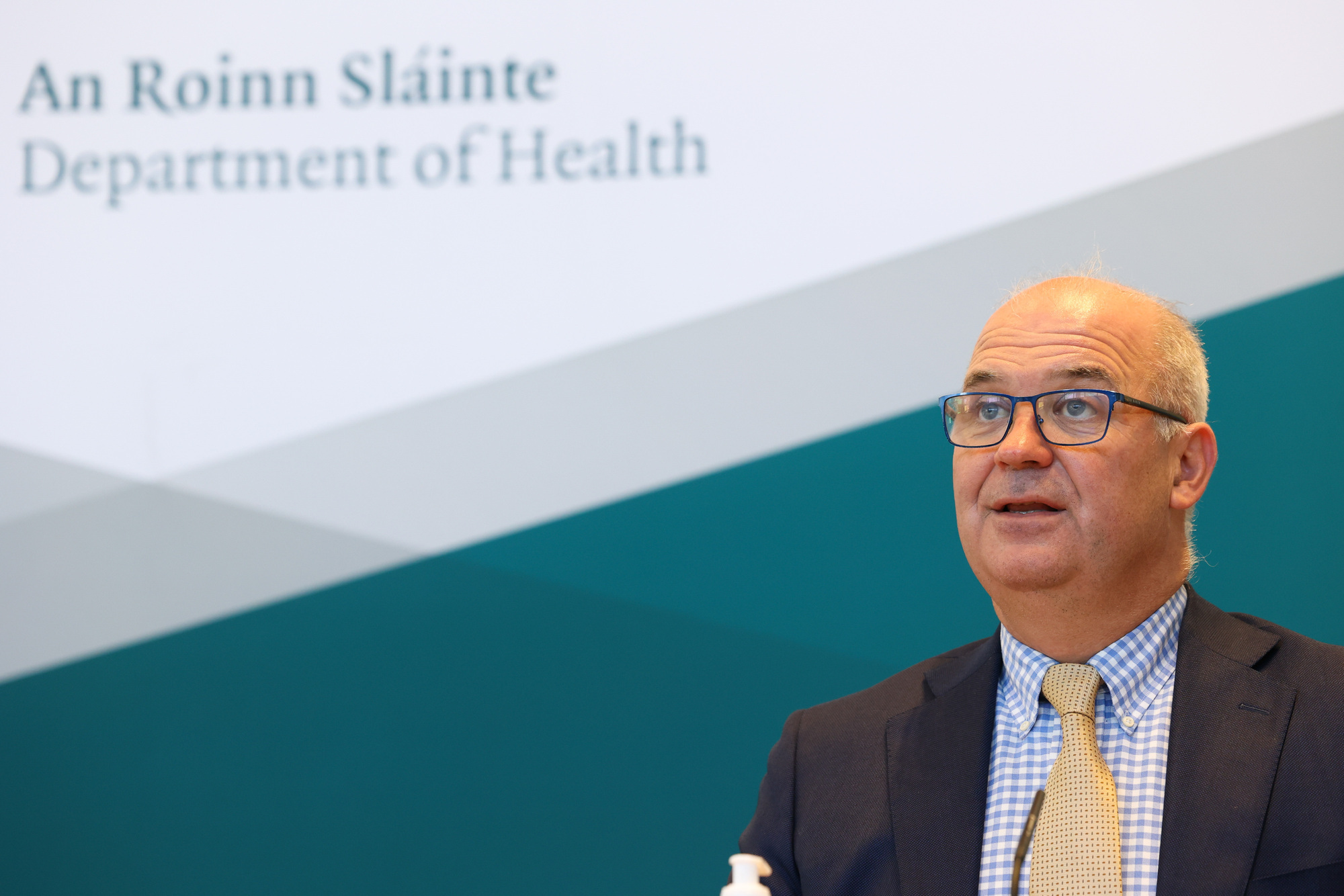
Chief Medical Officer, Dr Tony Holohan at this afternoon's breifing. Picture: Sam Boal / RollingNews.ie
The Chief Medical Officer is “hopeful” all Covid-19 restrictions will be gone in advance of Christmas, depending upon the progress made in vaccinating the population.
Dr Tony Holohan told a Nphet briefing in Dublin that he hopes “we’ll get there sooner than that”, when asked to comment on Minister for Health Stephen Donnelly’s assertion earlier that restrictions would be gone by the end of the year.
At first, Dr Holohan said that at present “we have no basis to say anything other than we expect incidences to grow”, adding that it is “simply not right for us to express such optimism at present”.
But, later in the briefing, the CMO asked to clarify his statements, saying that “now is not the time to be declaring that we have gotten to where we need to get to in terms of vaccination”.
“But I am optimistic that we will be in a situation whereby by reason of vaccination, and hopefully also by reason of where we will get to with infection status, that will allow us to express optimism that in the near term we can move on from some of these social restrictions,” he said.
The briefing heard of 1,571 new cases reported of the coronavirus, with Ireland’s 14-day incidence rate now at 526 per 100,000 people, a rate with Dr Holohan described as being “an extremely high incidence of disease”.

Ireland’s Covid incidence rate is now one of the worst in Europe, with head of Nphet’s modelling group Professor Philip Nolan describing the situation as one where cases are both high and also growing quickly.
At present, Ireland is reporting 41 new hospital admissions per day on average, and five new intensive care admissions, which equates to roughly five times the scenario observed in early July.
Professor Nolan said, however, that the peak, which is expected to arrive in mid-September, will plateau somewhat due to the progress made with Ireland’s vaccination programme.
Dr Holohan said that the vaccination programme is expected to have made full penetration across the population within between four and six weeks from the present.
The disease, meanwhile, is “primarily at the moment a disease of young, unvaccinated adults”, aged between 16 and 29, Professor Nolan said.
The peak of the current wave when it arrives will be “somewhere between 2,000 and 5,000 cases per day, closer to 2,000, as we currently stand” he said.
Regarding the lack of social distancing seen among supporters at last Sunday’s hurling All Ireland, Dr Holohan said that at this stage “people are well aware of what constitutes appropriate socialisation and engagement”.
He said that, for the unvaccinated, occasions like the All Ireland should be avoided, adding that applies to any event of such a size, not just those of the GAA.
Regarding the return of schools at the end of the week, Professor Nolan said that when schools reopened and closed earlier this year there was “little or no change in the incidence of the disease”.
Asked whether or not the current situation which sees just three unoccupied paediatric ICU beds across the country is sufficient, Professor Nolan said it is a “big leap” to link the reopening of schools with the paediatric ICU situation.
“The real challenge is to look after adults,” he said.