Complaints to Ombudsman about public services up 9% and highest since 2010
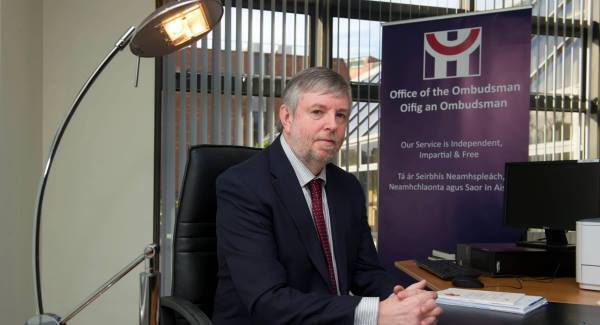
The number of complaints received by Ombudsman, Peter Tyndall, increased by 9% last year, with 60% of all complaints made about government departments and offices and local authorities.
The Ombudsman’s Office, which deals with complaints about public services, received 3,664 complaints last year, the highest number recorded since 2010.
In 2019 the bulk of complaints made to the Ombudsman related to government departments and offices (1,186 or 32%) and local authorities (990 or 27%), followed by health and social care services (708 or 19%), education (219 or 6%), direct provision (112 or 3%), private nursing homes (65 or 2%) and other public service providers (219 or 6%).
Launching his 2019 annual report, the Ombudsman said increases in complaints were seen in almost all sectors: “We aim to make sure that public service providers learn the lessons from the complaints we have considered and that public services are made better for everyone as a result."
“We received more than 3,600 complaints in 2019. That’s the highest number in any year since 2010 and my teams examined 10% more complaints than in 2018,” Mr Tyndall added.
He said Covid-19 had not impacted on the overall number of complaints received so far this year, which remain “significant” in number.
The pandemic, however, did trigger a “sharp increase” in complaints about the Department of Employment Affairs and Social Protection and the pandemic unemployment payment.
In one case, a man who was eligible for the payment was stranded in Poland and was refused payment when he applied online but the matter was resolved by the Ombudsman within 24 hours and he received payment.
The Department of Social Protection attracted 806 complaints last year, which the Ombudsman said stemmed from a “significant increase” in the number of people interacting with it.
The Ombudsman said a low number of complaints under the Disability Act 2005 last year (5 or 0.1% of all complaints) is “very disappointing”.
“It is vitally important that people with disabilities are informed about their rights on access to services and information and that they are aware of their right of recourse to me as Ombudsman to examine their unresolved complaints,” Mr Tyndall stated.
He highlighted delays in replacing the Mobility Allowance and Motorised Transport Grant schemes and said "numerous promises” to introduce new legislation have not progressed. Mr Tyndall also criticised the “lack of action” in reforming the eligibility criteria for the Disabled Drivers and Disabled Passengers scheme.
Other areas of concern include complaints to local authorities about housing, which increased 13% in 2019 on the previous year. More than half (546 or 55%) of all local authority complaints related to housing issues, in particular allocations and transfers and repairs.
Of the 708 complaints about health and social care services the highest number related to hospitals (36% or 261), followed by medical /GP cards (79), Tusla (73), and primary and community care (71).
Of the 1,818 complaints examined by the Ombudsman last year half (915) were not upheld; 30% (550) were fully or partially upheld; and 20% received assistance with their complaint.
The Ombudsman has not yet commenced investigations into prisoner complaints and is awaiting legislation before his office can take on this new function.
Case studies
Cork County Council was forced to review a decision that a housing tenant had breached his tenancy agreement after he posted information online about a neighbouring property owner.
The Ombudsman investigated the case last year after a complaint by a local authority housing tenant, who disputed posting a photo but said the information posted online and on social media was already in the public domain.
The complainant and the neighbouring property owner had previously been involved in a court case.
On investigation, the Ombudsman found the Council had failed to put allegations about the social media post to the complainant before it decided he had breached his tenancy agreement.
The Council also did not have a social media policy for tenants and it was “unfair” to refer to the tweet in a tenancy notification letter issued to the complainant, the Ombudsman found.
The complainant said the tweet was factual and that he wanted allegations made against him removed from his tenancy record.
Following the Ombudsman’s investigation, the Council reviewed its decision and cleared the tenant’s record. The Council also said it would consider the introduction of a social media policy for tenants.
A nursing home operator was directed to refund €3,500 in fees after a relative complained that their late brother had been double-charged for laundry services.
The refund was made following a complaint to the Office of the Ombudsman about a €50 monthly laundry charge paid by the complainant for his late brother when he was resident in a nursing home.
The nursing home resident had been charged the monthly fee for laundry services for nearly seven years in addition to nursing home fees.
The complainant questioned whether his brother should have had to pay the charges but the nursing home refused to issue a refund.
The Ombudsman examined the ‘contract for care’ between the nursing home and the complainant’s brother and found that the laundry services were included in the annual nursing home fees.
The nursing home said that while it charged a laundry fee of €50 per month it did not charge for organised activities and it offered the complainant €2,000, which was a refund of laundry charges less an amount for activities.
The activity charge, however, was not included in the ‘contract for care’ and the Ombudsman believed it was unfair to retrospectively charge for something that had not been agreed between the nursing home and resident.
CONNECT WITH US TODAY



Be the first to know the latest news and updates