Nine new cases of Covid-19 and first death of patient in Ireland
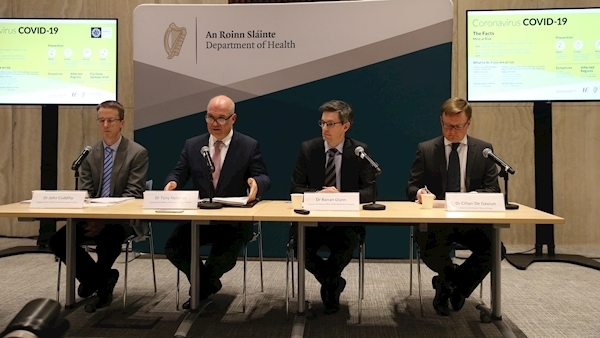
Ireland has recorded an additional nine cases of Covid-19 bringing the total number of infected persons in the State to 43, the Department of Health said.
At a press briefing this evening in the Department chief medical officer Tony Holohan said that six of the cases are associated with travel from Italy, with the remaining three coming from contact with known infections.
Six of the cases are in the south of the country, with the remaining three in the east, he said.
Earlier this afternoon the World Health Organisation upgraded the status of Covid-19, the illness caused by the novel coronavirus, to full pandemic.
Mr Holohan said that the Department is now stepping up its
Read More:
The public is being advised to practice everyday prevention such as through regular handwashing and sneeze etiquette, with shaking hands and close contact with unwell persons to be avoided. Social interactions and indoor crowded spaces are to be avoided.
All healthcare workers are meanwhile being asked to âraise their index of suspicionâ, while the HSE will be âsubstantially increasing its contact tracing and surveillance capacityâ in the coming days.
Testing for the virus is being ramped up significantly across the country, Dr Cillian de Gascun, director of the National Virus Reference Laboratory, said.
He added that in the region of 2,300 people have now been tested for the virus nationwide.
Mr Holohan said that âthere is still a lot of misinformationâ regarding the illness being spread across social media in Ireland.
Asked how the HSE feels about community efforts to aid those in self-isolation, Mr Holohan said âthe most reliable source of informationâ regarding how the illness should be approached remains the HSEâs own website.
He said that he doesnât believe the WHO had Ireland in mind when questioning âthe resolveâ of certain countries to deal with the crisis in its briefing earlier in the day.
He added that the issue of whether or not to ban mass gatherings, a suggestion earlier made by the Green Party prior to its call for a national Government to be formed, remains âunder reviewâ.
As regards whether or not asymptomatic transmission - the idea that many people with the virus who are not displaying symptoms could be silently spreading the disease - is considered to be a major issue here, Mr Holohan said âwe still donât know the answer to thatâ. A test on these shores for such asymptomatic cases has not yet been developed, he said.
âThe WHO has been clear on this, if there is asymptomatic transmission it doesnât appear to be an important part of the spread of this particular infection. Even though it is technically possible that asymptomatic transmission (can happen), it is much more likely to be transmitted by symptomatic individuals,â he said.
He confirmed that community transmission, that being where people have picked up the virus from unknown sources, in Ireland remains very low. People who have acquired the illness from known sources are considered to be associated with travel, he said.
âThe amount of community transmission is still quite low,â Dr John Cuddihy, director of the Health Protection Surveillance Centre, said, adding that people coming back from affected countries remain the primary focus of the battle against the disease.
[snippet1]987277[/snippet1]