'Something needs to happen to break stalemate' - farmers protest outside distribution centres amid beef row
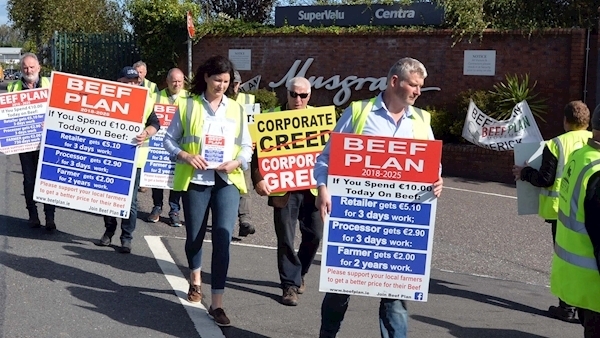
Talks to resolve the ongoing beef row are continuing in Dublin this evening.
Speaking on the way in to the talks at Agriculture House, Pat McCormack, President of the ICMSA says the meeting is well overdue.
Mr McCormack said: "My understanding is that Meat Industry Ireland has been in with Minister Creed and hopefully there is something meaningful on the table that we can go back to our membership with to discuss and that this impasse will move forward for the betterment of the Irish beef industry."
Eoin Donnelly from Beef Plan Movement is also hopeful a resolution will be found to the crisis.
Mr Donnelly said: "I’m hoping for some proposals to be put on the table by the various parties. We've been at talks now for a good number of days and we have a stalemate at the moment and something needs to happen to break that stalemate."

Earlier: Your questions answered as the sides meet to resolve the beef dispute
Meetings are due to get underway this evening between the Agriculture Minister, farm organisations and the meat factories in an effort to resolve the ongoing beef dispute.
A series of individual meetings is due to take place between the Minister and all of the key stakeholders.
A second round of talks to break the impasse was cancelled earlier this week when Meat Industry Ireland pulled out.
Today's talks come as a number of farmers have begun a picket at a Tesco Depot in Dublin. Trucks are being delayed from entering the Ballymun distribution centre.
Beef dispute Q&A
A number of factors have led to farmers picketing outside factories and, for the first time today, outside a retail distribution centre.
Brexit uncertainty, and the impact the UK leaving the EU will have on our largest export market is an ongoing concern.
This summer’s EU trade deal with Mercosur - the South American trading block comprised of Argentina, Brazil, Paraguay and Uruguay - hasn’t helped.
Ultimately, however, this all comes down to the prices farmers are getting for their cattle.
Dr Kevin Hanrahan, Chief Economist with Teagasc, told RTE's News at One that prices are back “significantly” this year, as compared to last year, down some 10% according to the latest Department of Agriculture data.
It also has to be considered that last summer’s heatwave brought with it a fodder crisis - meaning the cost of production for farmers bringing cattle to factories this year was higher.
Not according to Bord Bia, which said exports will be harder hit than the domestic market.
“Currently there is no significant disruption as retailers and their suppliers have put in place plans to deal with the situation. However, in the long term, depending on how events develop, disruption is a possibility,” Bord Bia CEO Tara McCarthy told the Irish Examiner.
“The matter is of serious concern and there is potential for significant business disruption. Apart from the immediate and direct impact being experienced by both beef producers and processors, in many cases our export customers are now having to consider alternative sources of beef. Several of Bord Bia’s promotional activities for Irish beef, including inward customer visits, are also being disrupted,” Ms Mc Carthy said.
That assessment is backed up by Dr Hanrahan.
“90% of our carcass output is exported, so even if we were running at half of our capacity, there would be more than enough meat produced to more than feed the Irish consumers,” Dr Hanrahan said.
“The real risk here is that we lose the export market that has been hard won over the last 30 years, and facing into Brexit and looking at very high barriers to a market that takes half of our beef at the moment, if we were trying to persuade buyers in the rest of Europe to buy the beef that we heretofore shipped to the UK, what's happening now is not a good way to advertise our reliability as a supplier.”
It's hard to know. We're in a Catch-22 situation where Meat Industry Ireland - representing the producers - says it won't enter into talks with farmers until the picketing of the factories end. The farmers say they won't stand down until MII members lift legal threats against protestors and come back to the negotiating table.