Blair faces new demands for NI elections date
British Prime Minister Tony Blair faced fresh demands from nationalists and republicans in Northern Ireland tonight to set a new date for Assembly elections.
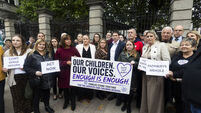
Thousands of Sinn Fein activists took to the streets in Belfast, Dublin and Co Donegal after a day of protests over Mr Blair’s decision earlier this month to cancel elections which should have been held today.
No new date has been set for the poll – but several Sinn Fein leaders and the nationalist SDLP staged pickets and mock ballots.
After handing over a letter of protest to the Northern Ireland Secretary Paul Murphy at Stormont, Sinn Fein president Gerry Adams, MP for West Belfast, warned that the peace process could suffer if elections were not held by autumn.
“The cancellation of elections is a subversion of democracy,” he said.
“The cancellation of the elections creates a dangerous political vacuum.
“The process of conflict resolution in Ireland, as elsewhere, is premised on the creation of a viable political, democratic and peaceful alternative to war. In short it is about making politics work.
“The British and Irish governments accepted this logic in their recently published Joint Declaration when they said ’The best way of ensuring that peace remains permanent is by demonstrating that politics work’.
“How then does cancelling democratic elections demonstrate, in any way, that politics work?”
On May 1, Mr Blair postponed the elections because of the IRA’s failure to produce a statement declaring an end to all paramilitary activity.
The election was halted four days into the campaign despite opposition from the Irish Government.
With Ulster Unionist leader David Trimble insisting he would not return to power-sharing without an end to all paramilitary activity by the IRA, Mr Blair said the elections would be meaningless without a move from the Provisionals.
Sinn Fein today staged protests in 30 towns and cities across Northern Ireland and Ireland.
Rallies were held tonight outside Belfast City Hall, the British Embassy in Dublin and in Letterkenny, County Donegal.
In Belfast and Omagh, republicans staged street theatre.
They also held a democracy auction outside the Dáil.
Commuters in Dublin were leafleted on their way to work.
White line protests were staged on Dublin’s main thoroughfares, in Cork city and county, Galway city and county and counties Mayo, Louth, Meath, Longford, Wexford, Kilkenny, Carlow, Wicklow and Kerry.
North of the border, activists staged roadside protests on Derry’s Craigavon Bridge, Toomebridge, the Ballygawley roundabout, Strabane, Downpatrick and Lurgan.
The nationalist SDLP also protested against the cancellation of elections with a mock ballot in south Belfast.
SDLP leader Mark Durkan said Mr Blair might have stopped people in Northern Ireland making their votes heard at the ballot box, but he would not prevent them from making their voices heard.
“The absence of the democratic process will not be used as an excuse for the abdication of responsibility in the political process,” he said.
“Our task is not only to revive the process, it is to restore the Agreement, implement it in full and renew people’s faith in the integrity of politics.”
Unionists opposed to the Good Friday Agreement also voiced their anger that the election was not going ahead.
As Tony Blair visited troops and schoolchildren in southern Iraq, Democratic Unionist deputy leader Peter Robinson said: “As polling day passes in Northern Ireland it is ironic that Tony Blair has gone to Iraq to witness the transition to democracy being established in that country.
“While Northern Ireland is denied democracy, Tony Blair travels to foreign countries to celebrate the delivery of democratic structures.”
CONNECT WITH US TODAY



Be the first to know the latest news and updates