Ombudsman report: Irish are slow to complain resulting in lack of change
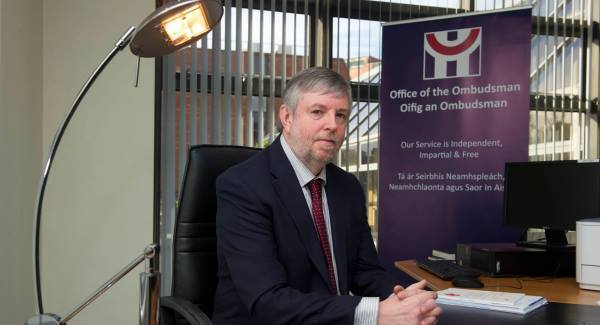
There is a reluctance to complain in Ireland, says Ombudsman Peter Tyndall, but he notes that complaining may bring benefits.

Ombudsman report: Irish are slow to complain resulting in lack of change

Mr Tyndall is head of the Office of the Ombudsman, the place to address complaints if you feel you have been unfairly treated by a public body.

Last year, the office received a total of 3,641 complaints from the public, which was up 3% compared with 2014.


“There is a reluctance to complain in Ireland. I contrast a piece of work that was done in England about health complaints, where staff within the health service, who were complaining, were advantaged in their treatment. Whereas there is a strong public perception in Ireland that if you complain you’ll be disadvantaged in your treatment. That’s a cultural difference,” said Mr Tyndall yesterday at the launch of his office’s annual report.

He stated that the public need to know that they are allowed complain and that they know where to bring their grievances.

“First of all, we have to make it clear to people that they’re welcome to complain. One of the things we’re doing with the HSE is trying to get the ‘you said, we did’-type poster visible across the health service, so there is evidence both to members of the public and to staff that complaining brings about change.

“We want people to see what difference it can make to complain.”

While there was a 3% increase in complaints to his office last year, there had been an increase of 11% in 2014 compared with 2013.

Before a member of the public can bring a complaint to the Office of the Ombudsman they must have taken all reasonable steps to resolve the matter with the public body at hand.

The civil service accounted for the greatest number of complaints in 2015, with 38.4% of cases. Local authorities accounted for 27.6% of complaint cases, and the HSE and Tusla accounted for 17.4% of cases.

Mr Tyndall said these figures are “consistent with the volume of interactions that these bodies have with service users”.

In August 2015, private nursing homes came under the remit of the office. Mr Tyndall said that they all worked alongside his office in establishing a system for complaints.

His office is in the process of setting up an online portal for complaints against public bodies.

CASE ONE: Leaving Cert student with Asperger’s denied a reader

A number of Leaving Certificate students, that were denied assistance during their State exams, appealed successfully to the Office of the Ombudsman.

In one case, a student with Asperger’s syndrome was refused a reading assistant in order to sit his Leaving Certificate.

In order to obtain a reader, the student must meet certain criteria.

The student, when having his reading ability assessed, was asked to read from the wrong paper. He was sitting three higher-level subjects but was asked to read from ordinary-level English sample papers.

A file from the State Examinations Commission (SEC)showed that the school had asked the student to read from ordinary level English sample papers.

This assessment did not provide a true reflection of the student’s reading difficulties.

“The Ombudsman asked the commission to have the student reassessed at the correct level.

“As a result of the assessment, the student was found to meet the criteria to qualify for a reader for his Leaving Certificate exams,” said the Ombudsman.

In another case relating to the Leaving Certificate, a female student had a writing disability and was initially refused access to a word processor in order to complete her exams.

In this case, she was only granted assistance four days before the start of her exams.

A mother complained that her daughter’s application under RACE (Reasonable Accommodations for the Examinations Certificate Scheme) to use a word processor during her Leaving Certificate examinations. The student had a developmental co-ordination disorder which made it difficult for her to write by hand for long periods of time.

“During the Ombudsman’s examination, the mother said that her daughter had scoliosis but that she had not informed the commission. The ombudsman contacted the commission to explain the situation and submitted extra medical evidence.

“The SEC immediately reviewed her application and the daughter was granted approval to use a word processor,” said the Ombudsman.

CASE TWO: Grandmother gets €28k in backdated ‘guardian’ pay

A grandmother, rearing her grandchild, received €28,000 in backdated “guardian payments” after the Department of Social Protection had initially refused her application.

The woman complained to the Office of the Ombudsman that the Department of Social Protection had refused her application for guardian payment.

The grandmother was seeking payment for her granddaughter, whom she is rearing in the absence of the child’s parents.

When the Department of Social Protection had refused to make the payment, the grandmother brought her case to the Social Welfare Appeals Office. This office upheld the decision not to make the payment.

“The department and the appeals office explained that their decisions were based on the fact that they were not satisfied that the grandchild had been completely abandoned by her parents,” said the Ombudsman.

Under current regulations, a child has to be abandoned by both parents, in order for a third party to receive the guardian payment.

The Ombudsman asked the appeals office to go over key points of evidence.

A number of officials of the Department of Social Protection, who had dealt directly with the grandmother, were interviewed.

These officials had found her case credible.

File documents, including statements from the child’s mother and grandmother, were also reassessed.

The Social Welfare Appeals Office, having reassessed the file, revised its earlier decision not to make the payment.

As a result, the grandmother received arrears backdated to when she had initially applied for the payment in 2011. The amount totalled €28,616.

The civil service, which includes the Department of Social Protection, was the largest source of complaints for the Office of the Ombudsman last year. However, the Ombudsman pointed out that this is down to the nature of the work carried out there as opposed to a reflection of work practices.

It is more so consistent with the volume of interactions that the body has with its service users.

CASE THREE: Dog fined after being wrongly accused of bite attack

A Cork dog owner had a fine quashed after his dog was accused of attacking a person, because the council did not carry out an investigation.

“It was a dog wrongly accused of biting and the dog was not entitled to a fair trial, it had no right to an appeal. So we stepped in and the dog owner was reprieved,” said the ombudsman Peter Tyndall yesterday.

A dog owner had been fined by Cork County Council based solely on an allegation, that his dog had attacked a third party.

The dog owner was in the process of contesting the fine in the district court when he simultaneously contacted the Office of the Ombudsman.

The man stated that Cork County Council had fined him without having properly established the facts of the case. Furthermore, there was no appeals process open to him.

What the Office of the Ombudsman discovered was that the council had a policy of fining dog owners when they received written statements about their dogs. These statements were not investigated, but accepted as fact.

The ombudsman considered this approach “unfair” and asked Cork County Council to review its canine fine policy.

The council conducted its own internal review and changed its policy as a result.

Now, when a verbal or written complaint is received relating to a dog incident, the dog warden will make contact with both the pet owner and the complainant in order to investigate the matter.

In this particular incident, Cork County Council dropped its case against the dog owner and he was awarded costs.

Local authorities are the second largest source of complaints for the Office of the Ombudsman.

There were 1,006 complaints to the office last year, made in relation to local authorities.

Aside from Dublin City Council, which accounted for 134 of the complaints, the next highest source was Cork County Council.

A total of 78 complaints relating to Cork County Council were made to the ombudsman and 61 were filed for Cork City Council.

More in this section

Lunchtime News

Newsletter

Get a lunch briefing straight to your inbox at noon daily. Also be the first to know with our occasional Breaking News emails.

Cookie Policy Privacy Policy Brand Safety FAQ Help Contact Us Terms and Conditions

© Examiner Echo Group Limited