Drawing was doodled during the devastation of Dublin in 1916
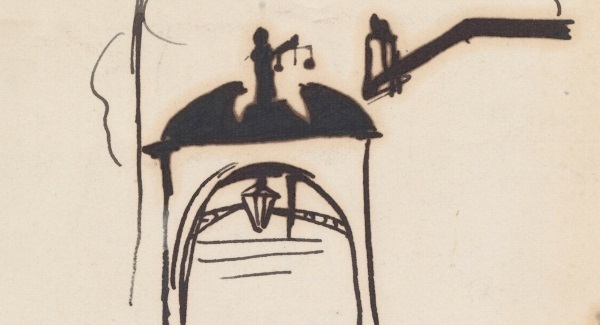
Thomas Bodkin was an artistic young barrister, from a prominent middle-class nationalist family. From the start of the Rising he travelled around witnessing the fighting, returning home with news and provisions. On the Thursday he joined the Red Cross as a stretcher-bearer, bringing the wounded to the Emergency War Hospital at Dublin Castle.
Excitement and tedium are both captured in the notepaper which Tom carried in his pocket. In a spare moment he began a letter to a friend describing the busy scene around him when his pen was suddenly lifted from the page mid-word.
Was he called to join another ambulance heading out? Or had more wounded just arrived?
Overleaf, in a hurried scribble, he jotted down key words against the days of the week: “Monday. Collins Roche walk to GPO”
“Thursday Johnston Mooney” — attempting to record the confusing flow of events.
Later, Tom expanded these into a full account of his experiences, but his initial notes show a tired man struggling to put order on chaotic days and nights. Details are squeezed in between lines.

For regular updates on news and features (as well as twitter action action as it may have happened 100 years ago) to mark the revolutionary period follow @theirishrev HERE
He corrected his memory of a visit to Dame Court and Anglesea Street — that was on Friday, not Thursday — he was “Up all night” so days bled into one another.
Tom sketched the entrance to Dublin Castle from inside the upper yard. In thick, inky lines he shows the statue of justice with some high clouds behind; as a barrister and artist, his choice of subject seems apt.
His simple doodle records another idle, or tedious, moment between ambulance runs out to some scene of fighting.
This scruffy sheet of notepaper found among Bodkin’s papers held in the Manuscripts and Archives Research Library at Trinity College Dublin reveals the confusion, excitement and consciousness of history felt in Dublin as Easter Week unfolded.