Monard oral hearing: Day 3: New town ‘won’t raise flood risk’
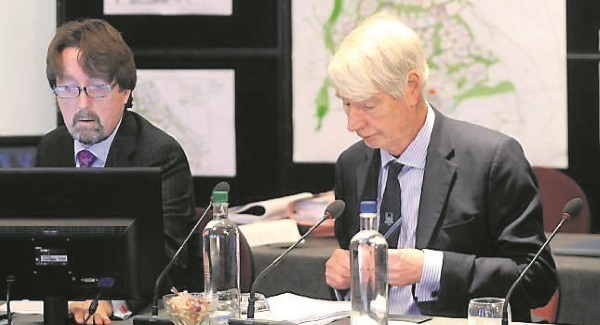
The claim was made by Cork County Council experts who endeavoured to allay fears that building a 5,300-house town at Monard, near Blarney, would increase the likelihood of flooding in Blackpool.
Representatives from Blackpool businesses, whose premises have been repeatedly flooded down the years and most recently in 2012, said they were concerned that building Monard, on high ground near Blarney, would increase the risk of flooding downstream.
Council experts told day three of a Bord Pleanála oral hearing they had carried out a computer simulation of a once-in-a-100-years storm, lasting eight hours and hitting Monard.

Donald Cronin, a county council engineer, said mitigation measures planned as part of the Monard development, which include basins to hold back flood water, “would, if anything, actually reduce the risk of flooding in Blackpool”.
The council has resubmitted a new plan for Monard after An Bord Pleanála turned down a proposal in 2012. One of the reasons it had cited for refusal was the steep topography of the site.
Council senior planner Andrew Hind said the local authority had been working for 15 years on the Monard plan. He said the council was “deeply concerned at the capacity of the Cork region to provide an appropriate supply of new housing to meet the immediate requirements of the State’s second largest metropolitan area at this critical period of economic recovery”.
Mr Hind said in the Cork Metropolitan area, which includes Monard, it would be necessary to construct 31,038 dwellings by 2022 to meet expected population growths.
He said Monard had been identified by the council as one of nine large landbanks which had been earmarked for housing but, even if all of them were fully developed, they would only provide just over 60% of the housing required in the next seven years. “Successfully completing the procedures in relation to Monard is a critical part of the suite of measures that the county council have put in place in order to progress the development of these nine sites.”
Mr Hind added, without housing for an increased population, the region would not achieve the critical growth needed to boost the economy. He said a balance was needed in development around the city. In past decades, growth was based on the southern and western areas. With the reopening of the Cork-Midleton, railway population growth to the east of the city was occurring as planned.
“The challenge now is to plan the delivery of the remaining elements of the scheme, particularly those in the corridor north of the city, so that they can be delivered when economic conditions improve,” Mr Hind said.
The oral hearing at the Metropole Hotel also heard from Nicholas de Jong, a chartered landscape architect representing the council, who said mitigation measures could be put in place to make buildings visibly less obtrusive. He said this could be achieved by planting woodland and a mixture of trees at various points around the site.

CONNECT WITH US TODAY



Be the first to know the latest news and updates