Boost for Julie’s fight to free husband
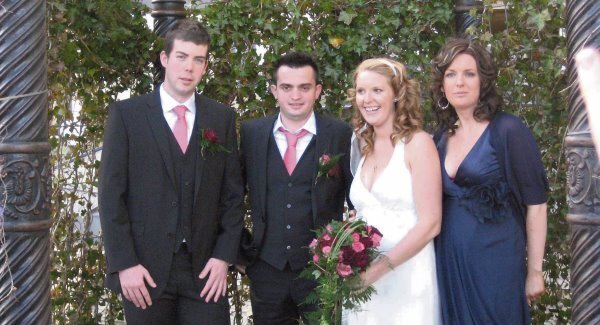
Julie Marku’s husband, Mark, has been granted temporary leave from prison and is now allowed a period of freedom every two months. He has also been told he will be eligible for full-time parole next April.
However, he is determined to continue his fight to clear his name after being convicted of a series of robberies that evidence verified by the Innocence Project shows he could not have committed — not least because he was in Ireland when some of the key crimes occurred.
“He is extremely upset with the courts and the justice system and how badly they have failed him so he is more determined than ever to prove that he didn’t do this,” said pre-school teacher Julie, who met Albanian-born Mark while on a working holiday in Greece where he was also working.
“Unless we prove his innocence, we have a very limited future in terms of us trying to get him home to Ireland and making a life, so we have to keep going.”
Julie and Mark got to spend eight days together on the island of Crete last month when Mark was finally approved for temporary release from prison on the Greek mainland on his fourth application. For the couple, who married in Ireland in 2009, it was an emotional reunion.
“It was amazing to spend some time with him but it was quite stressful for him and for me as well because it was the first time in nearly five years,” said Julie, who is back home in Rathvilly, Co Carlow.
“Going through the airport with this piece of paper saying that he’s from prison and they’re letting him out for eight days was surreal. We didn’t do anything major — just having breakfast in the morning together was lovely.
“One of the things that stands out was one of the nights I was sitting at my dresser taking my make-up off getting ready for bed and I looked in the mirror and he was there behind me. It kind of just hit me — he’s really here. It’s simple things like that, just being in each other’s company, that we’ve missed so much.”
Mark, 30, and his younger brother, Andreas, were among Albanian eight men arrested for the robberies. They faced 15 charges each.
They were tried and convicted early in 2012 and sentenced to 18 years in prison despite the fact that no evidence was produced for 11 of the charges and Mark was in Ireland on six of the dates cited.
Apparent witness identification evidence was shown to be contradictory and was widely discredited. A glove supposedly found at a crime scene with Mark’s DNA on it mysteriously disappeared, along with records of where it was found; while the DNA tests themselves were declared by an American expert at his trial to be flawed.
Lawyers and law students from Irish arm of the international Innocence Project based at Griffith College who worked on his defence were shocked at the conviction but even more so when it was upheld on appeal in June last year.
Mark has been waiting for the appeal court’s written judgment ever since, as he can’t take his case to the Greek supreme court without it.
“In theory, the courts should have the judgment ready within in a month but we were told in reality to expect a year. It’s a year next week, June 27,” said Julie.
By chance, a change in the law is working in Mark’s favour, as the Greek government has reduced the time an inmate must serve before becoming eligible for parole from three fifths of their sentence to one third, meaning Mark is in line to be freed after April 16 next year.
The conditions of his parole may mean he has to stay in Greece or opt for deportation to Albania so Julie and Mark have many decisions to make about their future.
“That’s the challenge for the next year,” said Julie. “It’s tough. The last year has taken its toll on everybody. It’s been a long, long road but it’s definitely a much better position to be in to be aiming towards something than where we were last year.”
Julie will be speaking of her experiences at the Innocence Project’s international conference at Griffith College on Friday, June 26.
CONNECT WITH US TODAY



Be the first to know the latest news and updates