SPECIAL REPORT DAY 2: How the floods changed Ireland
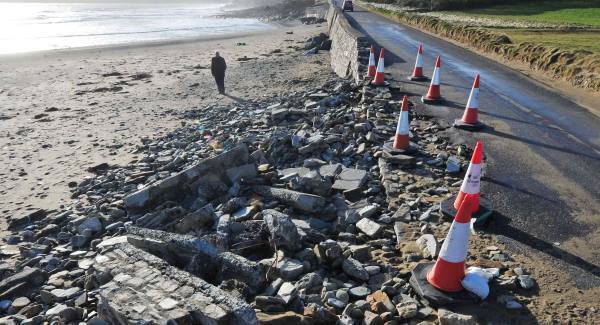
SO much of what happens is hidden from plain sight. Take the beautiful beach area of Red Strand near Clonakilty.
The recent storms have caused serious damage to counties from Mayo to Wexford and beyond. Sometimes the extent of the damage is obvious, other times not so much.
Red Strand, not far from the villages of Rathbarry and Ardfield, has clear evidence of damage. One of the walls alongside the road has been knocked, the sands have been shifted, along with rocks and stones, and the pillar displaying the Red Strand plaque lies knocked on the sand.
Local man Cornelius ‘Con’ Scully is a veritable historian of Red Strand. He has photos of the area dating back to the 19th century and knows every nook and cranny.
“The face of the strand has totally changed in a very short time,” he says from his conservatory overlooking the sea.
He remembers back to the 30s when a tunnel, a section of which is still visible to the left of the strand as you look from the road, was laid. “When that was built the high water [mark] was 20 ft further out to sea,” he says. “It’s coming in the whole time.”
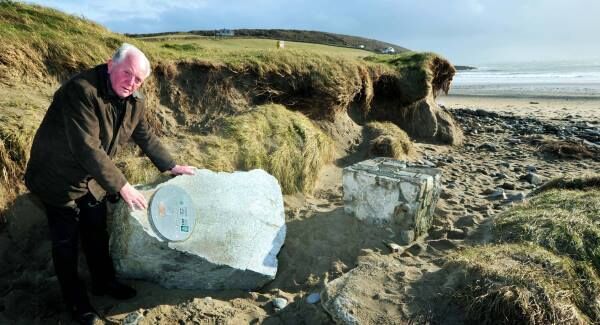
Due to storms and coastal erosion there is little rock left to hold back the tides. Back in the forties and fifties, he says, sections of the strand and adjoining roads being closed off for three months or more due to encroaching water was not unknown.
Following a fierce storm in February 1962 a council engineer, alongside local people, had the visionary idea of bringing large rocks from the Dunmanway area and placing them out from the shoreline to break the waves as they came in. Now, Con thinks it’s time for a similar plan to be executed.
“This is the only thing that is going to protect it,” he says. “Fifteen to 20 ft of rock and put it just below the present high water [mark].”
The issue has been discussed with local councillors, and it is clear that local people, protective of this local resource, want to ensure it is not allowed to fall into a state of decline.
However, when so many parts of the county, and the country, has been ravaged by bad weather, all seeking financial aid for repairs and restoration, Red Strand could be among the number of smaller areas that trickles to the bottom of the priority list. Why? Because no private property is currently in the line of fire, and the nearest shops and commercial enterprises are away from the coast, in Clonakilty and Rathbarry.
“They still have to keep on repairing year after year after year,” Con says, stressing that a longer-term solution might be a better option.
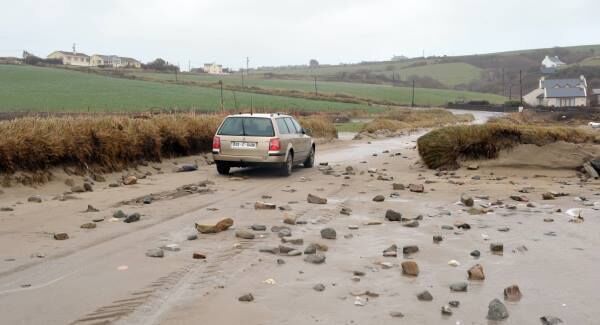
Red Strand is a popular swimming spot, seen as a safe area. According to Con a life has never been lost there, whereas nearby Long Strand is known as having vicious rips.
There is another aspect of the Red Strand that is not immediately obvious. Con displays a photograph which shows a rock, linked to the shore, which has become a very popular diving spot in recent years, the cliffs of Dunowen, but no longer.
Con says the recent stormy weather has blasted 200 tonnes of rock that linked the diving spot to the shoreline — it is now impossible to get across to the diving point.
“The beach has taken a new face,” Con says. “How long it will stay that way is hard to say. I think there has to be a permanent solution found to protect it.”
As if to highlight his point he points to an area in the water out from the beach where the sea churns up and swirls. It is the black rock, and he says that at low water between 6ft and 8ft of it was visible. Now, at low water, it can barely be seen.
In Rathbarry village, postmistress Breda Hodnett also runs a small, colourful museum of local and rural artifacts. Talk of storms brings to mind the horrendous flooding of summer 2012, when water piled in on top of the post office and caused serious damage. But she is well aware that Red Strand, so close to Rathbarry, is a vital local amenity that must be protected. “Red Strand is so important,” she says.
Not far out the road past Red Strand is Long Strand, and one effect of the storms here is that such a volume of sand and gravel has been pitched back inland that it is gumming up the flow of the river, which means water is flushed back over land instead of flowing into the sea. It has caused local road flooding and pushed water onto farmland.
Past this again is the town of Rosscarbery, and a quick drive out one of the coastal roads, opposite the Celtic Ross Hotel, shows that the sea wall has been burst in a number of locations. It raises the possibility of further flooding in future on one of the county’s most popular coastal drives.
Johnny Murphy of the Clon town engineers section of Cork County Council says additional work on the bridge at Red strand, first damaged by the flooding in summer 2012, will resume next month, but gives another insight into the force of the weather in recent times.
He says that after the storms local teams checking life buoys in an area from Rosscarbery up the coastline found that of the 100 buoys/life rings, a number had disappeared while many others were now either positioned too high or too low, as per regulations. The boxes holding the buoys may not have moved, but the earth and sand underneath did.
Add up all the seemingly small examples of damage and they become a big problem. Places like Red Strand want to ensure they don’t get left behind.
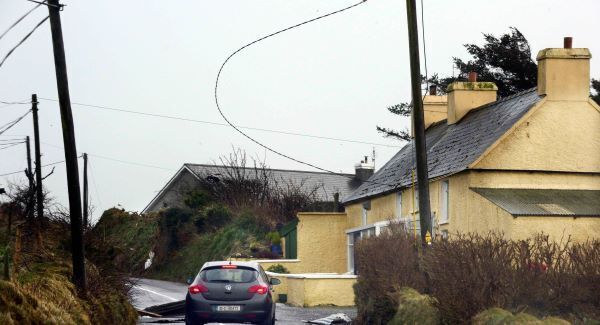
Cork County Council has revealed that the most recent storm which knocked out electricity supply across much of the county has also increased the bill for repairs and restoration of coastal areas.
The local authority had submitted an estimate of storm damage to the National Directorate for Fire and Emergency for €4,227,700 at the beginning of this month, following almost two months of bad weather that included fierce storms.
However, a spokesman for the Council said further storm damage had added another €600,000 to the estimate.
“Since then following further storms and investigations this [overall] figure has risen to €4,900,000,” the spokesman said.
The approximate breakdown as to how any funds would be spent shows that the largest amount of money, some €2.4m, would go towards coastal protection.
Approximately €1m has been earmarked for repairing damage to roads while €940,000 is the estimated cost of clean up and immediate repairs in different parts of the county.
The estimate for tourist Infrastructure is €400,000, with €160,000 for piers and harbours.
The council is just one of a number to have submitted estimates to central government and the Cork figure is significantly less than that submitted by Clare County Council to take one example.
The council said it would wait for funding to be provided before selecting which parts of the county would be have their needs addressed.
“The prioritisation has not been an issue to date as we are seeking funding for complete restoration but if the funding does not become available then we will have to curtail the programme and prioritise based on usage and risk to the general public,” the spokesman said.
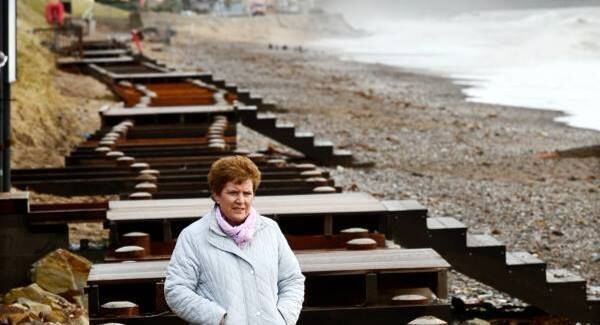
IN Luigi’s restaurant in the centre of Youghal is a black and white photograph of the town’s wooden boardwalk, showing it disappearing off into the distance. The real thing looks a little different.
The boardwalk, such a popular local feature along the town’s famous beach, was only laid a few years ago, but now some boards are missing and the rest have all been partially ripped up. A few benches remain, stitching a few boards together.
Youghal was one of the headline acts in Cork county’s ledger of storm damage. Cork County Council submitted an estimate of storm damage to the National Directorate for Fire and Emergency for €4,227,700 at the beginning of February. Since then following further storms and investigations this has risen to €4,900,000.
Youghal will certainly be seeking a chunk of that, with the local authority costing coastal protection at €2.4m and tourist infrastructure at €400,000. However, when it comes to who gets what, and when, a county council spokesman said: “The prioritisation has not been an issue to date as we are seeking funding for complete restoration, but if the funding does not become available then we will have to curtail the programme and prioritise based on usage and risk to the general public.”
Cllr Barbara Murray of Fine Gael is out walking the beach with her dog, Lotty, and stops to talk to a local man out walking with the aid of a three-wheeled walking aid. Both remark on the loss of the boardwalk — those with sore and aging hips don’t like chunnelling through the sand.
Protection against further storm damage in the future is high on Cllr Murray’s agenda, such as possible plans to deposit thousands of tonnes of rocks away from the shoreline. She firmly believes longer-term solutions are needed.
“It’s hugely missed,” she says of the boardwalk, before going on to explain how, in some ways, local needs after storm damage may impact on this year’s local elections. In her mind, with the scrapping of town councils, people may now be inclined to vote for local candidates — irrespective of party preferences — so as to retain strong local representation in the revamped municipal district council.
It’s a theory that, like many of the fields around Youghal, holds water. A council source has the full rundown of all the damage caused in the area and it is an extensive list. In addition to the boardwalk, the huge stones lobbed onto the concrete steps, the sand almost submerging the benches behind the back wall of the beach, there are other issues, such as damage to dunes down the coast, or increased water volumes in the nearby marsh. There was “serious erosion” on dunes in nearby Pilmore, and as the source outlines, dunes offer a natural protection to the coast from the sea.
Down the coast at Garryvoe, the surface of around half the car park has been swept away, the old tar and chip section, and signs have been bent.
Repair and restoration work is obviously required, particularly when you consider how many people and businesses rely on tourism come the summer. Car parks need to be ready for vehicles, roads and footpaths need to be cleared and fit for purpose, and access to local amenities needs to be guaranteed. At local level there has always been an element of discretion when it comes to spending an allocated budget, so part of a grant for urban roads could be spent on addressing serious damage to infrastructure elsewhere. Now, everyone has their wish list and must wait for the funding to trickle down. It will also mean money in the annual budget will need to be spent on repairs, rather than other schemes. Certainly, the likelihood of increased amounts of money being needed for coastal protection, such as groynes at Youghal beach and beyond, into the future has been highlighted.
“We have not had storms of that ferocity for quite a while,” the council source said, adding that the boardwalk would need to be one of the items prioritised given its central importance to the Youghal beach experience.
All is not doom and gloom. On a sunny day, Silva Urbonaviciene is soaking up the rays on one of the benches on an unseasonably warm February morning, and spreading a little sunshine herself.
Silva has been living in Youghal for just three months, and you might think she was unlucky to have come during such bad weather. Not so — she loves it here.
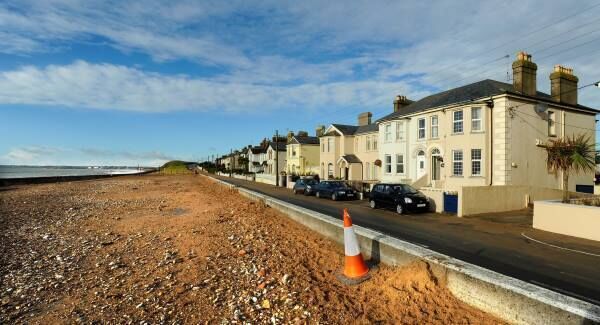
Having lost her job in Ashbourne in Co Meath she went on the internet to check where she might like to live. “I have a longtime dream to live by the sea,” she says. Youghal was one of the first names to pop up on her computer, and she checked with her daughter who lives in Fermoy. “My daughter said it was so nice,” she says.
She also remembers the day the “big wave” came that wrecked the boardwalk and caused such damage. She was down at the beach, even though her daughter had warned her bad weather was coming. “Maybe I am a little crazy,” Silva, originally from Latvia, jokes.
“I was just by the sea and it [the sea] was very close and started to worry and I started to go home.”
As she made her way back from the sea front she was covered in water “from head to toe” — “I had sand in my hair, it was a bit of a shock. I said ‘you are very cheeky’.”
“It’s very sad to see what happened,” Silva says, but you can see from her eyes and hear in her voice that she still wouldn’t want to be anywhere else.
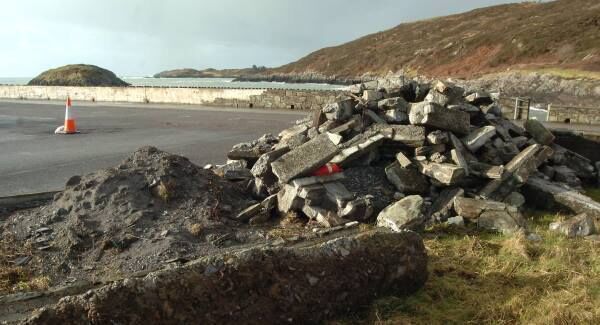
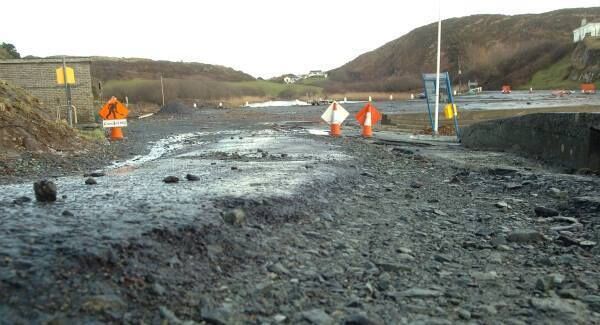
TRAGUMNA in West Cork has a new pot hole. It’s roughly the size of a car park. Actually, it is the car park.
The picturesque village a few miles out from Skibbereen is just one of a host of coastal communities in Co Cork that has taken a repeated battering from the elements in recent months, and the calculator has been out to tot up the cost of repairs.
It’s the same all over much of the southern part of the country and there are valid fears that the coffers of central government are not deep enough to furnish all the local authorities with the money they need to address the various parts of each county that has taken a pummelling.
Tragumna is a popular destination for locals in the West Cork area and for holidaymakers from farther afield. It is Skibbereen’s ‘beach’ and gets return visits each year from people around the country and abroad. Its small but perfectly formed beach is the main feature, but it was the power of the sea that caused the damage surrounding it.
The car park, a vital public amenity, is one casualty. One local man describes it as being like “a lunar surface”. The waves smashed over the sea walls and flooded right over the car park at speed, stripping most of the surface and carrying on to the small lake area directly behind.
The adjoining public toilets got a hammering, and the road leading up the hill behind those toilets looks like it was scoured with a gigantic pen-knife. Water coming in from the sea was joined by huge volumes flowing down the hill. A local woman says the council had been laying a water pipe when the worst of the weather struck; it was no-one’s fault, it just meant the road was prone to the elements.
Further along, you can see how far the sea water pushed into the land. Top stones on a wall were knocked off, parts of another wall was levelled, and a large pile of rock and stone has been gathered at the entrance to a group of holiday homes. Large stones still remain in parts of the car park while a sign for Skibbereen is now horizontal, bent at 90 degrees where it enters the ground.
Aine Hayes, who lives in Tragumna, took some eyecatching photographs of the sea as it piled in at the start of the year. You can see in her photographs the waves lashing off walls and covering the car park.
Pat McCarthy, who has lived in Tragumna “all of 55 years” and whose house is close to the beach, said he and other locals were hopeful that the damage would be repaired quickly.
“I think it will you know. What we are all hoping and praying for is that the council gets the money from Brussels; we are hoping that is going to happen,” he said.
“It’ll have to be fixed.”
Tragumna is a blue flag beach, something Pat says is “vitally important” to the area. It bestows status on the area, and means that its amenities much match up.
With that in mind, the local community association had just at the end of last year finalised the Tragumna Beach Facilities Upgrade, an innovative plan to redevelop the car park area, adding a picnic area behind it next to the lake area and to upgrade the public toilets, as well as a new life guard station.
John Kelly is the man in the know about the intricacies of the proposal, and he was optimistic that the local authority and the West Cork Development Partnership could deliver the funds needed, even taking into account the way the landscape of the plan has literally changed as a result of the storms.
Both the council and the WCDP have both been very supportive, and planning permission had been secured for phase one, which it’s understood would have cost around €250,000. Locals had raised €12,000 but then last week came the bad news: funding would not be available this year. Ian Dempsey, the CEO of the WCDP, said he hoped it could be revisited in future. Now the locals are simply hoping that Cork County Council can clean up the area as quickly as possible.
“It’s very, very disappointing because we had put a lot of effort into raising money,” John Kelly says. “It’s very difficult to tell people we are not doing anything with it. It took a lot of effort to get the money and we did it in good faith.”
John says that the Tragumna Island swim is one of the first big events in the area, followed by the Tra na Mona triathlon. “when these events are on we need that car park,” John says. “We have nowhere else to put it, really.”
The hope was that the redevelopment of Tragumna would have overtaken the basic remedial works, an ‘all-in-one’ approach that would have given the locals what they wanted.
Now Pat McCarthy is fearful that Tragumna may have to wait for even the basic repair work to be done. In the meantime, locals are getting on with things, even if the damage has caused some inconvenience.
“It has to a degree, but we wouldn’t complain over that,” Pat says. “We actually don’t see the point of repairing [the damage] til mid-March when we get some decent weather. If you had another storm again in a week’s time, it would cause more damage. We would be hoping it would be ready for the summer.”
It may well be — it just won’t be everything that the locals in Tragumna had worked for.
CONNECT WITH US TODAY



Be the first to know the latest news and updates