Foghlaimeóir ón Úcráin: how one Ukrainian woman fell in love with the Irish language
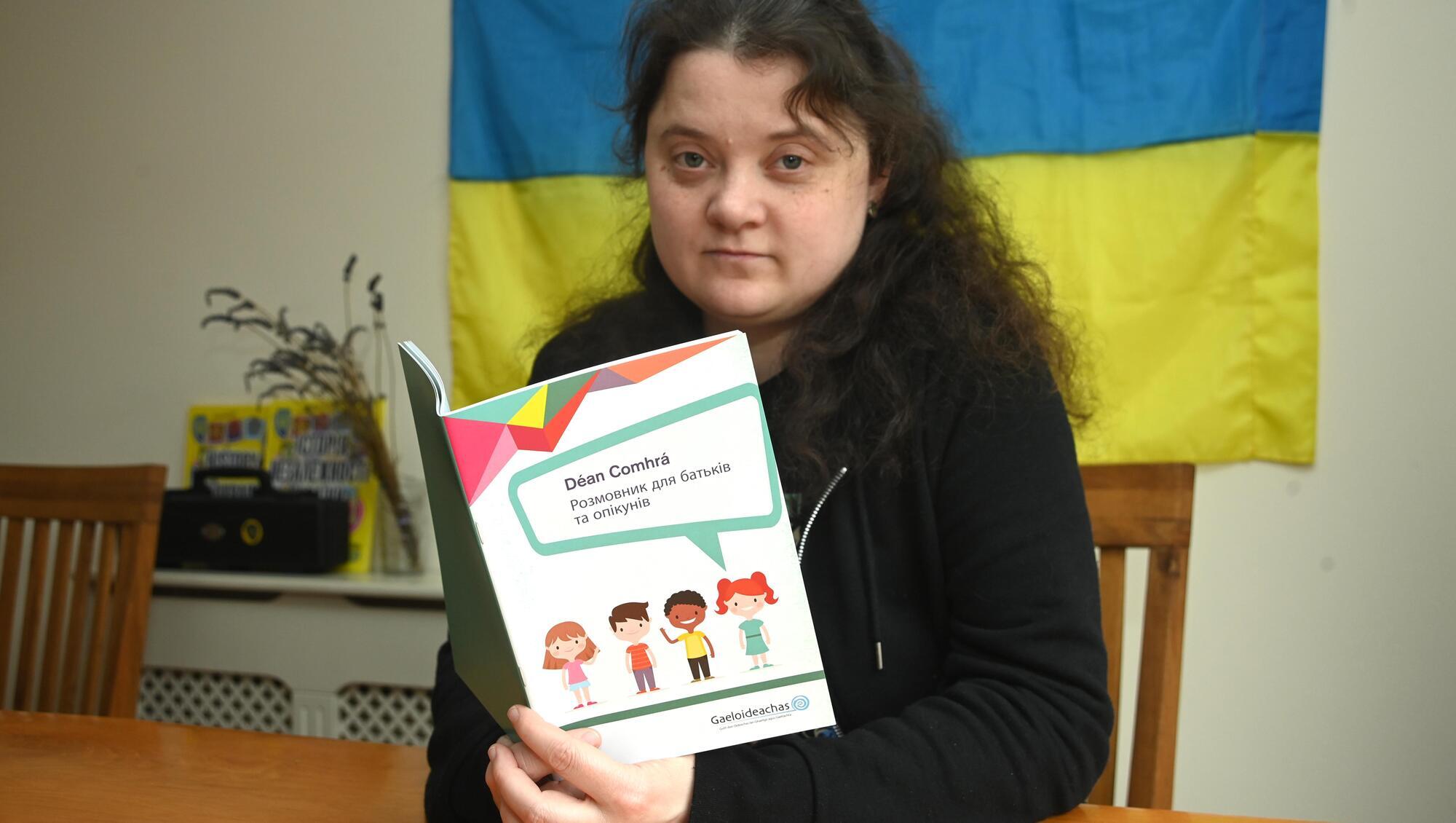
Irish speaker and traditional Irish flute player Nadia Dobrianska, from Ukraine, now living in Cork. She is holding a book she was involved in writing to assist people from Ukraine to learn to speak the Irish language. Pic: Larry Cummins
Nadia Dobrianska can still vividly remember hearing her first traditional song, an experience which sparked a deep love of Irish language and culture.
That song was ‘Gile Mear’, a traditional ballad performed by many acclaimed artists including Mary Black, James Last, and Celtic Woman.

In Nadia’s case, her first experience of the song was a recording by Irish and Scottish group, Relativity, and she felt both an instant connection to the song and an eagerness to know more.
“I was just completely taken,” she recalls. “I was like: I don’t know what this is, I want it.” It sparked the beginning of a love affair with Irish language, history, and culture for the Ukrainian woman, who returned to Ireland with family when Russia invaded Ukraine last year and currently lives in Cork.
Nadia had an interest in languages that goes back many years and was supported by her family. But when she first heard Irish, she was completely intrigued by the language.
“My parents used to send me to do English language courses with native speakers whenever they had this opportunity,” she says. “When I was a teenager, I had a tutor from the North of England. He really liked Irish and Scottish music, and I got to hear traditional tunes and songs through him.
“I later discovered there’s this big world of Irish music and Irish language and I was completely taken because I have some languages. I can speak a bit of German, French and Polish. I’ve been learning them at different stages in my life. Irish was nothing like any of these languages that I knew and I was completely absorbed.”
Now a fluent Irish speaker, Nadia is one of a growing number of non-Irish who are learning the language. But despite her ability with other languages, the cúpla focail proved challenging to master.
“When I was young, there was really no opportunity for me to learn it, because everything is through English in the first place,” she says of her initial efforts, adding that she didn’t feel confident enough in her English at that time to learn another language.
“I came to Irish on my third attempt, when I was in my first years of university and I was studying law. I was doing Irish dancing and playing trad. It was the mid 2000s and shows like and had already been going global,” she says.
Her first efforts to learn Irish through the use of an academic textbook in Russian may have proved unsuccessful, but Nadia would later make another attempt to hone her cúpla focail through English.
“Some years later, when I was working, I was more confident in my English. So I ordered a textbook from Ireland, in English. I couldn’t quite get past pronunciation again, because I wasn’t confident in my English.
“My last attempt was [the online app] Duolingo, maybe 10 years later, in 2018. It worked really, really well. Ever since I’ve been learning Irish, and I’m fluent by now. It’s going to be five years in July that I’m learning Irish.”

Encouraged by her breakthrough, and seeking a change of scene from her work in Kyiv, Nadia took a deeper dive into her growing interest in 2018, moving to Belfast to take a degree in Irish studies and develop her language skills further.
It was something she wanted to do for herself, she says, and felt it was the right time to pursue her dream.
“I got funded and I went to Queen’s University Belfast and then I went to learn Irish on the Falls Road, where there’s a cultural centre.
“It was very thrilling — I was doing Irish studies in Belfast. I was exploring the music scene. My degree was very broad and interdisciplinary, I drifted to Irish history and really enjoyed it and decided to do a PhD, which I’m finally doing right now.”
On returning to her native Kyiv, Nadia applied for further education while working as a project manager with a human rights organisation. But like many others, life was upended in the most shocking of ways when Putin ordered the Russian invasion of Ukraine in the spring of 2022.
She couldn’t have known it then but she would return to the country she had taken to her heart, this time to Cork city, and as a refugee as well as a student.
“When it started, I fled Kyiv with my parents and my brother initially, and after a week, my brother went back to Kyiv.
“We were in the countryside with my mother’s family. A grassroots organisation of volunteers from Cork and Dublin approached me and said: ‘Do you want to come over and stay with your family with us in Ireland?’ That time I got a lot of support through social media, from the Irish language community, on Twitter, and the music community on Twitter. It was great, great support.”
During this time, she also started talking about her experience to media outlets here in both English and Irish. She felt supported in incredibly difficult times Nadia says, and she made friends along the way.
“I think the Irish-language community in Ireland really made me feel welcome, and helped me in many instances during this very hard time. The Irish academic community of historians, they really supported me too. Being part of the Irish-language speaking community is really like a safety net I would say, for me.”
Like many of us, from fluent speakers to those with no Irish at all, Nadia has become a fan of Irish-language channel TG4 for helping her learn Irish over the years but also for its programming.
“[When I] started watching TG4, I was just a beginner and I watched these people speaking in Irish to each other and all I could make out were articles and prepositions. So I started watching TG4 with subtitles, this was just brilliant.
“I was picking up the language as I was listening and watching and I really enjoyed the fact that there is a broad range of programmes available for different audiences — I was watching documentaries about Irish food and historical programmes too.”
Like a great many of us at home and millions of cinemagoers internationally, she also fell in love with a quiet girl who made noise at this year’s Oscars.
“I have seen in the cinema and I thought it was fantastic.” Does she think Irish culture and language and music will always have a place in her life?
“Oh, definitely. Absolutely. I’m a researcher. I’m doing a PhD in Irish history. So this is something that I’m really interested in. If things were to go well, I would like to have an academic career. I’ve been doing a lot of work through Irish since last year, I’ve been translating books from Irish to Ukrainian. I would definitely consider a career working in the Irish language.”