Easy science experiments to try at home this week with the kids
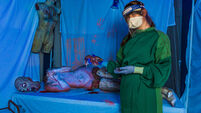
Ahead of Science Week, Linnea Dunne meets the team behind RTÉ’s ‘Let’s Find Out’ for their top experiments to try this mid-term
Easy science experiments to try at home this week with the kids

Mia and Ruby Clare on Let's Find Out

AS schools around the country wrap up for a well-deserved mid-term break, Science Week is almost upon us and the RTÉjr team behind Let’s Find Out is preparing to release the second season of the popular science show. We caught up with Mark ‘The Science Guy’ Langtry to find out what we can expect of the new season, why he loves science so much, and how parents can inspire their kids to get experimenting.

“Science is about understanding why things work, how they work, and how you can use that knowledge to live a happier, better life. It’s about learning things nobody knew before, things that can change the world for the better — for yourself or for a large amount of people,” says Mark, adding that an understanding of science and technology will be central to the future lives of all children, whatever they go on to study and work with.

“For kids, science is a superpower!” he enthuses.

“The scientific process teaches you how to analyse information and criticise it to understand whether or not it’s worth believing. The process of investigating, questioning, experimenting, and getting results — it’s a process that’s fun, that shows that you learn from your mistakes. Failing can be funny, and you’ll see a lot of that on the show,” he laughs.

Crazy adventures and a new level of ‘wow’

Amy Hassett and Mark ‘The Science Guy’ Langtry and Zoom

Season two of will launch on RTÉjr on Monday, November 8, just in time for Science Week. Taking place on the Curiosity Spaceship, the show sees the return not just of ‘The Science Guy’ himself, but also Zoom, the captain of curiosity. Joining them for this new season is neuroscientist Amy Hassett, who has previously shown kids how to make microscopes out of mobile phones and explained the anatomy of the brain using printed 3C models as part of the JellyLab team at Dublin Maker Festival.

“We get up to our usual crazy adventures of asking some kids a question and showing them how to do their own investigations, driven by their curiosity,” says Mark.

“We’ve really increased the level of ‘wow’ with our investigations and experiments. Even if we’re on a spacecraft hovering over Ireland, we have explosions, teddy bears flying on roller coasters — things that get super messy — and Amy and Zoom keep putting me to the test.”

Fun is at the heart of it, insists Mark, who adds that co-viewing with older siblings and parents is a great way to get younger viewers engaged and up for trying out an experiment of their own. “The show is full of simple experiments kids can do themselves — or they can just sit back and watch as I nearly explode myself!” he chuckles.

Diversity and morals for a better future

Neuroscientist Amy Hassett on set 

Diversity is at the heart of the show too, emphasising that “a diverse team is a winning team” and different perspectives make for better solutions and answers. It’s a huge responsibility, acknowledges the presenter, to represent science on television — especially Irish scientists and curious children to whom the viewers can relate.

Amy’s recipe for ‘liquid you can punch’ (oobleck)

Here’s Amy’s recipe for a substance called oobleck, which can act like both a solid and a liquid. Kids can have lots of fun testing it!

What you’ll need:

  • 500g cornflour
  • Warm water (around 250ml)
  • Bowl
  • Food colouring

Use around one part water to two parts cornflour, but keep a little extra water on hand, because sometimes the mixture can get really thick.

What you’ll do:

Add a few drops of food colouring to the warm water and mix. Make sure to use washable food colouring, because it might go everywhere!

To a bowl, add most of the cornflour and all of the water. Leave a little cornflour behind, as it’s easier to make it a little runny and thicken it up afterwards.

Mix the cornflour and coloured water gently using a spoon, or, if you like things messy, your hand. Slow movements work best for this. If you try to mix it using too much force, you will get splashed in the face!

Keep mixing until there are no lumps of cornflour left. Make sure to check the bottom of the bowl.

Add a little more cornflour until the mixture is thick enough that you can… play!

Some cool things to do with oobleck, once it is made:

  • Pour some onto your hand and try to make a ball out of it.
  • Pour some onto your hand and squeeze it really hard.
  • Punch it!
  • Dip your hand into it and try to pull it out really quickly.
  • Pour it through a strainer!

Warning: Do not throw the mixture down the sink when you’re done!

What’s going on?

Oobleck is a non-Newtonian fluid, which means it’s a substance that can mimic the qualities of a solid as well as a liquid. A Newtonian fluid, such as water or oil, has a constant viscosity — but the viscosity of a non-Newtonian liquid changes. Examples include ketchup and, yes, oobleck!

An experiment from the ‘Let’s Find Out’ kids

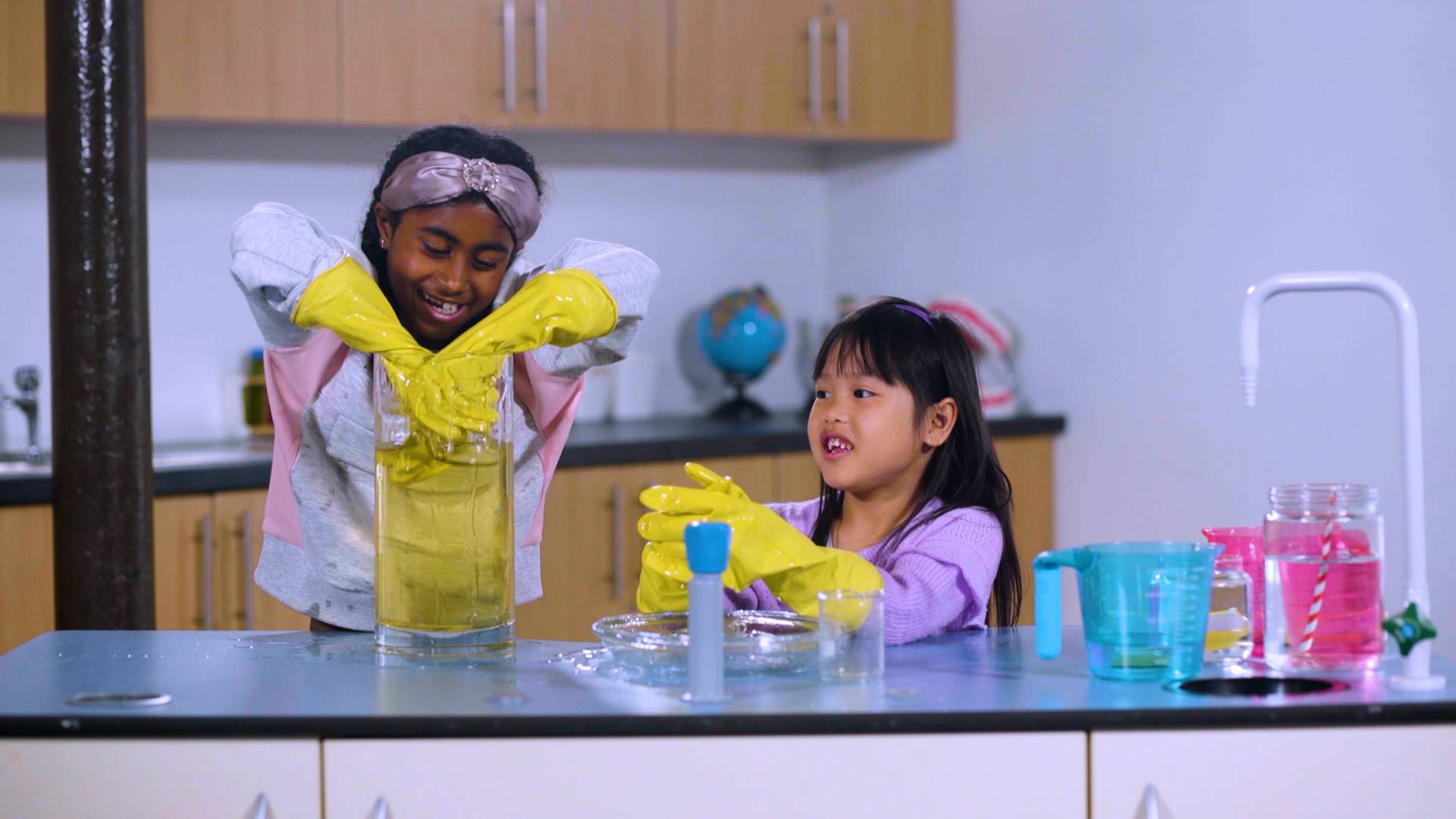
Mia and Ruby Clare
Mia and Ruby Clare

In the series, Ruby and Mia Clare from Cork show Zoom some really cool tricks with light. You can try them at home too.

The moving arrow experiment

What you’ll need:

  • A jug of water
  • A tall glass
  • Some paper or card
  • A marker

What you’ll do:

Using the marker, draw an arrow on the card that points to the left or right. Place the card about 10cm behind the glass of water and prop it up against something so it stays upright, the arrow side of the card facing towards the back of the glass. Bend down so that you’re looking at the glass of water, from the front, at eye level.

Slowly pour water into the glass. Does anything happen to the arrow you see through the glass?

If the arrow does not appear to change, pour off the water and repeat, moving the piece of card closer to the glass.

What’s going on:

At just the right angle, the arrow on the card should appear to change direction when the glass of water fills up in front of it. When the glass is empty the light travels through glass and air, bounces off the card and back through glass and air before it reaches your eyes.

When water is added the light travels through glass, water, and air. The water bends the light and makes the arrow appear to change direction. Ruby and Mia also do a ‘disappearing glass experiment’, but it does involve a lot of vegetable oil. Tune in to the episode all about light and decide if you want to replicate it at home!

Let’s Find Out, supported by Science Foundation Ireland, starts on November 8 on RTÉjr and will be available on RTÉ Player.

More in this section

Lifestyle

Newsletter

The best food, health, entertainment and lifestyle content from the Irish Examiner, direct to your inbox.

Cookie Policy Privacy Policy Brand Safety FAQ Help Contact Us Terms and Conditions

© Examiner Echo Group Limited