Teach your child how to think like a detective 

Tapping into young people’s curiosity, a new book explores complex subjects — inflation, climate change, and fake news — through fascinating stories 
Teach your child how to think like a detective 

“The world can be quite confusing for grown-ups, let alone young people,” says Harford, presenter of BBC Radio 4’s More or Less.

For any curious child, what’s not to like about an invitation to be a truth detective, so that they’ll be able to hunt down the truth about the world?

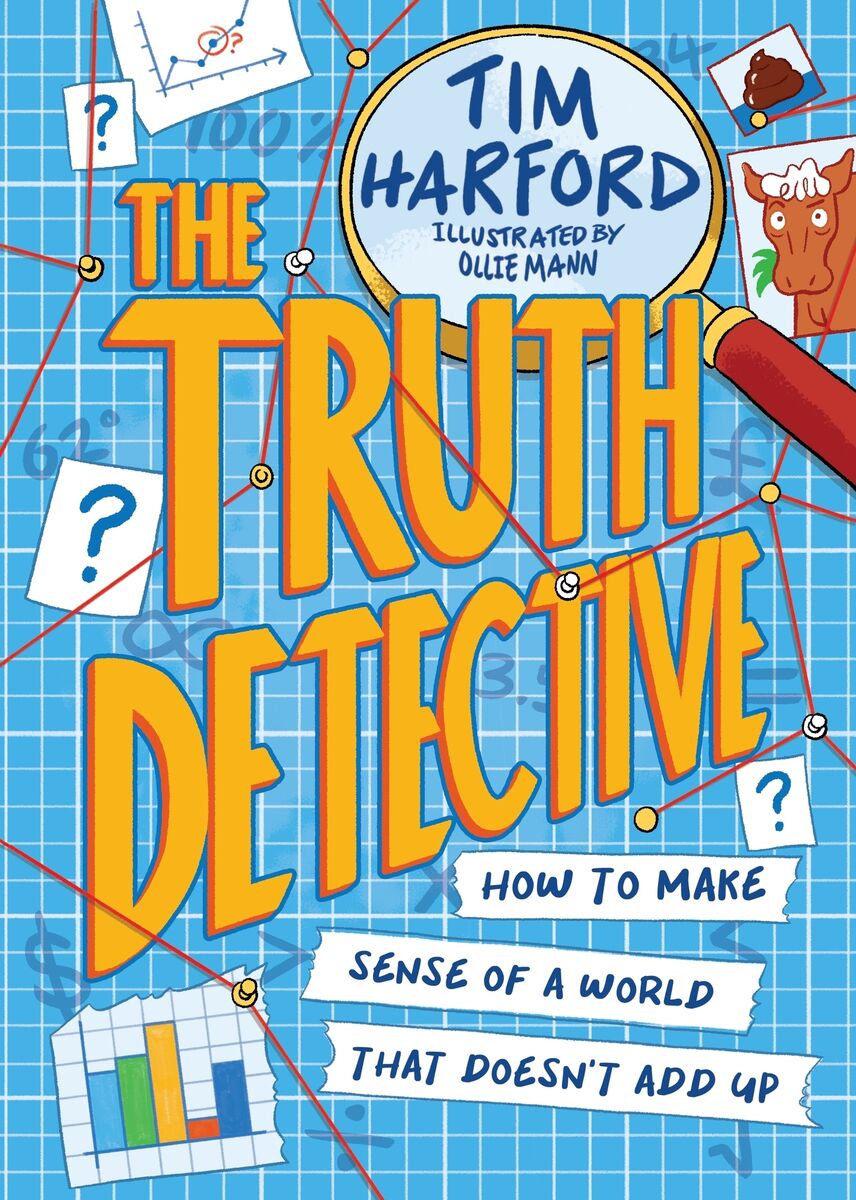
The premise of Tim Harford’s The Truth Detective (Hachette) is that the world is full of bamboozling headlines and numbers that don’t add up. Rising living costs, climate change, fake news and dodgy data make it hard for anyone to get their head around it all.

“The world can be quite confusing for grown-ups, let alone young people,” says Harford, presenter of BBC Radio 4’s More or Less and author of nine books, including The Undercover Economist and How to Make the World Add Up. He wants to give young readers tools to understand the claims they see made around them, for example, on social media or on television.

Sometimes, all the information coming at us can scare us. “So they may say, ‘I’ll just disbelieve everything’ or, ‘I’ll just ignore it’. I want to give children the right attitude — a bit of confidence, curiosity — around truth-finding,” says Harford, who writes and presents the Cautionary Tales podcast (timharford.com/articles/cautionarytales/), starring Helena Bonham Carter and Jeffrey Wright. It has reached 10m downloads.

Harford believes children’s natural curiosity, which comes without baggage, gives them an advantage over adults in finding the truth behind surface claims. “Grown-ups get themselves into tangles,” Harford says. “If there’s a statistic in the headlines, they’ll think, ‘I can use that stat to prove an argument’ or, ‘Wait ‘til I tweet about this’. Adults have lost the ability to ask what’s going on behind the headlines: They act out of biases and agendas.”

And while we’re all allowed to have emotions and political views, Harford says we need to be aware of these and notice how they’re interfering with how we think. “Children don’t have all this baggage. When they see a claim, they can just get on with asking, ‘Why did they say that? What’s going on there? I want to know more about this’. That curiosity is just so powerful.”

Tim Harford
Tim Harford

How to be a truth-finder

Harford, whose TED talks have been viewed more than 11m times, tells children three things they need to be truth-finders:

  • First is data: Numbers. They’re everywhere: Measuring, counting, and influencing our world. Everything is understood through the medium of numbers, he says.

“Think about music: We don’t just get to hear music, there are claims about downloads. We don’t just watch a football match: There’s data on the number of passes completed, peak sprint speed of such-and-such a player. Restaurant menus have calories listed.

“Every claim about the world has numbers all over it. To get to the truth, you have to get comfortable with numbers; data can provide vital clues. I want kids to understand how numbers work and not be afraid of them.”

  • Second, you need to use your brain. Being a good truth detective isn’t about carrying out a complicated mathematical procedure. “You could know loads about maths and yet be carried away by emotion [from seeing the truth]. A lot of it is about being thoughtful, imaginative, and willing to look beyond the obvious.”
  •  Third, and most important of all, is the right attitude.Without that, the smartest people with the deepest knowledge can be very, very wrong.”
Describing himself as “not a maths guy, really”, but someone who has “always been comfortable with numbers”, Harford is an engaging storyteller and uses real and fictional heroes and villains to illustrate points. Darth Vader, he says, is one of the scariest enemies in cinema. “But even the bad guy can give good advice, and Darth Vader [gives] very good advice to Luke Skywalker: ‘Search your feelings.’ Our feelings often determine what we believe and what we refuse to believe.”

And he illustrates this by telling how Sir Arthur Conan Doyle — creator of Sherlock Holmes, “the perfect symbol of brilliant logic” — got caught out. Conan Doyle, says Harford, got a letter from two Yorkshire-based girls. They enclosed a photo of fairies at the bottom of their garden. It showed a nine-year-old girl smiling into the camera, surrounded by four tiny women with wings.

Though Conan Doyle was an expert photographer, those children fooled him into believing in fairies. This happened, says Harford, because the author let his own emotions fool him. “Sir Arthur was feeling sad. His wife had died young. In the great flu of 1918, his brother had died, too. So had his oldest son. He didn’t want these people to be dead. So, what if they weren’t completely dead? What if they lived on in the spirit world, still watching him, perhaps still able to talk, if he could find the right way?

“Missing his wife, brother, and son, Sir Arthur was looking for evidence that there’s more to life than we can see and touch. The fairy photographs were that evidence. Sir Arthur did believe in fairies because he really, really wanted to.”

The Truth Detective
The Truth Detective

The power of understanding data

In encouraging children to be truth-finders, Harford throws out some tantalising questions: Did you know that a toy spaceship can teach you about inflation? (He tells about his own childhood LEGO Galaxy Explorer). Or that a pooping cow can show you how to invest your pocket money?

He gives real-life examples of how understanding data can increase children’s own power: What do you do if your parents think Minecraft is leading you into a life of crime? Or how much pocket money is a lot? And he shows children how to test claims like ‘free chocolate for everyone who clicks on this link’, or ‘the best band in the world are rumoured to be splitting up’.

Harford introduces children to the ‘brain guard’ — a security guard we all have for our brain. “New ideas, stories and facts come along, hoping to be let into your brain, but the brain guard is there, looking them up and down, asking if they fit or not.”

But he warns that our brain guard doesn’t always get it right. He highlights great questions children should want their brain guard to ask:

  • Does this idea make sense?
  • Does this story conflict with something I already know to be true?
  • Does the fact come from a trustworthy source?

And he cautions against other questions:

  • Does the person telling me this fact seem friendly and confident?
  • Do I want this idea to be true?
  • Does this story make me feel something, like fear or joy?
  • Is this a cool story?

“These questions aren’t a great way for a truth detective to solve a case,” he says.

As a child, Harford says he was “pretty nerdy” and loved good picture encyclopaedias. “Guides to the stars, guides to dinosaurs, guides to how to be a spy: That practical information about the world I just loved.”

Father to two teenage girls and a younger boy, he says they each helped in the writing of The Truth Detective. Stella, 18, played one of the book’s characters on stage — “with a wonderful Yorkshire accent” — in a recording for an audio podcast. Herbie, 11, was always on hand with a football analogy to help his father explain something, while he had Africa, 16, “the most mathematical of all the kids”, in mind when writing about the power of curiosity. “She’s so hungry to figure things out, so interested in everything.”

Does he get downhearted that truth today is more at risk than ever before? Not really. “It’s very easy to put yourself in a bubble where all you ever see is people who agree with you.

“But it’s also very easy today to find out the hidden truth behind every story. There are brilliant explanations, amazing science shows on You Tube, experts available on blogs. That’s why I emphasise having a curious spirit.”

His book, he says, is not about how to understand numbers. Rather, it’s about how to understand the world. “Being smart and savvy about numbers helps you be smart and savvy about everything.”

  • ‘The Truth Detective’, illustrated by Ollie Mann and written by Tim Harford, costs €14. 

x

More in this section

Cookie Policy Privacy Policy Brand Safety FAQ Help Contact Us Terms and Conditions

© Examiner Echo Group Limited