Sky Matters: Universe still challenges as we get to know it
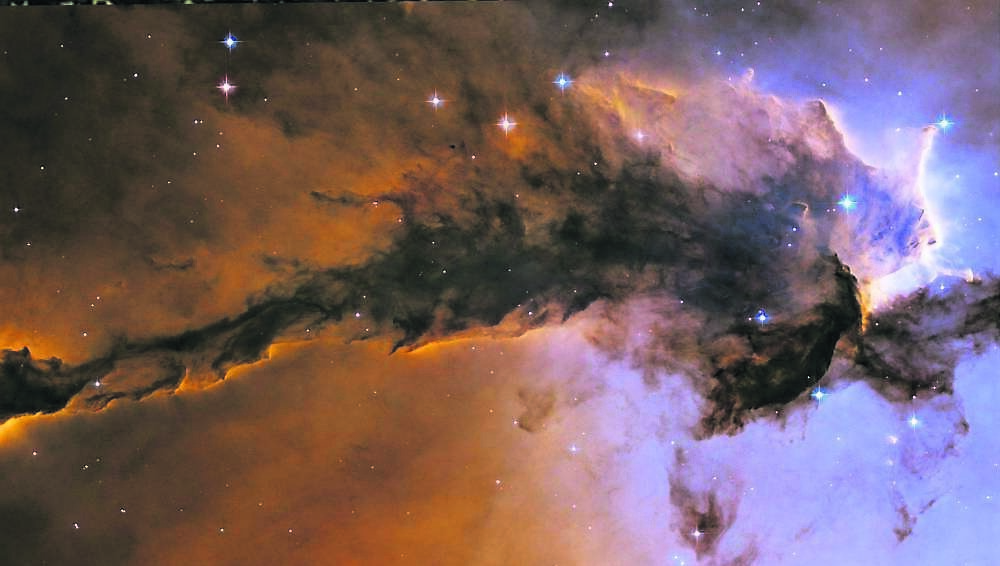
A stellar spire in the Eagle Nebula. One new theory which is gaining some traction suggests the Universe is actually 27 billion years old. That’s twice as old as we thought until recently. Picture: NASA/PA Wire
One of the greatest joys of working in the field of astronomy is how frequently it challenges our understanding of the Universe. On reflection, this is perhaps not surprising. It was, after all, only 105 years ago that we started to get any reasonable idea of how big or old the universe might actually be thanks to the work led by astronomer Edwin Hubble. Imagine that – for millennia, learned people sat around in architecturally breath-taking fora, philosophising about the world around them. The brightest minds of the day argued back-and-forth with vigour and certainty (and no little arrogance, perhaps). But until the early 20th century it was largely conjecture, devoid of the data necessary to establish a consensus.
Roll the clock forward to the 1990’s and thanks to new telescopes, new theories (including those of the likes of Albert Einstein) and a gargantuan scientific effort, astronomers started to home in on estimates of the size and age of the universe. The cosmos, it seemed, is 13.8 billion years old, give or take, starting in a Big Bang and expanding ever since. When the Universe was young that expansion was very fast. As the Universe aged that expansion slowed, but then as it got even older that expansion speeded up again. The data seemed clear. We live in a complex, perhaps bizarre Universe.
Roll the clock further forward to the 2020’s and cracks in our understanding of the most fundamental elements of the Universe have started to open up. For example, with the launch of the James Webb Space Telescope in 2021, astronomers could take images of the most distant galaxies ever seen. Distant galaxies mean galaxies that were formed soon after the Universe came into being. But the problem is – these galaxies shouldn’t exist according to our theories. The Universe, when it was very young, should have been too violent a place to allow for galaxies to form. Add to that observations which suggest some stars are older than the universe, and somewhere there’s a problem with our understanding.
One new theory which is gaining some traction suggests the Universe is actually 27 billion years old. That’s twice as old as we thought until recently. The same theory piggybacks on previous theories by some of the great theoretical and observational astronomers of the 1920’s and 1930’s. It’s intriguing to think that we might be at the start of something quite extraordinary in how we view our Universe.
Why does this matter? A more accurate theory of the formation of the Universe also has implications for how the Universe will appear in the future. Might it expand forever; might it collapse back on itself? Is this the first time our universe has existed or did it exist before, and if so what might it have looked like in that earlier incarnation? Was the physics and chemistry at the birth of the universe the same as that which we see all around us today?
While mulling over these fascinating questions, we should not despair that we live in a universe which is beyond our understanding. We can in fact be confident that we do understand much about how the universe works. We know that on 20th March the Sun will appear to be directly overhead of Earth’s equator and the night and day will be of equal length. This is the Spring Equinox. We can predict that the Moon and Jupiter will appear close on March 26th and 27th, while the Moon will pass in front of the bright star Regulus on March 29th. And on grander scales we can be confident that neither the Sun nor the stars will disappear during March (or indeed for a long time to come, at least for most}!
It’s apparent that our Universe is slowing revealing some of its secrets. But thinking we truly understand it yet – well, that would be plain foolish and much less fun!