Albatrosses — creatures of the wind that scarcely need to flap their wings
Doldrums are what happen when the wind 'withdraws its services'... and scientists are learning more about them using data collected from buoys in the Atlantic 
Albatrosses — creatures of the wind that scarcely need to flap their wings

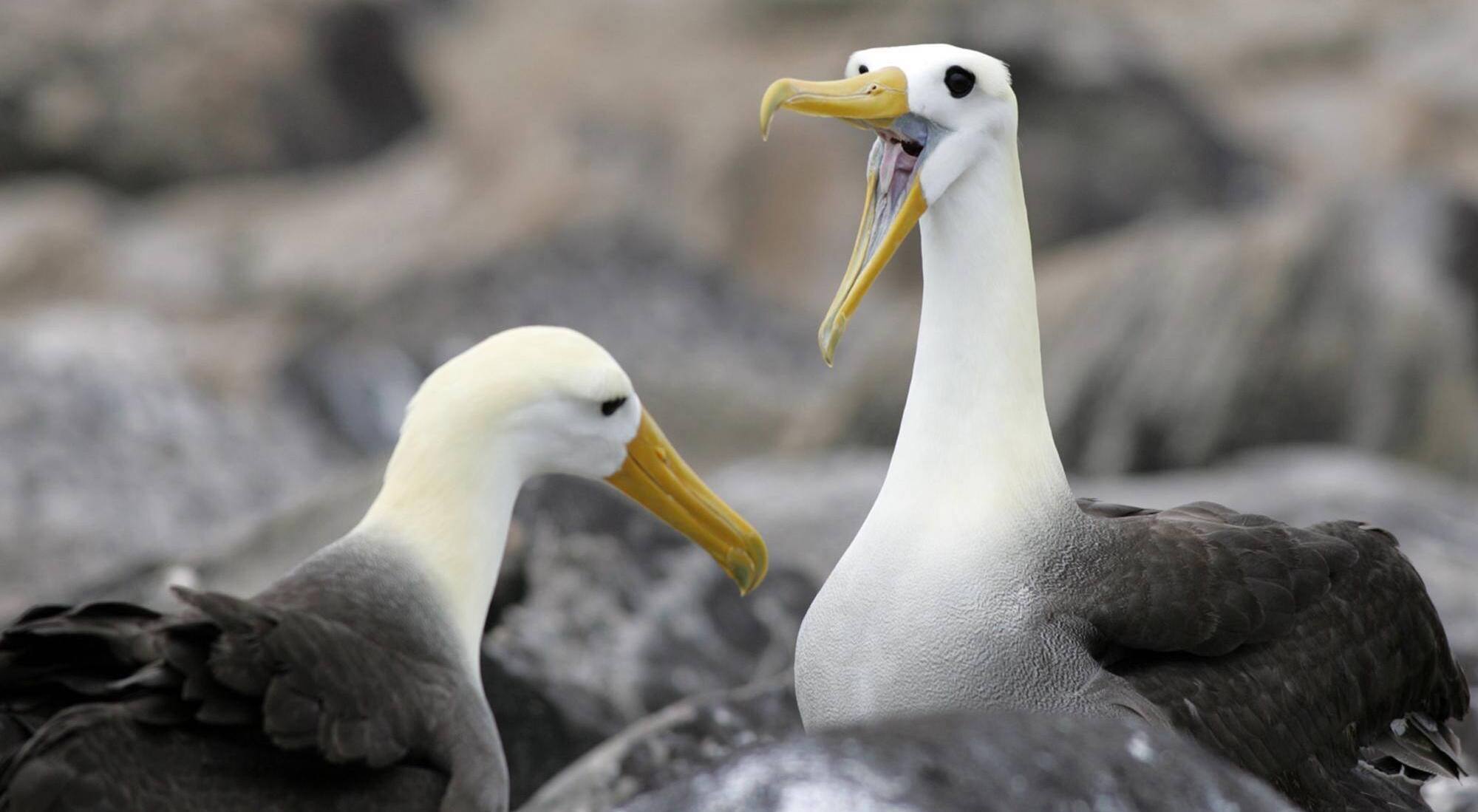
Two Waved Albatross in the Galapagos Islands. Picture: AP Photo/Simon Stirrup

In Coleridge’s Rime of the Ancient Mariner, an albatross befriends the ship’s crew. "And every day for food or play, it came to the mariner’s hollo". But the bond between man and bird is cruelly betrayed. "With my cross bow", confesses the sailor, "I shot the albatross". Retribution follows the mindless act, with a punishment that fits the crime.

Albatrosses, great ocean wanderers, are creatures of the wind. Exploiting the air pushed upwards by the waves as they roll by, these giants scarcely need to flap their wings. But the sailors also depend on winds for their survival. The winds withdraw their services and the ship becomes trapped in ‘the doldrums, "as idle as a painted ship upon a painted ocean".

A grey headed albatross. Albatrosses regularly make epic round-the-world flights when they are not busy breeding. One bird tracked by researchers took just 46 days to travel a minimum distance of 22,000 kilometres. Picture: British Antarctic Survey/PA

‘Doldrums’, a nautical term, is said to be a fusion of ‘dull’ and ‘tantrums’. In the days of sail, becalming was the seaman’s worst nightmare — a vessel could be trapped motionless for weeks. Food would be rationed. Water supplies dwindled. "Water water everywhere and all the boards did shrink. Water water everywhere, nor any drop to drink".

Horses were transported during colonial times. To save water, the unfortunate animals were thrown overboard to drown in what became known as the ‘horse latitudes’. Irish waters are seldom calm for long, so we can hardly envisage what being trapped in the doldrums must have been like.

But why are some other regions of the ocean prone to these prolonged calms? Atmospheric scientists thought they knew. In the Age of Sail, a ship’s captain would follow what were known as the ‘trade winds’. These tended to blow from the northeast in the Northern hemisphere and from the southeast below the equator. The winds met each other in the ‘Intertropical Convergence Zone’, where the air was forced vertically upwards, leaving a windless ‘bubble’ at the surface.

But an atmospheric scientist, appropriately named Julia Windmiller, is not convinced. Working at the Max Planck Institute for Meteorology, she examined data collected from buoys in the Atlantic between 2001 and 2021 and wind-speed data recorded at the fringes of the Convergence Zone. It is not rising air masses which are responsible to the doldrums, she claims. If air were rising upwards from the surface, the air would be moist and rainy. Conditions in the doldrums, however, are notoriously dry. Descending air is moisture-free. 

She says: "Most of the air inside the Convergence Zone is actually going down rather than up." When the winds meet, air sinks downwards towards the sea surface and diverges in a zone extending north and south of the equator.

A Laysan Albatross with her newly hatched chick. Picture: John Klavitter/US Fish and Wildlife Service

Coleridge’s description of the doldrums, as rainless lethal deserts resembling their sandy equivalents, is accurate. His account of albatross behaviour is also spot-on. I remember watching these giants wheeling close to our ship in the Pacific. The crew didn’t offer them food, as Coleridge’s mariners did, but they expected to avail of waste food thrown overboard. Albatrosses, nesting on the Galapagos, allowed us to approach. These are tolerant birds.

"He prayeth best, who loveth best, all things both great and small."

x

More in this section

Revoiced

Newsletter

Sign up to the best reads of the week from irishexaminer.com selected just for you.

Cookie Policy Privacy Policy Brand Safety FAQ Help Contact Us Terms and Conditions

© Examiner Echo Group Limited