Islands of Ireland: Nature endures — even on this storm-battered Galway island
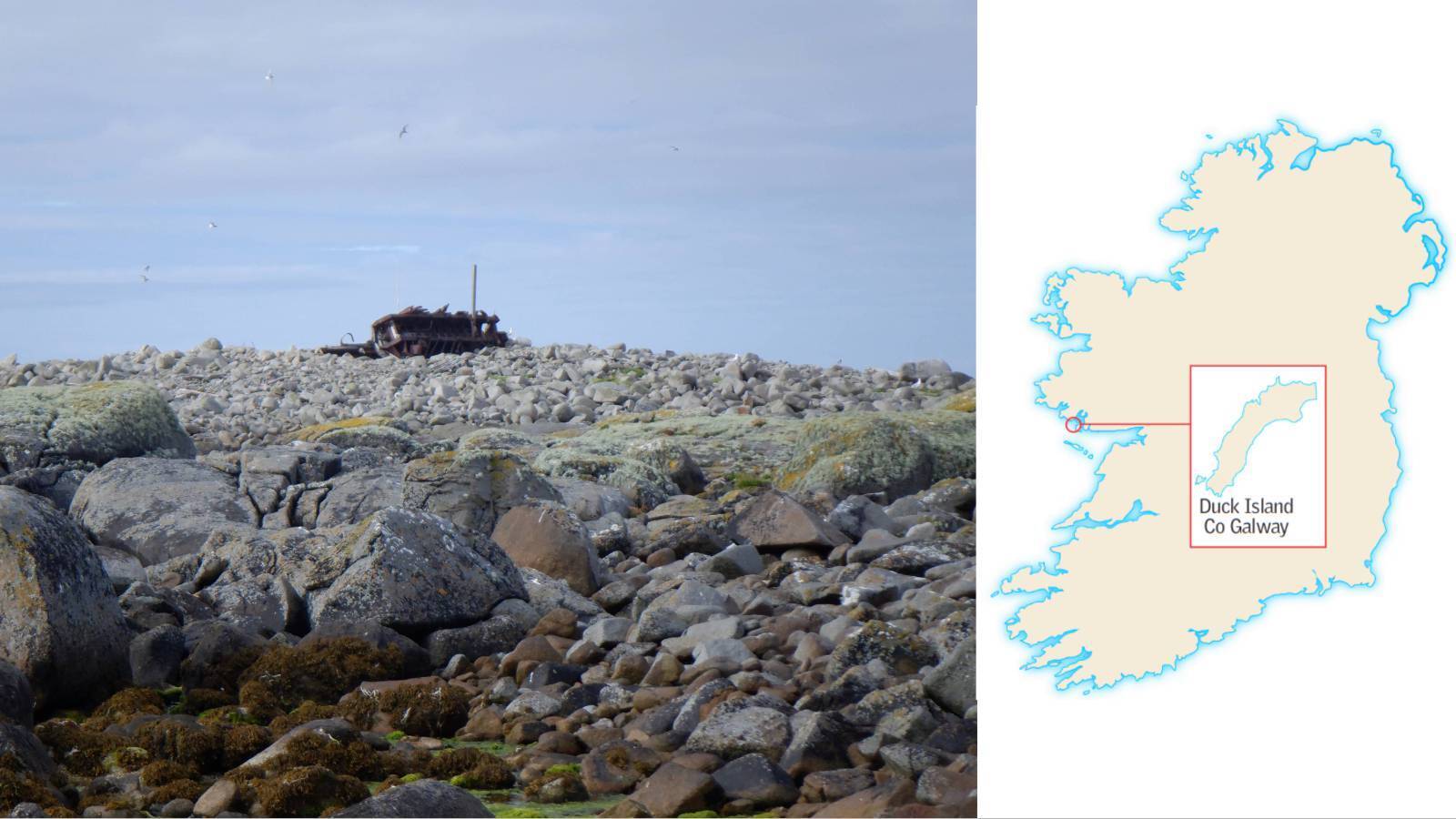
Splashes of vivid orange lichen on the rocks contrast with the deep green and white of the seething sea
Islands of Ireland: Nature endures — even on this storm-battered Galway island

The wreck of the St Oliver on Duck Island, County Galway. The boat sank in 2004 with the loss of four lives. Picture: Dan MacCarthy

Apart from the shrill cries of oystercatchers, the standout feature on this extremely flat and treeless island is the wreck of a fishing boat. Stuck fast above the tideline it is a macabre memorial to the fishing tragedy that befell the community of Connemara in 2004. The wreck of the St Oliver is a reminder of the mercilessness of the sea.

Duck Island lies between the formerly populated islands of Mason and Feenish and adjacent to the always uninhabited Inishmuskerry.

There are several dangerous reefs around the island which generations of fishermen carefully avoided. Nobody ever lived on Duck Island (Oileán Lachan) and there are no man-made structures of current, historic, or pre-historic vintage. There is not even a holy well — and these are often to be found along the coast in southern Connemara.

It lies 500m south of Mweenish Island which is tethered to the mainland by a few short causeways. It is a mere scrap of an island characterised by a rubble-strewn strand and a brackish pond. It is a haven for multiple species of bird including several gull-types and the aforementioned oystercatchers. Indeed, the writer and cartographer Tim Robinson reported a ternery a few decades ago in its northern half and advised people to stay away from the island in June as the birds were hatching then. He also identified a profusion of sea beet which until then had not been recorded in southern Connemara. So, even on an island battered by storms and virtually empty of flora, nature somehow endures.

Splashes of vivid orange lichen on the rocks contrast with the deep green and white of the seething sea. There is a scant covering of grass and the island is bereft of flowers. And though it is so close to Mweenish, the relative shelter of the latter’s bay provides no foretaste for the often turbulent seas of the west coast where no outlying islands disturb the Atlantic breakers.

Duck Island was the location of a fishing tragedy in 2004 when the St Oliver was overwhelmed in high seas and four men drowned: John Dirrane, Michael Faherty, Joseph Connolly and Michael Mullen. The Marine Casualty Investigation Board was not able to pinpoint the reason for the disaster but gave the opinion that the boat’s crew may have been caught unawares in very high seas.

There have been many poems and songs written about seafaring disasters in Ireland, many of them unpublished and surviving only in local areas. The poem written about the tragedy at Duck Island by Aran islander Stiofán Ó Direáin (Stephen Dirrane) is a haunting reminder of the dangers of the sea as well as an homage to the men who died. Two of the men who died were neighbours of Ó Direáin: John Dirrane and Michael Faherty.

As Ó Direáin is an oral poet there is no text available for ‘Lament for the St Oliver’, but you can hear him read it in Irish here. This is a rough translation:

“Sadness and sadness/ Grief and disappointment/ Breaks my heart I heard the cursed music of the fairies/ From the harbour of the two yellow kings Light of the moon in the big western harbour/ The screeching of the sea On the western blowhole/ Our very best neighbour died tonight After the tears, his spirit came amongst us/ And the Twelve Bens shed tears tonight.”

Ó Direáin’s lament recalls a poem by Richard Murphy on the Cleggan Disaster of 1927. Murphy’s poignant work commemorates the drowning of 45 fishermen in Co Galway in 1927 when a severe storm struck unexpectedly.

“A storm began to march, the shrill wind piping/ And thunder exploding while the lightning flaked/ In willow cascades, and the bayonets of hail/ Flashed over craters and hillocks of water. / All the boats were trapped.”

This Duck Island is not to be confused with another not far away at Slyne Head.

How to get there: No ferry. Kayak from a beach south of the townland of Ardmore which is 3km east of Carna.

Other: 'High Island: New and Selected Poems’, Richard Murphy, Harper & Row

x

More in this section

Revoiced

Newsletter

Sign up to the best reads of the week from irishexaminer.com selected just for you.

Cookie Policy Privacy Policy Brand Safety FAQ Help Contact Us Terms and Conditions

© Examiner Echo Group Limited