Islands of Ireland: Westmeath's Hare Island has had royal and Nobel visitors — as well as Vikings and holy guests
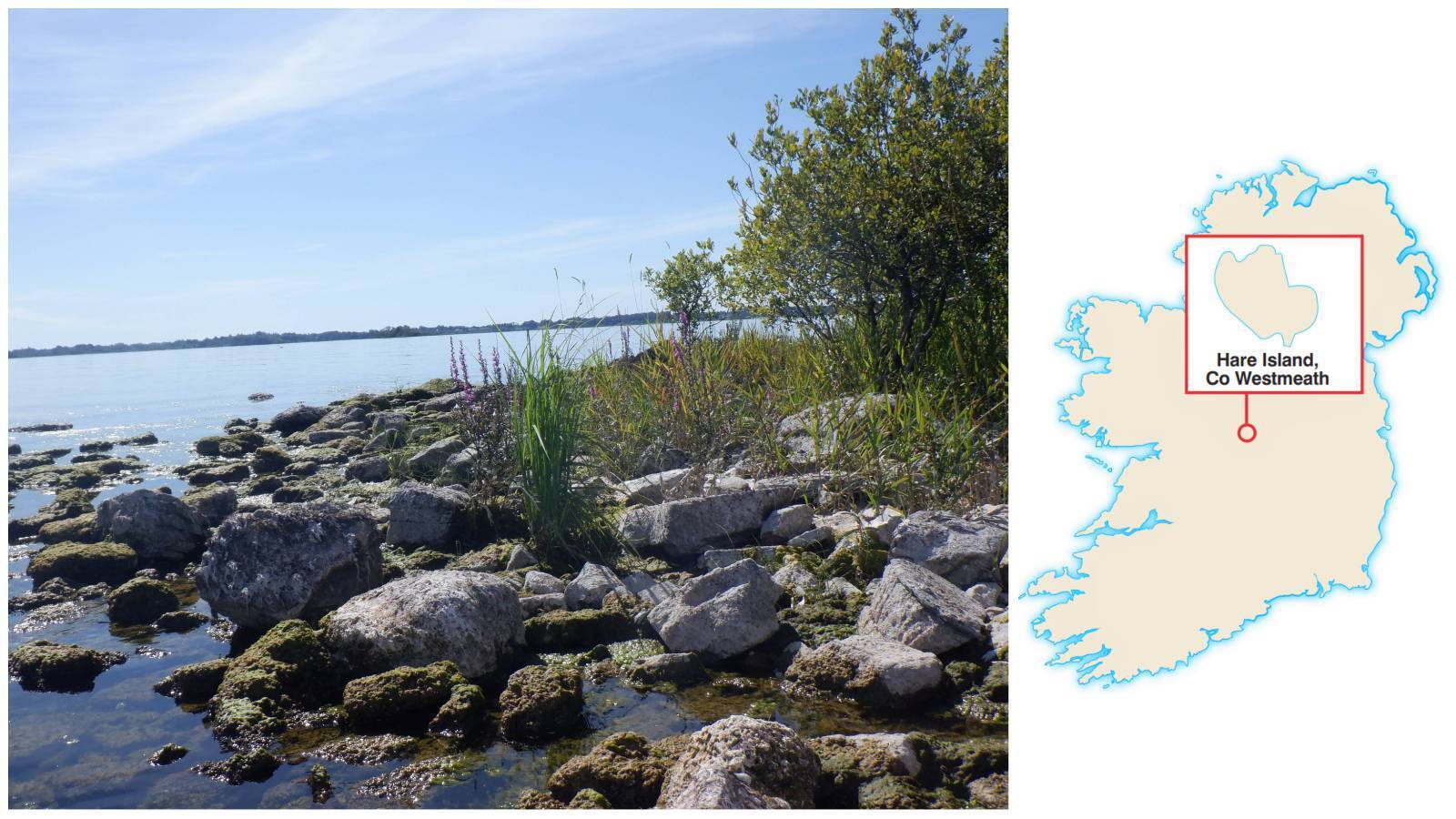
The island was once home to aristocrat-owned hunting lodges but these are now crumbling ruins with trees growing through the roofs and briars and vines choking the masonry
Islands of Ireland: Westmeath's Hare Island has had royal and Nobel visitors — as well as Vikings and holy guests

Islands of Ireland: Westmeath's Hare Island is in the lower reaches of Lough Ree, just north of Athlone

This is a first visit to County Westmeath for this column and features the discovery of an island with a fascinating past. It is very overgrown now save for a small meadow in its centre, but Hare Island, or Inis Aingin, in County Westmeath was once a hive of activity with pleasure craft and hunters availing of its usually benign nature to connect with nature. It is densely forested now with multiple native species evident.

Lough Ree is divided between counties Westmeath, Longford and Roscommon with an invisible border running lengthways, and also at its mid-point, running east. In the lower reaches of the lough, just north of Athlone, the heavily wooded Hare Island can be found. So appealing have its shores been that it can boast of antique links (a huge Viking hoard was found there), several church ruins, and 19th-century hunting lodges that appealed to the aristocratic class, seemingly oblivious to the hardships of the local people.


It is one of the largest islands on Lough Ree and by far the largest in the southern part of the lough. Its neighbours including the islands of Crow, Bean, and Yellow could collectively be packed into one of Hare’s quirkily-named harbours: Hexagon, Oldhouse, or Lords. Access to the island from the mainland at Coosan Point is via a very short boat ride.

These harbour names date from the early 1800s when Hare was used as a hunting lodge. There was a complex of four houses towards the western end which attracted well-to-do hunters for weekend forays into the wilds of Lough Ree. Today, these are crumbling ruins with trees growing through the roofs and briars and vines choking the masonry. An echo of another world.

Hare Island on Lough Ree, Co Westmeath. Picture: Dan MacCarthy

The island was in the possession of the Handcock family when William of that name was created Lord Castlemaine in the early 19th century. The Handcock’s seat of power was Moydrum Castle just outside Athlone — now a crumbling ruin. In tandem with the once magnificent castle, the hunting lodge was commissioned and guests entertained on shooting and fishing parties. Guests included royalty in the form of a cousin of Queen Victoria, Prince George of Cambridge. Castlemaine sold his estate, but not the island, to the State in 1921. By around the 18th century, the island was lived on by the Duffy family who appear to have worked for the various owners of the island over the years. Later, they occupied the farmhouse adjacent to the lodge and farmed on its 110 acres. They continued the tradition of hosting guests drawn to the charms of Lough Ree, and Hare Island in particular.

Nobel prize winner Sean MacBride, son of Maud Gonne (inspiration to WB Yeats) and John MacBride (executed for his role in the 1916 Rising), was one of the best-known visitors there in the 1950s. He returned for several years. And the German novelist Heinrich Boll, more famous for his connection to Achill Island, also stayed in the 1950s. The second Nobel prizewinner to stay on Hare (Boll for Literature, MacBride for Peace) frequently travelled with his mercurial friend, the photographer Georg Fleischmann, who was a former internee at the Curragh Camp in County Kildare after his Luftwaffe plane had crashed.

Boll encountered something of the historic aristocratic flavour in the form of a retired English colonel who brought them over in his boat. “With his long red hair, pointed red beard, he looked like a mixture between Robinson Crusoe and Mephistopheles,” Boll is quoted in a book by German author, Gisela Holfter.

One of Boll’s reasons to visit the island was to film one of the elderly members of the Duffy family, an old man with grey hair, and record his stories.

The island’s sixth church was dedicated to St Ciarán who went on to found the monastery at Clonmacnoise in County Offaly after his time on Hare. The monasteries on the Shannon were repeatedly raided by the Vikings and Hare was no exception. Ciarán’s church was largely destroyed and replaced/ rebuilt by a 12th-century Augustinian structure the remains of which are still standing.

How to get there: No ferries. Island is privately owned.

Other: askaboutireland.ie

x

More in this section

Revoiced

Newsletter

Sign up to the best reads of the week from irishexaminer.com selected just for you.

Cookie Policy Privacy Policy Brand Safety FAQ Help Contact Us Terms and Conditions

© Examiner Echo Group Limited