Richard Collins: What caused a millennium-long cold spell 12,000 years ago?
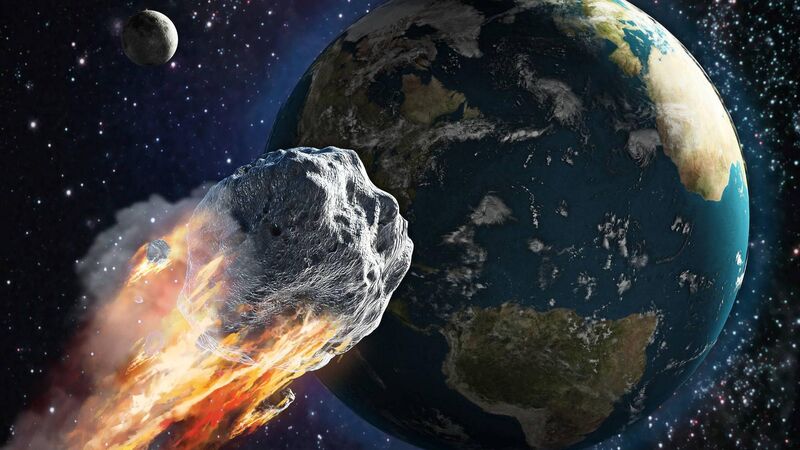
One candidate explanation is that an asteroid strike led to a ‘global winter’. However, no evidence of such an event has been found. Picture: iStock
According to Patrick Joyce’s (1911), ‘Nahanagan’ comes from ‘Loch na n-Onchon’, meaning ‘the lake of the otters’. This large pond in County Wicklow, however, is less famous for otters than for evidence, found there, of a strange climate change episode.
The great ice mass covering Europe began to thaw 22,000 years ago. Ten millennia later, as temperatures approached today’s, a new cold spell set in. The great reversal, known in Ireland as the ‘Nahanagan Stadial’, and in Scotland as the ‘Loch Lomond Stadial’, is also called the ‘Younger Dryas’. Leaves of Dryas octopetala, the mountain aven, were found in deposits from that time. The cold period lasted 1,000 years.
The causes of the temperature change have been much debated. One candidate explanation is that an asteroid strike led to a ‘global winter’. However, no evidence of such an event has been found, but, supporters of the theory argued, it might lie buried under the polar ice cap.
The Danish explorer, Lauge Koch, led 24 expeditions to Greenland, the world’s largest island. In 1922, he surveyed a glacier, located at the country’s north-western tip, called after the native-American chieftain Hiawatha. Koch noted that the glacier’s ‘tongue’ extended under a local lake. In 2018, a huge crater was discovered there.
Buried under a kilometre-thick mass of ice, the crater has a diameter of 31km. Analysis of rock samples and debris from the site, indicated that a metallic asteroid, with a diameter of 1.5km and a volume of about 20 cubic km, had struck the area.
Only two dozen or so impact craters of this size have been discovered on Earth. The Hiawatha object was about one-eighth the size of the one which eliminated 80% of the world’s animal species, including the dinosaurs, 66 million years ago.
Although the Hiawatha impact did not cause as much mayhem, its effect must have been catastrophic. Could it be the missing link supporting the ‘Younger Dryas Impact Hypothesis’?
To cause climate reversal, the asteroid must have struck around 12,900 years ago. It is exceedingly difficult to date objects buried deeply under the Greenland ice-mass, but scientists in Denmark and Sweden have managed to do so.
In a paper just published, they describe two independent dating methods used. One involved uranium and lead isotope analyses of pebbles carried downstream by glacial meltwater. The other used lasers to release, for examination, samples of the inert gas argon trapped in glacial sand.
The results of both the analyses agreed; the Hiawatha crater turned out to be much older than expected. The asteroid, which produced it, arrived around 58 million years ago.
This finding does not rule out the possibility that another, as yet undiscovered, meteorite strike was responsible for the Nahanagan Stadial, but the Hiawatha asteroid is no longer a suspect.
Alteration in ocean currents, resulting from polar icecap meltwater, offers a more plausible explanation of the ancient temperature reversal. The great ocean ‘conveyor belt’, which brings warm water northwards in the Atlantic, appears to be slowing down.
An anarchic thought; would another Nahanagan event help prevent our current climate disaster?
- Gavin Kenny et al. A late Palaeocene Age for Greenland’s Hiawatha Impact Structure. . 2022.


CLIMATE & SUSTAINABILITY HUB
CONNECT WITH US TODAY



Be the first to know the latest news and updates