Richard Collins: Are fish part of the exclusive self-consciousness club?
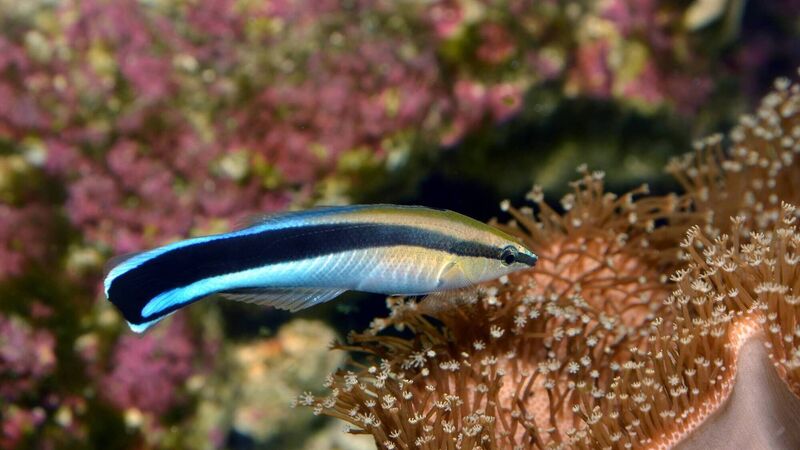
A team placed marks on the throats of captive cleaner fish. On seeing themselves in mirrors, three out of the four of the fish began rubbing their throats against rough surfaces. Picture: iStock
A paper published in 2017 caused a stir. Its authors argued that some fish are self-aware, an unlikely claim as only humans and chimpanzees are fully accredited members of the exclusive self-consciousness club.
There is evidence, however, that other great apes, dolphins, elephants and crows are also worthy of inclusion. While some experts accept that these creatures meet the club’s strict entry requirements and deserve at least associate membership, others don’t. The suggestion that a mere fish should be admitted was too much for them to stomach.
The Mirror Self-Recognition test (MSR) was invented by the American psychologist Gordon Gallup in 1971. If, on seeing your image in a mirror, you notice a smudge on your face, you will investigate it. An animal responding similarly, Gallup argued, must also be self-aware; it knows that the image is its own.
When chimps with Tippex-style marks on their foreheads saw themselves in mirrors, they investigated the marks, thus passing the MSR test. Chimps, clearly, are aware of their own existence and mental states.
A team, led by Masanori Kohda of Osaka City University, placed marks on the throats of captive cleaner fish. On seeing themselves in mirrors, three out of the four of the fish began rubbing their throats against rough surfaces, apparently trying to remove the marks. Kohda claimed that, in doing so, they had passed the MSR test and that they are, therefore, self-aware.
Living in tropical coral seas, these fish remove skin parasites from the bodies of larger fish and eat them. The creatures they harvest from their hosts’ bodies in the wild are brown. The marks used in the experiment were brown. When green or blue marks are used instead of brown ones, the fish ignore them.
Only brown marks elicit the scraping response. Responding to seeing a brown mark was a natural response to what appeared to be food. Reacting to seeing it did not require that a fish be self-aware, but spotting that the mark was on a fish’s own body did.
Critics, however, were not satisfied. Marks on throats, they argued, might cause discomfort. Were the fish rubbing themselves against surfaces to obtain relief? It was not necessarily a response to seeing their images in mirrors. In any case, too few fish had been tested in the experiments to merit such an exalted conclusion.
In a new paper, just published, Kohda and his colleagues try to meet these criticisms. They have increased their sample sizes and refined the marking regime. In their original experiments, marks were injected to 1mm beneath the skin of the fish being tested.
Increasing the depth to 3mm rendered the marks almost invisible and the fish with 3mm-deep marks, they found, responded less frequently to their reflections. This suggests that the sight of the marks in mirrors, and not discomfort, triggers the response. Nor do cleaner fish react to seeing similarly-marked individuals.
It seems that these riff-raff cleaner fish will have to be admitted to our snooty self-consciousness club after all. Is nothing sacred?
- Masanori Kohda et al. Further Evidence for the Capacity of Mirror self-recognition in Cleaner-fish and the Significance of Ecologically relevant Marks. PLOS Biology. 2022.
CONNECT WITH US TODAY



Be the first to know the latest news and updates