How the power of self-belief can help when you start to doubt your abilities and skills

Dr Shadé Zahrai
Have you ever stayed quiet in a meeting despite having something to say? Stepped back from an opportunity because you doubted your abilities and skills? Or overthought things, replaying events in your mind and ruminating over what you should have done differently?
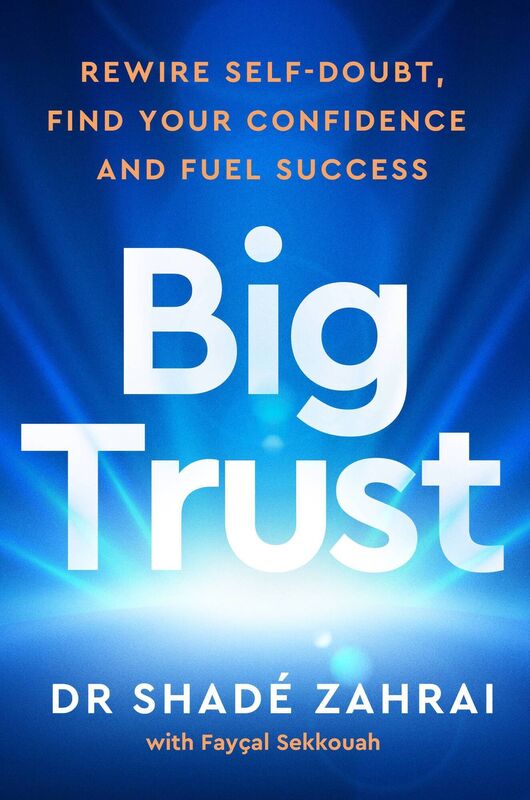
Dr Shadé Zahrai used to do all those things. The ex-lawyer and former banker is now a behavioural researcher and leadership strategist. She coaches senior staff at companies like Microsoft. She spent five years researching self-doubt and recently co-authored a book called
The book explores self-doubt and its impact on personal and professional growth. It also contains evidence-based techniques to challenge self-doubt and transform it into self-trust, one small step at a time.
Zahrai says: “It’s basically a book for people who are like I once was: People who know they are capable, but who constantly find themselves second-guessing themselves.”
Zahrai grew up believing she had to “be perfect in order to be lovable”. This belief caused her huge anxiety when she started working in commercial law.
“I’d hide in my cubicle rather than admit I didn’t know something,” she says.
Her self-doubt caused her so much stress that she left law. “I learned to fake it in banking,” she says. “From the outside, it looked like I was confidently achieving, but, deep down, I was eating myself alive. I’d tried to reinvent myself, but doubt clung on.”
Over time, she realised she wasn’t the only one feeling this way. “People from entry level to CEOs did,” she says. “I developed an obsession with why. Self-doubt became the subject of my PhD and everything I’ve learned is now in my book.”
The book acknowledges that doubt can be positive, that “it’s the brain protecting us from risk and rejection by keeping us alert to the world around us”.
However, too much can be paralysing and prevent us from moving forward.
Zahrai’s research led her to develop a four-pillar framework to define doubt: Acceptance, agency, autonomy, and adaptability.
All four attributes combine to form our doubt profile. The book has a 12-question diagnostic tool to help us identify our own personal profile. It consists of statements such as, ‘I often feel inadequate compared to others’ and readers rate themselves on the extent to which they agree or disagree with these statements.
Each attribute can be ranked as a superpower: An area where you’re generally confident and assured; so-so; a hindrance; or what Zahrai calls “a red alert zone, where self-doubt takes up so much space that your ability to make choices, relationships, and emotional state are affected”.
I was deflated to learn that my acceptance, agency, and autonomy scores landed in the so-so zone, and adaptability was a hindrance.
But Zahrai reassured me that we all have the power to “break doubt’s grip by developing healthier habits”.
The bulk of her book is devoted to techniques for doing just that. Here are three I have adopted.
The first takes on my inner critic. Zahrai’s research has unearthed not one, but four archetypes.
“There’s the classic judge who constantly evaluates your performance, telling you you’re not good enough,” she says.
“The misguided protector tries to shield you from embarrassment, rejection, or failure by urging you to play it safe. The ringmaster drives you on to do more, earn more, and be more productive. And the neglecter makes you chase approval by prioritising everyone else’s needs above your own.”
The key to defeating these inner critics is understanding that “even though they sound and feel like you, these voices are not you”, says Zahrai. “Step back, identify who is speaking, and then say something like: ‘OK, misguided protector. I see you. I know what you’re trying to do. Thank you, but no thanks’. When you psychologically separate from your thoughts, you can choose to let them go.”
The second technique involves replacing doubt with “growth-oriented statements”. An example is replacing the words ‘I have no idea what I’m doing’ with ‘I’m in the process of figuring things out’.
“Or try growth mindset expert Carol Dweck’s strategy of adding ‘yet’ to the end of your doubt,” says Zahrai. “I’m not confident speaking up ‘yet’ implies you believe you can improve with time.”
The third technique relates to adaptability, the area where I scored lowest. Zahrai says that working with emotion is key to mastering self-doubt. Rather than automatically responding to our feelings, we should see them as “data: Not good, not bad, just information that needs decoding”.
A 2007 study found that naming unpleasant emotions reduced activity in the amygdala, the brain’s alarm system.
“Naming an emotion creates space between you and it, giving you time to question whether it is serving you, and what you should do next,” she says. “Maybe you’re feeling anxious because there’s a real risk and you can take action to minimise that risk. But maybe you’re feeling anxious for no real reason. In that case, a few deep breaths might help.
“Taking a moment to name your emotion engages the prefrontal parts of the brain that control rational thinking, so that you can respond to emotions thoughtfully, not reactively.”
Zahrai’s book serves as an antidote to the times we live in, when social media encourages us to compare our lives to the curated versions we see online.
“We end up feeling inferior, which magnifies self-doubt,” says Zahrai. “I hope my book shifts the focus back to our capacity for growth.
“Rather than trying to eliminate doubt, which is impossible, we can, instead, feel the doubt and decide what to do with it. Doubt will always show up, but it doesn’t have to run the show.
“Our minds can learn to handle it more effectively, so that we can back ourselves in the moments that matter.”


CONNECT WITH US TODAY



Be the first to know the latest news and updates