Cancer care is all in a day’s work for CUH team
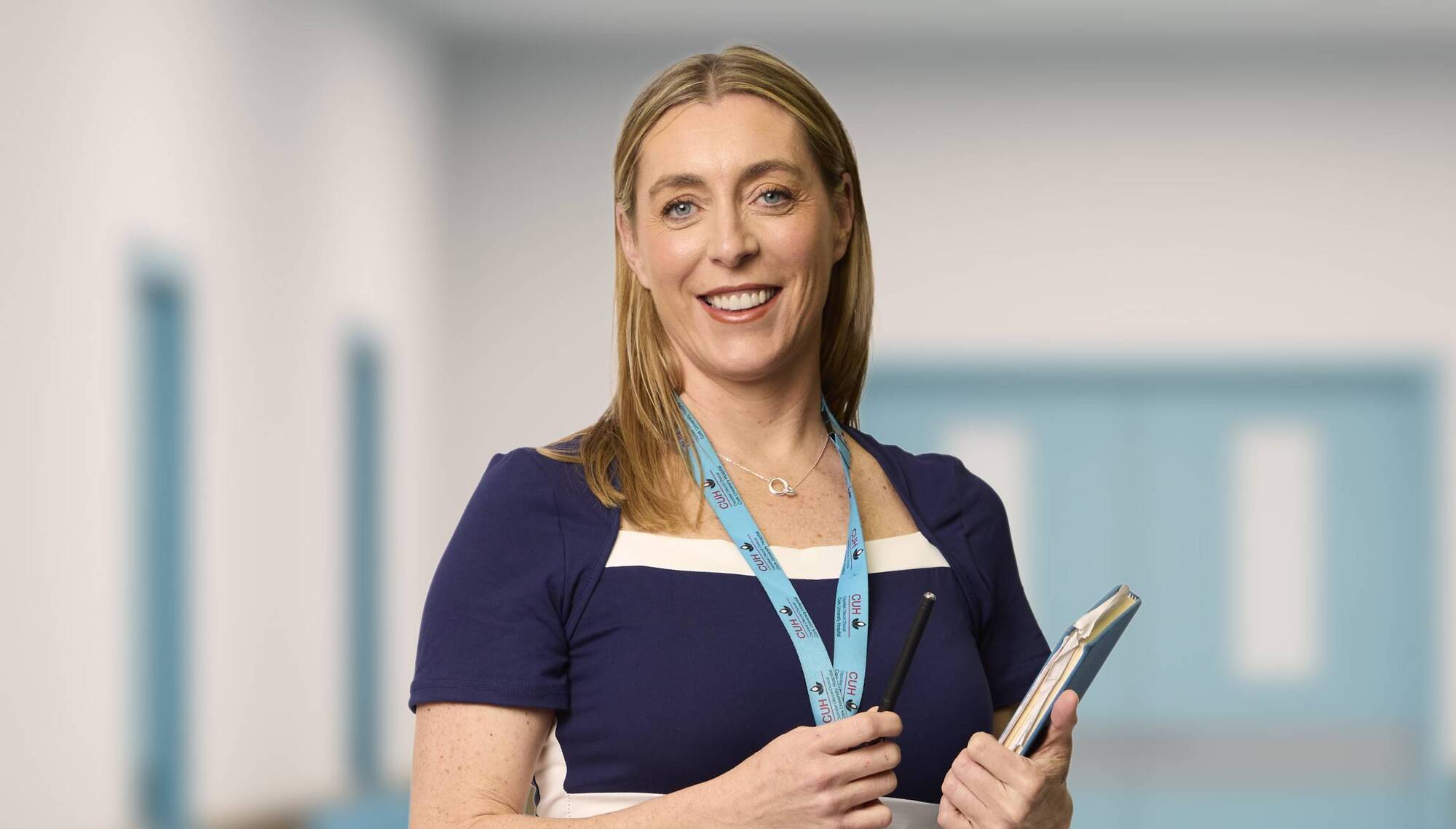
Dr Dearbhaile Collins, CUH
Sue from Ballylanders, Co Limerick, has stage four ovarian cancer. The 64-year-old is attending Cork University Hospital (CUH) for chemotherapy. It’s her second time being diagnosed with the disease.
Consultant Dearbhaile Collins, the clinical director of cancer services and consultant medical oncologist, has identified a new drug that could potentially help.
Sue’s story is just one of those featured in the RTÉ series — a six-part series that takes viewers inside the walls of CUH, where cameras chart the daily and nightly shifts of those who work there.
Collins, who appears in episodes two and five of the series, oversees a multidisciplinary team at CUH that manages cancer care such as haematology, radiation oncology, psychosocial oncology, and palliative care.
She is also responsible for setting up and delivering new services and initiatives, including expanding cancer therapies delivered at the hospital, in line with Sláintecare, and expanding community-delivered services that would allow cancer patients to receive care closer to their homes.
Over Zoom, we discuss her involvement in and the themes of loss, heartbreak, and joy the series explores.
“I have two stories in the series involving two of my patients [Tim and Sue]. Two very different stories, both cancer stories,” she says.
She hopes the series conveys to viewers the complexity and scale of the hospital and the team of people it takes to treat each patient who walks through its doors.
“When a patient comes in here, I don’t think they realise that there are dozens of staff involved in their care from start to finish — multidisciplinary team meetings about their care, deciding the best pathway, what’s possible, what’s not, trying to improve their outcome, [for example] trying to get a cure for cancer, trying to prevent or minimise the effects of stroke,” she says.
She describes the high level of engagement and professional relationships among hospital staff. “I truly believe we deliver incredible patient-centred care.”
Speaking about the emotional and unpredictable nature of cancer care, she says: “Even when we’re trying for the very best outcomes for our patients, cancers can be unpredictable. Sometimes, we don’t always achieve what we all hope to be the very best outcome for patients.
“Where possible, we see patients, and we treat them appropriately, and we can say at the end: ‘You’ve been cured from your cancer, you’re cancer-free on your scan.’ They are the highlights, and that’s what gives me incredible warmth inside. I don’t know how to explain it.”
It’s a very different scenario when the news is not positive.
“We do have lots of patients, unfortunately, that we don’t cure from cancer, and that can be very emotional for them, and it can be very emotional for me and the nurses that are involved,” she says.
The goal, in some cases, is to buy people time and memories, taking into consideration someone’s quality of life as well as quantity of life.
Touching on the increasing demand for cancer services and the importance of early detection and prevention through vaccinations, Collins acknowledges the rise in cancer incidence but notes that the trend is multifaceted. According to the National Cancer Registry Ireland (NCRI), the number of cancer cases could double by 2045.
Collins notes a reduction in certain cancers, such as lung cancer, due to improvements in smoking rates. However, she has seen an increase in other cancers, such as colorectal cancer, among younger patients, with the NCRI reporting an average of 2,500 new cases diagnosed annually.
She says more people are surviving as cancer care continues to improve, highlighting that HPV vaccinations will see cervical cancer “disappear over the next decade or two”.
Ireland’s Cervical Cancer Elimination Action Plan is committed to achieving cervical cancer elimination by 2040 in line with the World Health Organisation’s target.
Collins also has high hopes for personalised cancer treatment, which uses genetic information to tailor cancer therapies for individual patients.
“I’m the clinical lead for the Irish Molecular Tumour Board, which is discussing and identifying the treatments that might be suitable for certain mutations, and CUH has been identified as the national hub for what we call precision oncology,” she says.
“It is a big part of how we’re changing the treatment and how cancer care is going to be better in the future.”
She says her patients and their stories have influenced how she lives and what her priorities are.
“I would never consider myself immune to a cancer diagnosis. It’s one in two now, so it is highly likely I would end up with a cancer diagnosis myself,” she says.
She is taking steps to minimise her risk of developing the disease, such as recently taking up surfing.
“I like to keep myself busy, active and healthy, which I think is important, because living an active and healthy lifestyle is really important for cancer prevention.
“One of the main reasons why I live that kind of life is because we can’t take for granted how long any of us have, and living in a way that maximises life is how I choose to live.”
- continues on RTÉ 1 on Wednesday at 9.35pm