Joshua Fletcher: This is what's really going through your therapist's mind

'I wanted to make people see therapists as human... a lot of people think there’s some omnipotent know-it-all waiting for them'
Joshua Fletcher: This is what's really going through your therapist's mind

Pic: iStock

Fans of Insta-therapy may have come across Joshua Fletcher in the form of @AnxietyJosh, a 34-year-old psychotherapist who runs The School of Anxiety, and whose Manchester practice is called The Panic Room. 

He initially made his name on social media, where he has thousands of followers on Instagram and TikTok, and has published several books on anxiety. 

His USP, aside from accessibility and humour, is his own lived experience.

Josh the successful psychotherapist is a fairly recent development. 

A decade ago, when still a primary school teacher, he was Josh, the walking panic attack, after a serious mental collapse left him with acute anxiety disorder, unable to work or socialise; he thought his mind had broken.

In 2013, his younger brother had died aged 15 from a rare form of cancer. Three years later, his dad died aged 50 from motor neurone disease. Josh was in a perpetual panic state, self-medicating with booze and other “poor hedonistic choices”, and couldn’t function. Couldn’t leave the house.

He had no idea he was suffering from anxiety; he just thought he was going mad. (“I thought I was in The Matrix, losing my mind.”)

He was offered medication rather than explanation, and in desperation began a process of psycho-education, learning about anxiety through the work of the late anxiety expert, Dr Claire Weekes, which gave him insight into what was happening to him. (“Oh wow! This exists!”)

He says that when someone writes a book and you can see yourself in it, “it’s one of the most powerful things”. 

Joshua Fletcher. Picture: Stephanie Eid

He went on to write several of his own books about anxiety, initially self-published, and during lockdown, went online to share information as @anxietyjosh. 

He qualified as a psychotherapist in 2017, after undergoing therapy to help him with anxiety, bereavement, “mummy/daddy stuff, school stuff”, even “notions of masculinity and what it means to be a man”.

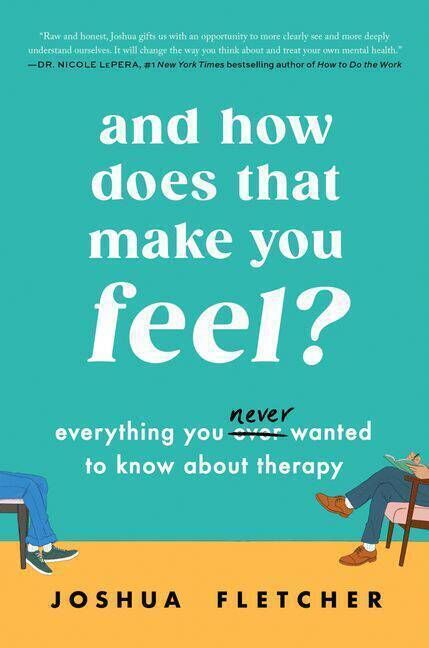
In his latest book, And How Does That Make You Feel?, Josh breaks with the traditional self-help formula and moves into ‘stealth-help’ by taking us inside his head during therapy sessions. 

He positions the reader not just as a fly on the wall, but a fly on the inside of his brain. It’s a hugely engaging process, not unlike an adult version of the 2015 Pixar film, Inside Out, as he describes the 13 inner voices of his therapeutic process, and how this inner dialogue works in session with clients. 

Unlike standard books about the therapeutic process, it’s also funny.

“I wanted to write something people would read,” he says. “A lot of mainstream opinions are formed through entertainment. And I wanted to make people see therapists as human. That way you’re more likely to go to therapy. A lot of people think there’s some omnipotent know-it-all waiting for them, with jarring power dynamics.”

The inner voices he shares are: 

  • Analytical (seeing something from the perspective of counselling theory)
  • Anxiety (the voice of worry that focuses on threats and unlikely catastrophes)
  • Biology ([his own levels of] hunger, fatigue, pain, discomfort, toileting, temperature etc)
  • Compassion (the willingness to understand and help)
  • Critic (a judging voice)
  • Detective (the voice that searches for clues and meaning); Empathy (trying to imagine and experience how the client is feeling)
  • Escapist (the voice encouraging him to avoid difficult feelings); Intuition (a nudge from the gut that goes beyond rationale and reason)
  • Irreverence (bizarre and unexpected thoughts)
  • Saviour (the desire to ‘save’ a person outside the realms of professional duty)
  • Trigger (jealousy, anxiety, anger, defensiveness, associated trauma)
  • Volition (metacognitive intervention, ie choosing to listen to a more appropriate voice than the one that initially arises).
So if he drinks a large coffee just before a session, here’s how some of these voices appear.

Biology: “You’re going to piss yourself.”

Critic: “Idiot. You should have gone before you started.”

Anxiety: “You do know holding it in is bad for your prostate, right?”

Then Daphne appears. Daphne is “A-list royalty, a celebrity, an award-winning actor”. 

He wishes he could tell us who she is, but obviously he can’t, because like the other three case studies in the book, she is a composite character, there to illustrate how therapy sessions work. As is Levi, the scary bouncer, Zahra, the panic-stricken junior doctor, and Noah, the self-harmer with a terrible secret.

“None of them have any identifiable traits whatsoever. It was written with integrity and imagination,” he says. “[It is] an amalgamation of things that happened over the years. Obviously, confidentiality is a cornerstone of the profession.”

To maintain this confidentiality, his “top priority”, all “client characteristics, representations, dates and events have been scrambled and anonymised” via “a safeguarding process backed up by rigorous clinical supervision and legal consultation”. 

So we’ll never know who Daphne is, though when Josh opens the consulting room door to her, 12 of his 13 inner voices silently shout “fuck!”, apart from Irreverence, which says “lol”.

And how does that make you feel? by Joshua Fletcher

As well as this entertaining and unorthodox device, there’s a lot of useful information on panic attacks, bereavement, the role of the amygdala, depression, self care, the flight/fight/freeze/fawn response, anxiety, social anxiety, OCD, domestic violence, sexual assault, introjection (absorbed beliefs), emotional conservatism (“I’m fine”), exposure response prevention (letting intrusive thoughts arise without banishing them), exposure therapy (challenging our fears), and what happens when therapy isn’t working.

“We still see therapy as scary, because we don’t know what to expect. There’s still a mystery around it. Therapists are not there to be your friend, they’re there to give you invaluable objective views borne in unconditionality,” he says. 

“I still see a therapist every two weeks. I’m happy, but I regard it as like going to the gym. People prioritise pumping their guns, but your brain is the most important part of your body.”

The importance of finding not just the right therapist, someone you feel at home with, but the right type of therapy is crucial. These modalities come in many therapeutic flavours. 

For example, psychodynamic (“stop trying to shag your mam and dad”); person-centred (“I’m going to sit here and say nothing until you speak”); cognitive behavioural therapy (“let’s conceptualise your suffering into numbers”); transactional analysis (“my inner child wants a milkshake”); trauma informed (pinning everything on “a vague concept of trauma beyond the definition of PTSD”) etc.

There’s no one-modality-cures all, and it’s important to choose the right kind of therapy, as well as the right individual therapist, for what you need.

“If I’m having panic attacks, I don’t want to see a psychodynamic therapist, because that will make me feel worse,” he explains. 

“If I’m grieving, CBT is a bit mechanical and robust, so I’d go to person-centred therapy instead. If I’m struggling with OCD, I wouldn’t go to person-centred therapy because I’d just sit there ruminating. If I’m having relationship issues and conflict, I’d probably go to transactional analysis. If I want to obsess about hidden trauma stored in my buttocks, then I’d probably go to a trauma-informed therapist and exorcise the demons that way.” 

He pauses. I think the last one may have been tongue in cheek.

“If you have conventional anxiety, worries about your job, your relationship, your driving test, then talking therapy is fantastic. But if you’re struggling with inward disordered anxiety like obsessive compulsive disorder, that’s where CBT is essential. Just as exposure therapy is brilliant for panic attacks.”

In essence, picking the right person and modality.

“What really upsets me is when people say, Oh I tried therapy and it was naff, they just wanted me to talk about mum and dad’,” he exclaims. “That was a mismatch! Try someone else!”

  • And How Does That Make You Feel? by Joshua Fletcher, published by Orion, is out now

x

More in this section

Lifestyle

Newsletter

The best food, health, entertainment and lifestyle content from the Irish Examiner, direct to your inbox.

Cookie Policy Privacy Policy Brand Safety FAQ Help Contact Us Terms and Conditions

© Examiner Echo Group Limited