Surgical robot's vital role in helping CUH to save lives
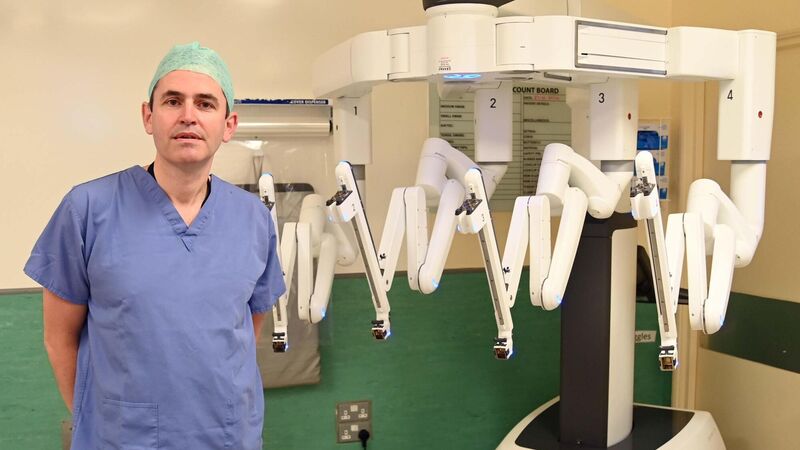
Mr Kevin O'Connor, consultant urologist, with the Da Vinci Xi Robot in the theatre. Picture: Denis Minihane
Wherever and whoever you are, you will want to know that you or your loved ones will receive the best possible standard of medical care should such a diagnosis land at your door. For those in the Munster region, it’s reassuring to know that Cork University Hospital (CUH) is a specialist cancer centre with a rapid access prostate clinic.
The centre was established in conjunction with the National Cancer Control Programme (NCCP) to ensure patients with a suspicion of prostate cancer can be seen and treated promptly.
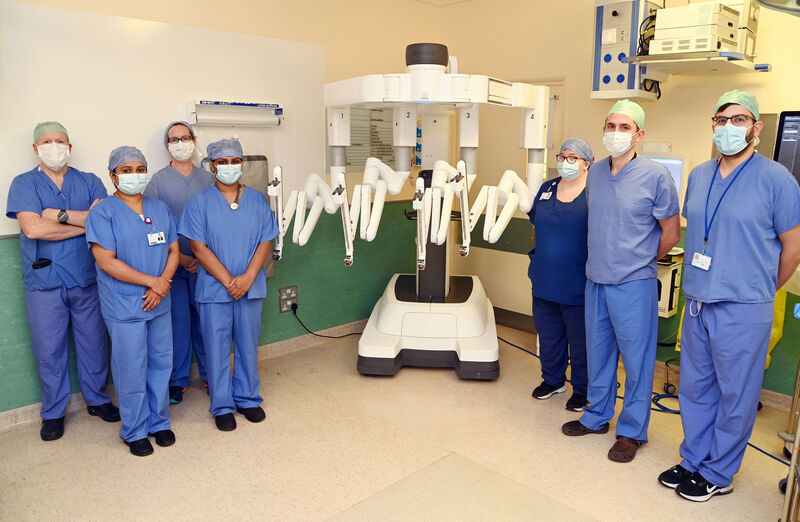
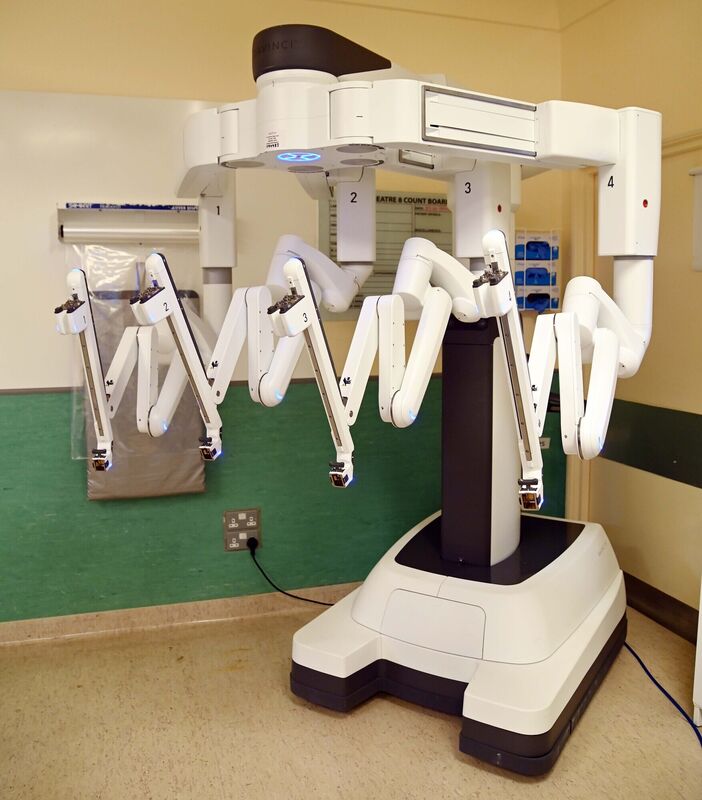
Robot-assisted prostatectomy has in many parts of the globe become a surgical standard of care. At CUH, the da Vinci Xi surgical system promises to save lives and enhance health outcomes for patients for years to come.
Of course, just because robotic-assisted surgery for the management of prostate cancer has become a surgical standard of care, doesn’t mean it’s necessarily the best option for every prostate cancer patient. Whether and what sort of treatment might be warranted for any such patient, is a matter for their senior medical team to decide.
Explaining how those decisions get to be made, Kevin O’Connor, consultant urologist at CUH says: “Being diagnosed with prostate cancer usually involves a patient first visiting a GP. They may present with bothersome urinary symptoms, or for a routine or well-man checkup.
“The GP may then discuss with the patient, the pros and cons of getting a blood test that measures the amount of prostate-specific antigen (PSA) in the blood.
“If this test is done and the results dictate, the GP might refer the patient to CUH’s rapid access prostate clinic. There, they are seen and assessed by myself or my colleague Frank O’Brien.”
The assessment may lead to the patient having an MRI.
“Some are then sent back to their GP with the result that there is nothing there. Others are referred for further tests, which might include a prostate biopsy which would be carried out at the CUH Orchid Suite by a consultant radiologist.”
All of the patient’s results are then reviewed and if prostate cancer is diagnosed, the case is discussed at a multi-disciplinary team meeting (MDT). Mr O’Connor says some of the specialists in attendance might include surgeons, pathologists, radiologists, medical oncologists, radiation oncologists and specialist nurses.
“After that meeting takes place, the patient is again seen at the clinic, so that options can be discussed,” he says. “These might include surgery to have the prostate removed, radiotherapy or active surveillance.
“The dilemma for us is picking out those who need to be treated and those who can be safely monitored.”
Mr O’Connor explains that the latter may be considered when a patient has a low-grade cancer, or one that is unlikely to change over many years: “In those instances, the patient may be checked every six months for signs of change. The disease may not progress. But if it does, then radiation therapy or surgery might be offered.
“The da Vinci Xi surgical system facilitates the surgery in many ways, which include improved magnification, improved surgeon ergonomics and greater technical ease of suturing in a tight space deep in the abdomen. This translates into better outcomes for patients in relation to less pain and a quicker recovery.
"At CUH we’ve done over 200 robotic prostatectomy cases. The nurses, anaesthetics and every other member of the team have all made massive efforts to succeed in becoming proficient with what would initially have been difficult new robotics technology. Great credit must go to them.
“Every one of them works so hard to ensure patients get the best care possible, from the moment they first come to CUH, to the time when they’re in the care of the wonderful post-operative care nursing team.”
Ask whether surgery by open or robotic route is likely to be best for a prostate cancer patient, and you are asking the wrong question.
Mr O’Connor puts it this way: “The main determinant of patient outcome is the surgeon and not the tool. It is the surgeon’s experience, not the tool that matter most. While the robot is beneficial, the patients with the most experienced surgeons at higher volume centres will fare best in terms of cancer cure, and in terms of associated side effects such as post-surgical impotence and urinary incontinence.”
There were a few years when Mr O’Connor and his colleagues had the use of a da Vinci X robotic instrument, which was owned by Cork University Maternity Hospital (CUMH).
“That robot was wheeled over to CUH once a week for use in prostate surgery,” he says. “Then in July last year, CUH Charity purchased a robot for CUH.”
How important is it for CUH to have the da Vinci Xi surgical robot and other new technologies on-site for patients in Munster?
“In providing good healthcare, we have to push boundaries. If we stand still we fall behind. The Irish population is going to expand hugely as people are living much longer and patients’ expectations are higher than previously. We have to constantly move forward to meet demand.”
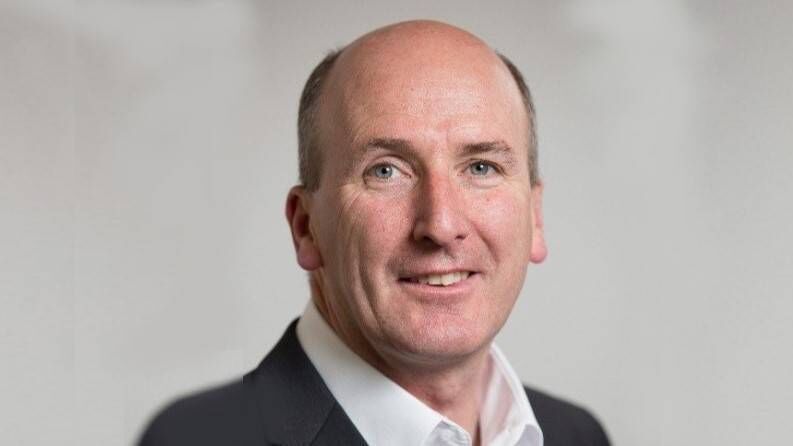
Michael Nason, CUH Charity CEO is passionate about raising funds for Cork University Hospital.
Mr O’Connor is full of praise for his colleagues in CUH and for the CUH Charity team. “So many people are working so hard to push this thing forward,” he says. “CUH Charity has made the purchase of vital robotic instruments for CUH a priority.
“CUH Charity involvement was vital in equipping CUH with the one da Vinci Xi surgical instrument we have, and with the simulator that’s used for surgery and surgical training at the hospital. This is technology which has also benefited the patients of my colorectal colleagues Mr Shane Kileen and Mr Peadar Waters.
“Everyone who uses the tech at CUH has gone abroad to train in and become proficient at using the technology and come home to Ireland to use it.”
In conversation, the phrase ‘live longer and live healthier’ is one that’s often repeated by Michael Nason. Clearly, helping CUH patients to do just that, is an integral part of the mission of CUH Charity and indeed of the man himself.
It’s a noble mission — one in which we can all play a part.
Michael Nason urges those of us who can to: “Try hard to take better care of our health, so that whatever resources there are can be spent on those amongst us who need it most.” He also urges those of us who can to help CUH Charity with its fundraising efforts, and to help keep the hospital equipped with the vital high-tech equipment to help save people’s lives.
We can do so, safe in the knowledge that every donation will be used to help ensure CUH patients have access to the best of medical instruments.
To donate today, please click: www.cuhcharity.ie/donate/


CONNECT WITH US TODAY



Be the first to know the latest news and updates