Let’s talk about sex
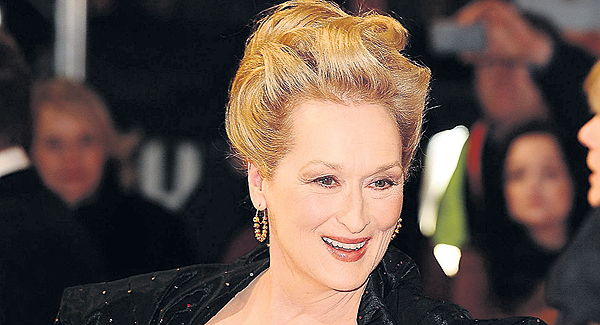
HOLLYWOOD icon and the woman widely perceived as the greatest actress in the world, Meryl Streep, is talking about sex. Even today the subject remains taboo for many — including the character that the three-time Oscar winner plays in her new movie — and Streep thinks that many of the issues stem from plain old embarrassment.
“Talking about sex is allowing yourself to be vulnerable, to show your weakness,” begins the 63-year-old superstar, “to show what you need, to show what you are not capable of doing all by yourself and how much you need something. That’s what it is. And that’s what’s embarrassing and hard. I think you can see that in the movie.”
Her latest film is called Hope Springs and she features alongside craggy American actor Tommy Lee Jones, the pair starring as a middle-aged married couple who have lost the spark in their marriage.
At least that’s what Streep’s character fears. Jones’s character seems content to let their marriage drift, intimacy-free, which is a major part of the problem. The couple visit a marriage counsellor, played by Steve Carell, and a wry, witty yet uncomfortable sadness unfolds.
“I can’t speak for all humanity, even though I often try,” laughs Streep, “but for me, it’s very easy to imagine and to be caught being complacent.”
Complacency, of course, threatens every relationship.
“You make assumptions, and it’s not always the best idea. We know this intuitively. I have a wide circle of girlfriends all of whom talk about the exact same things, so we all know where we are in our lives. We know this film is relatable by many people.”
Which is what attracted Streep to the film, directed by Marley & Me’s David Frankel. “I thought, ‘Oh God, nobody makes a movie about this, about people my age wanting to be seen, heard, and intimately known’, that’s a really unknown landscape in the movies.”
Charting unknown landscapes remains one of Streep’s most consistent achievements even at the apex of a career that spans five decades and which includes films as diverse as The Deer Hunter, Kramer vs Kramer, Sophie’s Choice, Out of Africa, The Devil Wears Prada and Mamma-Mia! She won Oscars for the second and third of those movies.
She won again this year with her turn in The Iron Lady, which proved a courageous exploration of aging. So too does her latest outing. The ailing sex life of the over-fifties is not a subject that appeals to the masses.
“It’s probably uncomfortable for younger people,” concedes Streep of Hope Springs’s subject matter. “Maybe it’s nice for them to think that they are not like that and yet young people can also be calcified in their relationship and ignorant of each other’s needs. They can take a page from this, too.
“There are lots of people that talk about sex all the time that don’t talk about intimacy and their own needs,” she adds. “Sex is easy to talk about. What your longings are, what your loneliness is, what your sadness is, that is what is very hard to talk about. I think often it’s less to do with sex really than with longing for love and a need to be felt and heard and seen and reflected in the person you are closest, to.” Streep enjoys a healthy relationship with her husband of almost 34 years, sculptor Don Gummer, with whom she has four children, Louisa, Gracie, Mamie and Hank, and says that advancing years have brought their own happiness. “As you get older, you have more to pull from, because you have more stuff inside,” she says. “There are a million things. Your imagination does not stop firing. You have a bank of experience to apply. When you get older, you have an appreciation for how little time you have to tell your stories. You want to pour everything into it and to still work with new people.”
Amazingly, given the breadth of their respective careers (Jones debuted on screen in 1970’s Love Story, Streep in the television movie Deadliest Season, in 1977), Streep and her co-star have never starred together, though both did appear in Robert Altman’s final movie, the 2006 ensemble piece A Prairie Home Companion. Neither she shows no sign of slowing down, either.
In the past few years Streep has delved into musicals with the $600m mega-hit Mamma Mia! and romantic comedy for the middle aged, with Nancy Meyers’s It’s Complicated. She also took on the action-comedy genre in Julie & Julia, before shining with her Oscar-winning turn in the powerful Maggie Thatcher biopic The Iron Lady.
“Doing this film was not an antidote to The Iron Lady,” she says. “I just wanted to make the movie.” So what keeps Streep professionally motivated after all these years?
The screen icon pauses for a moment before quoting her friend and her director on 2009’s Julie & Julia, Nora Ephron. “Nora said: ‘There are no secrets. You can look at an entire person and know what fuels him. Your work manifests who you are.’
“And it’s true. You could look at all of Tommy Lee’s work or my work and read who we are as human beings. You’ll be able to read it in the work.”
In which case Streep remains an engaging and amusing character, always keen to challenge perceptions — even if that means talking about sex.