Author interview: How Irish dancing became the victim of its own success
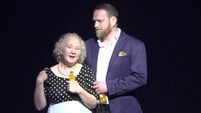
One can’t discuss Irish dancing without mentioning ‘Riverdance’ and its seismic impact, something Ellen Coyne explores in the book. She describes the show as ‘rocket fuel’ for Irish dancing. File picture: Jack Hartin
- Dirty Dancing: The Inside Story of the Irish Dancing Cheating Scandal
- Ellen Coyne
- Gill, €19.99
As a political reporter and correspondent, Ellen Coyne has worked on plenty of important news stories in her time but one of the most high-profile scoops of her career was about a subject she admits to being entirely clueless about.
In 2022, after receiving an anonymous tip-off, Coyne broke a story about alleged cheating in the highly competitive world of Irish dancing.
The claims that judges and teachers had colluded to rig competitions came to be known as the ‘feis fixing’ scandal and led to then Tánaiste Leo Varadkar warning of ‘reputational harm’ to the nation.
Read More
“There’s huge soft power in Irish dancing. You don’t have to be of that world to appreciate how it’s a massive cultural export.
“It’s worth billions, and it’s outwardly seen as so wholesome that it was definitely worth investigating if what was being alleged was true and there was something darker going on underneath.”
“There was so much colour that I was picking up that was not making it into the newspaper.
“I felt like people understood the alleged feis-fixing scandal itself, but they didn’t understand the big personalities in the background.”

The cloak-and-dagger approach of the whistle-blower’s initial communication continued throughout Coyne’s investigations, with the people she spoke to reluctant to go on the record.
“There was this kind of ‘Deep Throat’ treatment for people who were ostensibly just talking about a hobby.
“I’ve never really worked on a story like that before, but that’s the privilege of journalism, that you get to briefly visit these weird worlds that you would have no business being in otherwise.”
“Every time I was at an Irish dancing competition, I was most certainly persona non grata. Nobody wanted to be seen speaking to me.
“But staying overnight, I would wake up the next morning to a flurry of anonymous text messages from people saying, ‘I really want to talk to you about this’.
“Some people treated me as a therapist, they wanted to offload whatever guilt they felt about what they had witnessed or what they’d been party to that they had on their conscience.
“There were so many hours spent talking to people, some of them in tears, saying they regretted going along with feis fixing, they just felt that because everyone else was doing it, they had no choice.”
“As I write in the book, the Irish dancing universe is split down the middle between what happened before and what happened after, because it professionalised Irish dancing.
“Before then, people would have had aspirations to finish competitive Irish dancing, maybe set up their own Irish dancing school, but now they had this possibility to go on a world tour for something that was selling tickets faster than they could print them.
“With the and other offshoots as well, it made Irish dancing an economic powerhouse and accelerated its globalisation.”
“It’s just this really unique blend of a super-competitive sport that has elements of elite athleticism and a cultural art form, which makes it really beautiful and spectacular.
“It also means that at that top level, at the All-Irelands, at the Worlds, the margins are so thin, the dances evolve literally year by year, the routines get so much harder, and it’s just competition and glory.
“In the book, I explain how this is not a modern post- phenomenon. Even back in the 1800s, people were punching each other at feiseanna over who deserved to be the rightful winner.”
“There are better rules in place now as a result of the cheating scandal and there’s more transparency in terms of judging.
“That was the closest Irish dancing ever got to making a tacit acceptance that it had a major problem.
“I don’t believe Irish dancing had the reckoning that I thought it would, I don’t really think that it reformed itself. The cloud of it will kind of probably hang over it in some way, shape or form, forever.”
Many people involved in Irish dancing, and those outside it, also have reservations about the increasingly time-consuming and expensive nature of the costumes, makeup, and wigs involved. Coyne says it’s a complicated issue.
“On one hand, I felt that when the story broke, people were using that as a shorthand to be rude and disrespectful.
“I’m always loath to humour talking points that are making fun of a female-dominated sport and how women look.
“However, while researching the book, it became very obvious to me that there has been a power struggle for a very long time in Irish dancing about the aesthetics, like the depth of the colour of the tan, the price and the extravagance of the dresses, the height and the girth of the wigs.
“Some people in Irish dancing have been saying, ‘does this serve us and is it possible to strip it back?’. But within the politics of Irish dancing, there’s a comparatively small group of people who have voting power within the CLRG.
“They’re traditionalists and they don’t have interest in reforming it. They’re keen to keep things as they are.
“It’s like the Catholic Church, it changes in centuries, rather than decades, it’s a slow sport to reform.”

While the intensity of the assignment was often overwhelming, Coyne says writing the book gave her a profound appreciation of Irish dancing.
“I did develop a real affection for Irish dancing. Sometimes I was accused of being a saboteur but the only reason I kept writing about it is because I think it is a really important cultural institution.
“I hope it comes across that this isn’t a takedown of Irish dancing, it is actually something I wrote from a really deep respect for the sport.”