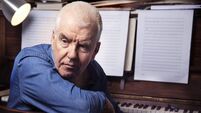
Tommy Tiernan Show: The sports writer whose chronic anxiety prevented him leaving Cork
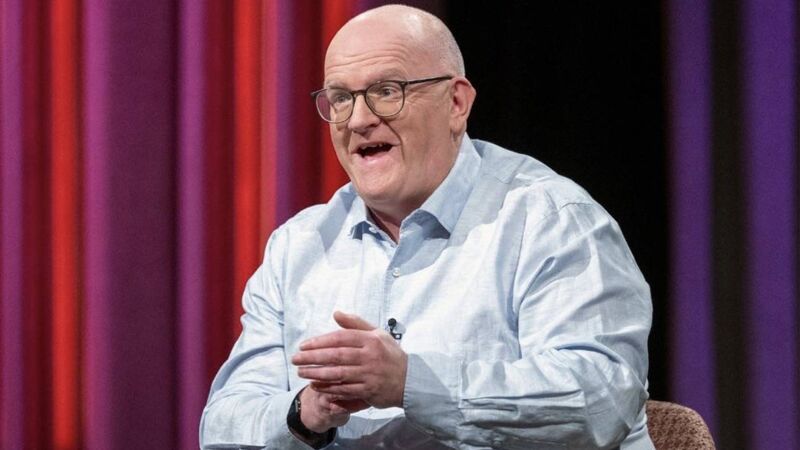
Eamonn Sweeney joined Tommy Tiernan to talk about the crippling anxiety that still affects him. Picture: Tommy Tiernan Show/RTE One.
Tommy Tiernan returned on Saturday night with guests John Mulaney, Leah Hayden Cassidy and Eamonn Sweeney.
Comedian, actor and writer John Mulaney joined Tiernan for a chat about his chat show experiences, family life, his sobriety, and his Irish heritage and upcoming performance at the Olympia.
Mulaney, who hosted and spoke about his chat show experience and the notable characters he has interviewed, including hypnotist Kerry Gaynor, Marcia Clark, David Letterman, Bill Hader, Pete Davidson, Los Lobos, Beck, and John Cale.
He touched on family life, and how his wife, Olivia Munn, and their two children join him on tour.
Read More
Describing what touring with an 18-month-old and a four-year-old looks like and why they made the decision to do so, he said: “It’s much more fun to fold them into the tour and bring my son backstage and have the kids around than it is to leave and come back. Because I go out for four or five nights a week.
“They get to know the hotel people, and they think it's their home, and then we, you know, they're confused, and then we tell them, it's not their home, and it's all great.” He went on to explain that there will come a time when his kids won’t be able to tour with their dad, and that he wants them to have that experience now.
“And I thought there's an age where they won't be able to come, where school will have opinions on how often they're there. So let's do it for now,” he said.
Mulaney, who has been doing stand-up since 2003, said he has become a performer over the years, saying he was a writer who did stand-up for the first 10 or so years.
Speaking about his Irish connections, he explained that on his mother’s side, his great-grandmother came from Ballyhaunis to Boston and married his great-grandfather.
On his father's side, he said he believes his relatives moved to the eastern coast of the US in the early 19th century.
Speaking about his sobriety, Mulaney said he will be celebrating five years of being sober on December 20.
“So I stopped drinking for the first time in 2005 - it was a lot more drugs, by the way - so I had a pretty bad relapse in the late 20-teens, and then went to two different rehab places in 2020 and got sober,” he said.
Speaking about how he shifts gears from being a performer to being a parent, he explained: “I'm hyper present on stage, and then when my 18 month old very much wants to eat a latex glove, I'm hyper present, but in a different way, and I find that gear shift really nice.
“So it's not immediately going, that was fake, and this is real. Some people try to do that with their career, the family, that's real and this is fake. And I think that creates a weird split in people. Both are real, both are a different type of excitement, and both have an incredible amount of immediacy.”
Tiernan and Mulaney’s conversation wrapped up with Mulaney saying he was really flattered to be on the show and that he really enjoyed their conversation.
Tiernan’s second guest of the night was Leah Hayden Cassidy, a barber from Dublin now living in London, who discussed her journey from playing football in Ireland to becoming a barber.
Cassidy, who grew up in Blanchardstown and has lived in London for the past eight years, spoke about opening a studio space in London, which started as a one-chair studio and expanded to an 800-square-foot space in Hackney.
She explained that the studio space was created to provide a community for creatives, offering pop-ups, art clubs, and a welcoming environment for clients.
“I think a lot of people, including myself, felt a little bit of social anxiety, you know, and like, financially, I couldn't afford to open a shop, I didn't have a space to work in. I thought maybe just, you know, whatever savings I had, let me put it into a space that I can just create, an environment that feels a little bit like home, and, you know, it cuts the doors down,” she said.
She said that oftentimes, when someone is sitting in the chair to have their hair cut, there’s a surface-level conversation happening, and she wanted to change that, saying that people needed something a bit more than that, particularly after the pandemic.
Speaking about the relationship she has built with her clients, she said: “I'm in a very grateful and beautiful position where a lot of my clients really trust and, you know, I've built amazing relationships with them. A lot of them have become my best friends. I'd happily go for a point where every single one of my clients.
“I think there is this kind of almost putting this wall up when guys are in a room together, you see it all the time, where it's like this kind of a bad onus. I think your barber, for a lot of people, is the person that you think you can confide in. I've been the first to hear about weddings or engagements or divorces or babies or issues when they haven't been able to have a child, like deep issues. I think giving a safe space of that one chair initially was so important, especially at that time when we came out of such an isolated space, because people were going through so much.”
Touching on her football career before becoming a barber, Cassidy recounted her early days playing football on the streets of Blanchardstown and her transition to playing for boys' teams.
She described her experience of being told to join the women's team when she got older, her initial disbelief that girls could play football, and how she continued playing through secondary school, balancing her love for football with her academic interests.
She was inspired by the film and pursued a football scholarship in America, ultimately choosing Georgia.
Touching on a tackle that ultimately ended her time over there, during a playoff game, one of the last games of the season, she explained that her leg “completely snapped, tibia and fibula in four places”.
“I broke my leg and had to go through the surgeries, and had to go through everything in Georgia on my own. My mum couldn't get over to see me, and my family couldn't get over. We just couldn't financially afford it. So I did all the surgeries and everything on my own, and was it not for the people in that town, I don't know how I would have gotten through that,” she said.
Cassidy spoke about her decision to return to Ireland after her injury, feeling ready for a new chapter in her life.
She reflected on the support and encouragement she received from her mother, an artist, who taught her to pursue her passions and be happy in her work.
She mentioned her role as a grooming ambassador for Dior and her experience of teaching and educating on stages around the world.
The conversation concluded with Tiernan describing Cassidy as “a remarkable woman”.
Tiernan’s final guest of the night was Eamonn Sweeney, a former sports columnist for the Sunday Independent, who discussed his recent career changes and personal struggles with chronic anxiety.
After 20 years of writing, he quit his job as a sports columnist and moved out of his long-term residence.
“I've written about the same thing for 37 years, and I'm just gonna go. It all goes back to a book I wrote last year, which is about the fact that I’m doing the job, and I've been battling with this kind of mental illness for years and years and years, and eventually, two years ago, it kind of lifted. But the odd thing was that as it lifted, I kind of realised I want to do other stuff with my life, you know, as a new horizon opened up. I thought, yeah, I feel like a new me. So maybe a new me should do new things," he said.
He detailed his battle with what he described as “a real chronic anxiety”, which meant that he didn’t leave the country for 23 years and didn't get on a train for 10 years.
“I think I moved outside the county boundaries of Cork about once in six years. I was pinned to the house almost; it was a kind of a private lockdown. I remember actually being relieved when covid came because I thought, well, now everyone's in this and nobody's going to be asking me, 'Why aren't you going anywhere' because covid was no change for me,” he said.
He described his experience of being in an incredible wave of panic when walking into a match in Killarney back in 2000. He said he doesn’t understand where the feeling of panic came from, but that his anxiety spiralled after that.
Sweeney mentioned his three daughters, who he said have been supportive throughout his struggles, and shared a memorable experience of going to see with them, which he said was a significant milestone for him.
He also reflected on his childhood, noting it was unremarkable and not the source of his mental health issues, and went on to describe his attempts to manage his anxiety, including giving up drinking and taking up running, but nothing provided lasting relief.
“No matter what I did, I was stuck with it,” he said.
“I had actually come home after one more disastrous outing, a particularly bad one in Galway, had probably the worst panic attack I ever had. I thought of it, going into full-blown psychosis. And I got home and I said, That's it. I'm never going out again. I have my books and poetry to protect me,” he continued.
He spoke about getting the train from Galway to Dublin to take part in the show, explaining that it’s still a thrill for him that he is able to do that.
Touching on how he became a sports writer, Sweeney said: “I kind of ended up as kind of the accidental sports columnist. I’d been a novelist back in the late 90s. I’d been a sports journalist back before that, and I was just asked to write a column in the Indo and kind of went on from there and I did it for 20 years. I think I was reasonably good at it.”
Speaking about future aspirations, he discussed his plans to return to writing novels, despite the challenges and uncertainty of the current market.
“I’m always saying to my kids, do what you want to do. Follow your dreams. Do the thing you want to do and you find someone to pay you for it and you'll be happy doing that. And I thought, well, maybe I should follow my own advice,” he said.
Sweeney expressed a desire to avoid being the person who could have done more but didn't, and to follow his passion for writing.
Closing out the show on Saturday was The Olympia Quartet performing by Florence Price.