Tommy Tiernan Show: Former republican activist and wife of IRA murder victim on unlikely friendship
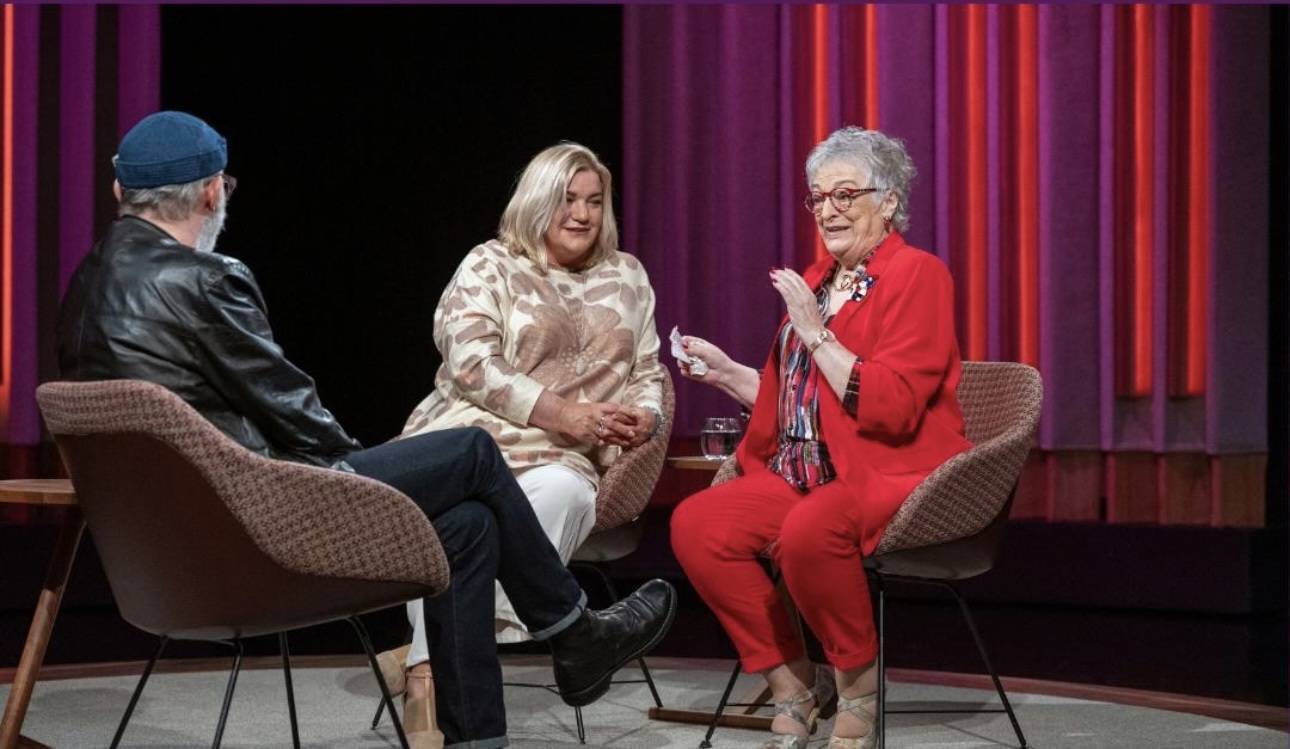
Cross-community activists Anne Walker and Kathleen Gillespie discuss their unlikely friendship with Tommy Tiernan. Picture: The Tommy Tiernan Show/ RTE.
on Saturday night explored the cross-community work of two women who have lived through the Troubles, and now use their very different experiences of that time to educate others.
Tommy Tiernan’s guests on the night included cross-community activists Anne Walker and Kathleen Gillespie, retired snooker player Steve Davis, and rapper and singer-songwriter Mike Skinner.
Tiernan's first guests of the night were Anne Walker and Kathleen Gillespie.
Kathleen Gillespie introduced herself as “a proper Derry girl born and bred” and shared her background, including her husband's murder by the IRA 35 years ago.
Gillespie explained that her husband was named as a legitimate target of war because he was employed by the Ministry of Defence as a civilian worker in one of the army camps in the town.
She explained how they were held captive in their home by the IRA on the night of October 23, 1990, and that her husband was taken, chained to a van with explosives.
She said the van was driven into a camp that they wanted to destroy, and the explosion was detonated, killing five soldiers, along with her husband.
She shared her confusion and hope after the incident, believing her husband might still have been alive, but the inquest confirmed her husband's death, and she had to accept the reality of his passing.
At the inquest, she said it was found that her husband shouted a warning that saved many lives.
Gillespie discussed the IRA's presence in the community and the lack of charges against the captors, and said she could have been walking around the town with them.
Anne Walker also shared her personal story, including her uncle's murder during Bloody Sunday when she was just three years old and her subsequent involvement in the IRA.
She describes her upbringing “through the worst of the Troubles” — house raids, hunger strikes, harassment by police and the British army.
She was asked to join the IRA at the age of 18, saying she’s been a friend of Gillespie’s for the past 15 years and that, together, they share their stories to effect change in cross-communities.
Walker described her role within the IRA, within a small unit that moved weapons around, never knowing what they were being used for.
She later began questioning her role and what she was doing, and that before that she believed what she was doing was right and knew that she could die.
“A few things had happened, and I was questioning my role and what we were doing. Even though initially, I really believed what I was doing was right, and I knew that I could die and that was okay, I knew that I could end up in jail, but I would discover that I couldn't kill.
“When the IRA sent me and a comrade out on an active service mission one night to set off a bomb that would kill a passing police and soldier patrol. Interestingly enough, that day, I was very sick, with a very sore headache, and I didn't want to do this, not because I had the headache. Still, I had never been directly involved in actually killing somebody. I'd been sort of part of the background.
“Went out anyway to do this operation, and I got very sick. I needed to go to the bathroom. My comrade says, You better go to the toilet. There was a pub close by, but on the way back, there was a pain in my head. It felt like somebody hit me with a hammer. I went round to him, and he said, ‘There's something wrong with you. You need to go home’. And I said, ‘No, I'm staying here with you’. But I started throwing up, and it was obvious that there was something really wrong. So he sent me home, and we aborted the mission.
“We had been set up that night. The British Army were never going to come. We'd been set up by an informer, and if I hadn't had the brain hemorrhage, which is what actually happened, we probably would have been shot or arrested.”
Tiernan said he was “thrown” by the conversation, saying that he has always thought that people in the south are not in a position to moralise about people in the north because for the most part, it was not their lived experience — the sectarianism and brutality. And that he has always thought, in theory, that if people decided to they wanted to join the IRA, he could understand that choice being made, but that he has never sat across from someone who has said, ‘I was in the IRA’.
Gillespie shared a poem that she said resonates with her feelings about her husband's death, discussed the complexities of forgiveness and reconciliation in the aftermath of his death, and expressed fear for her sons' safety and pride in their development into responsible men.
Walker touched on the current fear in Northern Ireland regarding a potential united Ireland and the need for groundwork for future unity.
The conversation also touched on the personal bond between the two women, defying societal expectations of animosity.
“People think that I should hate her, I should not be friends with her, because she was part of the IRA when my husband was murdered,” Gillespie said.
“They don't understand why I could be such good friends with her. You know, they just don't understand.”
Tiernan’s second guest of the night was retired snooker player Steve Davis, who discussed his journey in the cue sport, highlighting his competitive nature and strategic mindset.
Davis reflected on his evolution from a serious, emotionless player to a more light-hearted persona.
He also shared his experiences as a father and professional, noting the sacrifices made for his career, and spoke of his newfound passion for DJing and playing a modular synthesiser, forming a band called The Utopia Strong.
Davis behinds his conversation with Tiernan by reflecting on his early passion for snooker, mentioning his natural talent and enjoyment of the game's tactics and strategy.
He also discussed his father's influence, who he said taught him to play chess and snooker, and influenced his love for strategy games.
Tiernan noted Davis’ transition from a serious, emotionless player to a more lighthearted and entertaining personality, with Davis explaining how his public image evolved, from being seen as boring to becoming more approachable and humorous.
Touching on the challenges of balancing professional life with personal life and parenting his two children, Davis said: “I was never there, really. I was on the road, so I wasn't particularly a good dad, I'm sure. I don't think they hold any grudges; they're doing all right, but I don't think that was necessarily something that I was particularly great at.
“There's the one thing about people in sport… You're a very selfish person. Yeah, I'll put my hand up to that. And you're involved in what you're doing. So during the 90s, I was still playing professional snooker and very much in those ‘blinkers on’.
"And maybe it's better if you're not so prolific, then you can perhaps dip in and out a bit more. But the prolific winners in the sport I know, perhaps they have to be very selfish. Maybe that's one of the reasons why you are good.”
Touching on his current involvement in snooker and his thoughts on the game, he said he isn’t playing anymore.
“Don't want to get the ball in the hole anymore. Don't see the point of it. There's no point,” he said, going on to talk about his other interests in life.
“What I have done… I've been so lucky, I've started, by accident, doing some DJ. That's been fun. But I've also, by accident, discovered a musical instrument called a modular synthesiser that has loads of wires coming out of it, doesn't have a keyboard, so you don't need any skill as such, but it makes music.
“As a result of that, I've been with my friends, musician friends, making music and putting albums out… I’'ve had so much fun now making music in the moment. And so making music is something that I didn't ever think was going to happen in my life. My second hobby has become half a journey as well. I can’t believe my luck.”
Davis emphasised the importance of living in the moment, touching on how his band The Utopia Strong focuses on improvised performance and how it relates to how he lives his life.
“It’s a certain type of performance, but improvising, for me, has become this really important thing of the moment — we're all living in the moment. So, as much as you can improvise your life and enjoy it, do it.”
Tiernan’s final guest of the night was rapper and singer-songwriter Mike Skinner, who discussed his busy touring schedule, reflected on his album which blends personal experiences into a narrative, and touched on the importance of trustworthiness and loyalty.
Skinner discussed the hard work involved in touring, emphasising that 95% of the effort goes into preparing for the tour.
“I am very busy. The big lie about touring is that you're busy, because actually, the hard work is before the tour. So, probably 95% of my energy just goes into remembering words.
“This show that we're doing at the moment is less like rap music and more like a musical, because I made an album called A Grand Don’t Come For Free, so it was a story, right? So it's, it's everything that I've experienced rearranged into a beginning and an end, and the song, which was the biggest song, or one of the big songs, it was… for me, that's a real thing that really happened.
“So, I think about that when I sing it, but after you've been singing a song for 20 years, I don't experience the song anymore. I mean, I experience it in the sense that, are we going to f*ck it up tonight? That's my experience. No, we didn't f*ck it up, great.”
Skinner mentioned some of his heroes in live performance, leading to a discussion about rap music and its influence, with Skinner speaking about how he has been influenced by films and comedy, specifically referencing Stuart Lee.
The conversation also touched on the difference between writing music 25 years ago and now, with Skinner acknowledging the cliches of the music industry.
Skinner discussed the vulnerability that comes with being a performer but explored the real meaning of vulnerability.
“I think it's very easy to convince yourself you're being vulnerable. If you sing a sad song, that's the same as every other sad song that's ever been out; you can convince yourself that you're being vulnerable, but you're not. You're just singing a sad song that's exactly the same as all the other sad songs, which is pretty much what every musician starts off doing.
“Embarrassment, it is like vulnerability, but it's like you've made a song that isn't like all the other sad songs that everyone's ever written, ever, you're doing something different, and that comes with a deep feeling of embarrassment. And then what you have to do is go, okay, I've made the decision to do that, and now I'm going to stand here, and I'm going to look at you all, and I'm going to say, ‘This is what the fuck I'm doing’. And you have to try to convince them that you mean it.”
Touching on personal beliefs, Skinner opened up about his fascination with UFOs and near-death experiences, despite his family thinking he is “crazy”.
“Because I'm an artist, I can be mad. I don’t need for people to think I’m sane because I am an artist, I'm crazy. I've always been quite happy to say this, this is what I believe, but I fully, I mean, people laugh at me. But as I said, I get paid to be embarrassed,” he said.