Book review: Imagining a not so wee North
If we are moving towards a 32-county Ireland anything that prepares the ground for the kind of difficult, uneasy sacrifices needed to make that evolution a success is welcome
Book review: Imagining a not so wee North

Samuel G Beckton is a historian of contemporary Irish History who studied at Trinity College Dublin and Queen’s University Belfast.

  • The Unbroken Covenant: Could Ulster Unionists Have Controlled a Nine-County Northern Ireland 1920 – 1945?
  • Samuel G Beckton 
  • Peter Lang, pb €37.10 

Our newly minted president assures us that a reunited Ireland is an inevitability. 

However, like that other inevitability, she — nor anyone else — can be precise about the day or the hour.
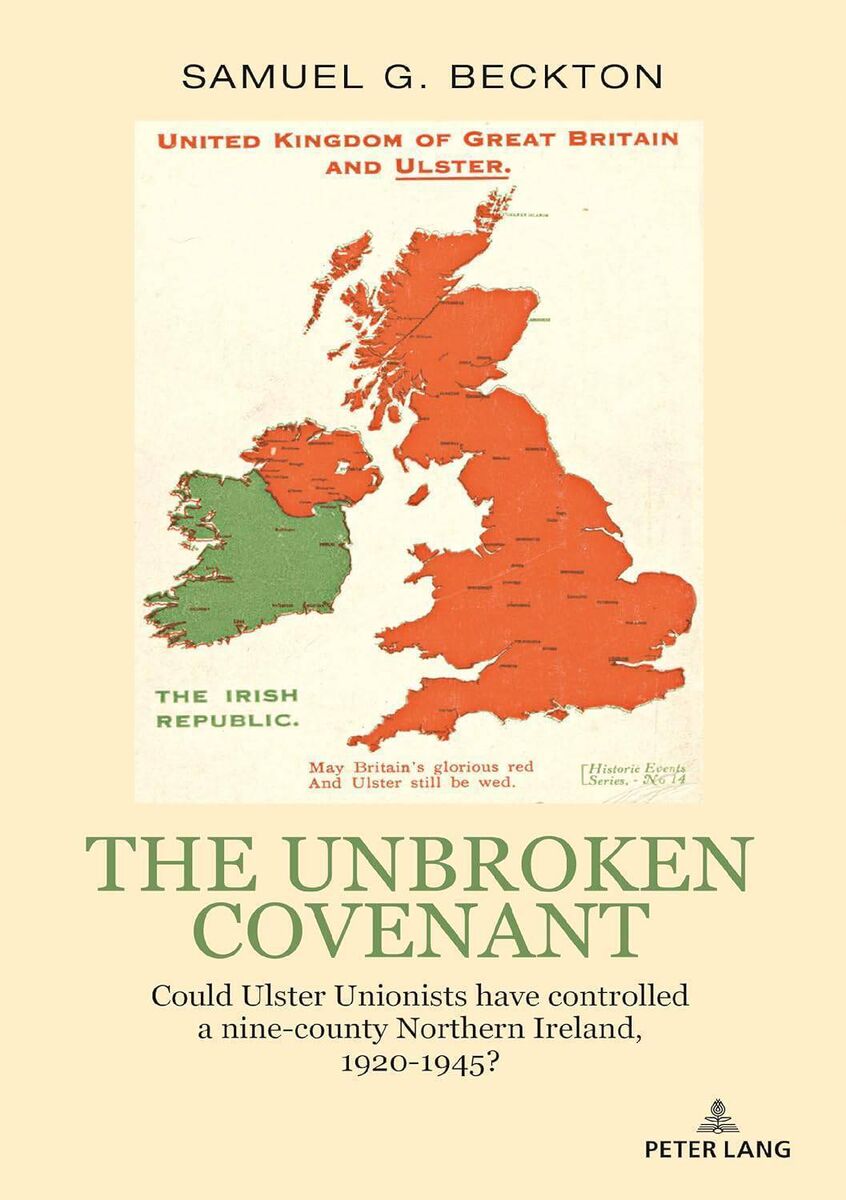
This difficult, almost unapproachable book does not attempt to predict a when or how but rather focuses on how the ever-changing relationships between this Republic and Northern Ireland might have been different had Cavan, Monaghan, and Donegal been embraced by Northern Ireland rather than secured by a nascent Free State a century ago. 

Author Beckton asks a simple question: How might things have been, or be, different if the Wee North was the Not So Very Wee North.

This may seem a fatuous process, but if we are moving towards a 32-county Ireland anything that prepares the ground for the kind of difficult, uneasy sacrifices needed to make that evolution a success is welcome.

This counterfactual study obviously reflects the societies as they were in the decades since post-colonial partition was imposed by a waning Britain. 

It is thankfully impossible, though, to believe that religion remains the toxic, hateful force it once was. 

That a family might be burnt out of their home because it was born into one faith or the other now seems all but unimaginable. 

Of course, there will be exceptions, but if the changed place of religion as a defining social force, sometimes sectarian, means an end to pogroms, that must be welcomed.

This book, a heavenly but opaque treat for data-crunching statisticians, considers how one community tried to dominate the other in the decision-making processes that managed the entities they lived in. 

Relentless, corrupt gerrymandering and bizarre rules around who could or could not vote, all might have featured in the efforts of the traditional ruling classes to maintain their grip on power. 

It may be necessary to recall that businesses with revenues or employees beyond a certain threshold had multiple votes in many elections. 

It is easy to imagine that Trump might invoke that principle, allowing Elon Musk to outvote North Dakota. 

The other side of that coin was the relentless uprooting of the Protestant communities in the three Ulster counties in the Republic. Fear was inevitably the driving force.

Peter Lang is a publisher of academic books but it is a great pity they did not ask a professional editor to winnow this sometimes-unwelcoming work, as it would then have made a substantial contribution to the reunification debate.

Beckton points out that both communities in this tragic drama felt betrayed — the Protestants by Britain and the Catholics by the Free State. 

However, his main conclusion is that a nine-county Northern Ireland would have been more difficult and expensive to support — especially during the Second World War — and that this hard reality might have changed the timescale in what President Connolly describes as an inevitability.

Time will define and time will tell.

BOOKS & MORE

Check out our Books Hub where you will find the latest news, reviews, features, opinions and analysis on all things books from the Irish Examiner's team of specialist writers, columnists and contributors.

More in this section

Scene & Heard

Newsletter

Music, film art, culture, books and more from Munster and beyond.......curated weekly by the Irish Examiner Arts Editor.

Cookie Policy Privacy Policy Brand Safety FAQ Help Contact Us Terms and Conditions

© Examiner Echo Group Limited