Patrick Holloway: When I moved back, Crosshaven had kept something of me and gave it back
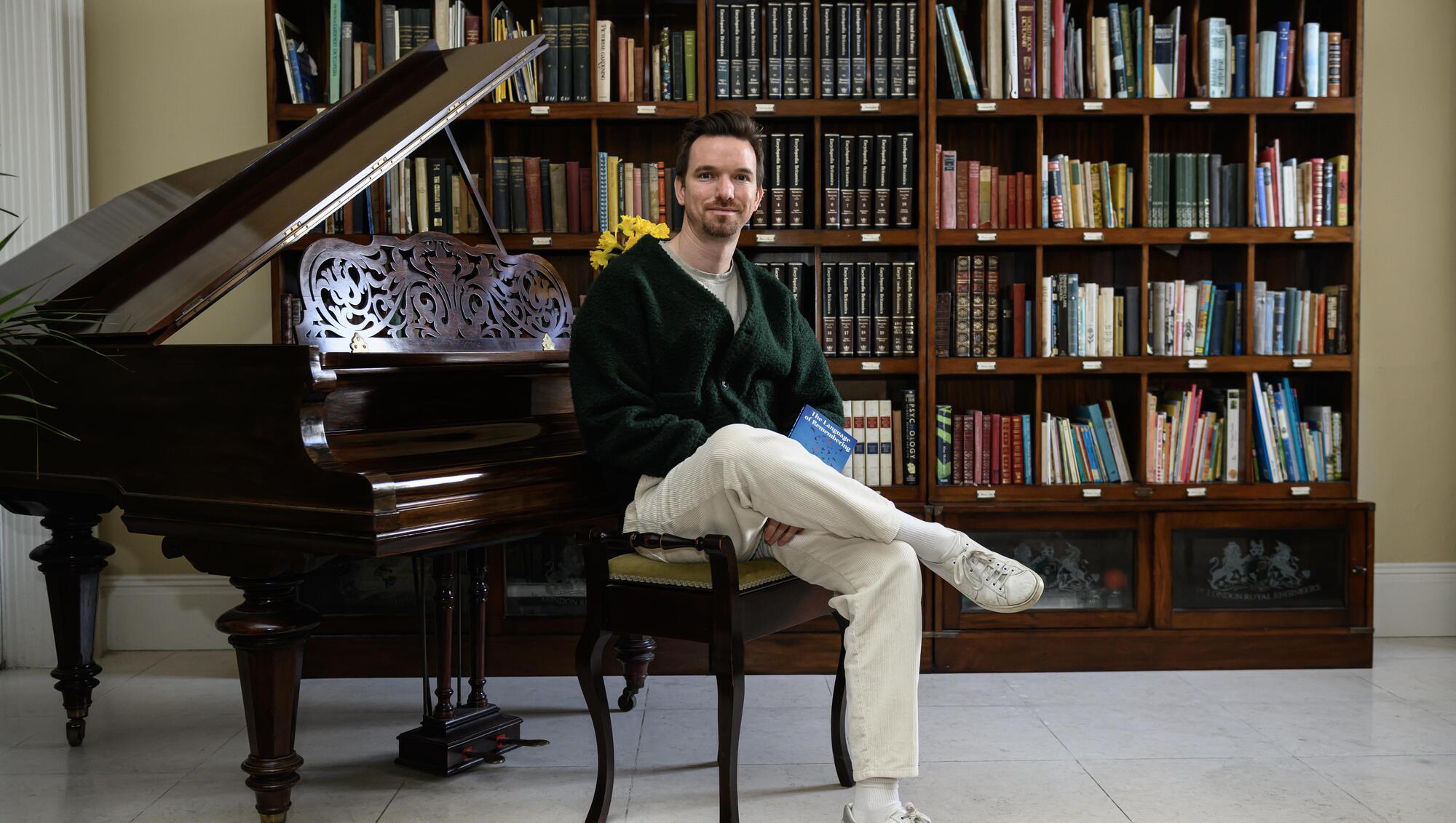
Author Patrick Holloway at Crosshaven House, Cork, with his new book the Language of Remembering. Picture: Dan Linehan
After 15 years of living abroad, nine of them in Brazil, I decided to move back to Cork in the middle of the pandemic.
My wife and I packed up our lives in the strangest of times and got ready to return ‘home’ with a baby, a toddler, a dog, and a cat.
We were those people on a plane you didn’t want to sit next to you.
Flights changed, were cancelled, everything was up in the air until the moment we sat on the first flight, and even then we weren’t sure we’d make any of the connecting flights.
When we did arrive in Cork, the welcome home I had imagined was quite the anticlimax. My parents moved out of their house so we could quarantine.
We spoke between masks and windows. We held up Luna Faye, not yet one, and watched as my parents reached their hands out to the glass.
We finally made the decision to move home for two main reasons: safety (I was robbed at knife point, my wife at gunpoint), and so I could really give the whole writing thing a proper go.
We knew it wouldn’t be easy but were carelessly naïve in how we thought the big things would slot into place.
Maybe we were wilfully ignorant because one more barrier, and we probably would have stayed.
We didn’t think for a second it would take over two years to get a mortgage, or that renting (with said baby, toddler, dog, and cat) was simply out of the question.
Then there were also the challenges of slotting back into a life I’d left behind at the age of 18.
For my wife, it was tougher still. We saw how our eldest daughter Aurora slowly started favouring English instead of Portuguese.
How adaptable children are, how malleable. Adults, we’re more rigid, set in our ways.
And I found it harder to be back than I had thought. Or maybe it was that I missed what I had left behind.
I got busy writing to try to discover what it was I felt, and soon the bones of gained flesh.
In Brazil, I was the other, the gringo, and it became an identity I learnt to embrace. I enjoyed the person I was there. Enjoyed the life I had.
Back home, shadows of who I had been kept coming back, and at times I wondered how I could fit back into who I had once been.
Coming from a big city to a small village is tough in any circumstances. In a city, you have the nucleus of family, friends. You can still be anonymous.
The only people who have any say or influence are those closest to you. In a village, your business is everyone’s business.
And I loved that growing up. I loved knowing so many people cared, so many people wanted the best for me.
My failure was on show, and everyone had a say.
Whenever my wife and I spoke about this, normally over wine, we’d remind ourselves that we moved home for a better life for the girls.
And they were, they are, having a better life. The sense of community they have here is something we cherish.
The amazing creche, their amazing friends. We also moved so I would have more of a chance with my writing. And in that sense, it has been surreal.
The writing community in Ireland is unparalleled. Writers I greatly admire have been so kind, so forthcoming.
I have made the most brilliant writer friends and each of their wins somehow feels like our wins. I don’t think I could have gotten to where I am without that sense of community.
I believe people have many nuances to who they are, and depending on who they are with, those nuances change, become more acute, or even fade away.
I believe it too about place. That place influences who we are, who we become. I often wonder if we can only be the best version of our selves in one place, among certain people.
When I moved back, it was like Crosshaven had kept something of me and gave it back, achingly.
Almost four years back and I still miss the life I had there, the person I had become.
The long, sunny days, the clay tennis courts, the barbecues, the mangos, the beaches and canyons, my friends, my students. It all became so complete and I too, felt complete.
It is hard calling anywhere home now, when there is this other place that holds something of me, this unnamed thing that I long for.
Or maybe that is just the past, and we always want for it, for what it meant, then, there, to be so alive with so much yet to happen.
The Language of Remembering asks how we connect to the people we love, and how we move on from the past and find meaning in the present.
I suppose, this is a general and universal challenge, and I find myself facing it daily.
I do not want to forget the past but carry it with me so I am ready to face whatever comes next.
- , published by Epoque Press, is available from Tuesday