Mary Robinson's accomplishments and controversies chronicled in new documentary
Mrs Robinson: a film on the life of Mary Robinson, in cinemas from August 23
She was the president who had a transformative impact on Ireland, the leader whose election heralded a massive period of social and political change.
Now a new documentary tells how Mary Robinson’s determination to push for a better world is ongoing — even though she initially declined to take part in the documentary.

Approached many times over the years, Robinson was persuaded to take part in Irish documentary after her friend and advisor, Bride Rosney, told her it could encourage other women into politics.
“She has been very explicit in interviews since the film came out that she actually didn't want to make a documentary at all,” says the film’s director, Aoife Kelleher.
“It was Bride Rosney who convinced her that a documentary would be potentially very inspirational and at a time where it is becoming increasingly difficult."
“After a time where progress was made and where things began to open up, Mary feels that it's a very difficult time for women getting involved in politics and that social media has made very personal, very direct attacks possible. The possibility of appealing to young women and encouraging them to get involved in taking up leadership roles, getting involved in politics and having their voices heard, I think, appealed to her a lot.”

The feature-length documentary serves as both a portrait of Ireland’s former president and a stirring social history of Ireland. It charts how Robinson became a reforming constitutional lawyer and senator early in her career, before winning the Irish presidential vote in 1990, at a time of huge political and societal change in Ireland.
Later, she would campaign for human rights as UN High Commissioner and as a member of The Elders, the group founded by Nelson Mandela.
But Kelleher says she wanted to include some of Robinson’s more controversial moments, too: “I think that, actually, multiple companies approached her at the same time. And I think that she liked the warts-and-all concept that we were presenting." The filmmaker adds: "We made it very clear that we'd be addressing issues like the fact that she hadn't completed her term, the fact that she had quite a controversial role in the saga of Princess Latifa Al Maktoum. That appealed to her — she wanted to acknowledge where mistakes have been made and in the case of not seeing out her presidential term, talking about the lead-up to that and why that had felt necessary at the time to her, even though she absolutely acknowledges it was a mistake.” The documentary reminds us that the former president and UN High Commissioner’s work is very much ongoing. Now the Chair of The Elders — an independent group of social leaders — she is also spearheading Project Dandelion, a climate justice campaign.
“The fight for climate justice she regards as the key battle of her life,” says Kelleher. “Basically that this is the mother of all battles — that everything has been leading up to this. You really can't tell her story accurately without telling that story. It was vital to include that.
“There would have been an argument for ending the film, for example, after the presidential campaign and it certainly could have been done, for it to be an exclusively archival piece. But for Mary, the central truth of her life is that climate justice is this key issue of her life.
“Also it is very unusual to have a politician still be as active at this point in their life,” Kelleher observes. “You've had many members of The Elders, for example, step back. When we were filming, this is someone you might imagine who would always have an entourage. But actually she travels alone a lot, and she has a very full schedule to an extent that I do think is unusual.”

tells Mary’s story, in her own words, for the first time, interspersing her testimony with slices of observational filmmaking in locations that include Ireland, USA, UK, Rwanda and Uganda.
Almost 30 interviews were conducted for the film to capture a broad scale of Robinson’s impact — as well as family members, contributors include Peter Gabriel, Richard Branson, Fintan O’Toole and Olivia O’Leary.
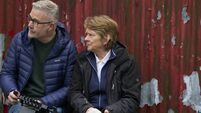
But interestingly, also shines a light on her relationship with husband Nick, the nature of which Kelleher was surprised by.
“The story of Mary and Nick is something that I really think has not been in the public domain,” she says. “And the extent to which she relies on him is something that I would have found very surprising.
“She is really explicit about the role that he has played throughout the course of her career — not just as a support and not just as someone who was holding the fort while she was off traveling internationally. Her preference was always for him to be by her side as a sounding board, as an advisor. That was very surprising — I think there had been a perception of Nick as kind of a 'silent partner' but he's played this really active, very supportive role.” Dublin filmmaker Kelleher first came to prominence through her critically acclaimed documentary series which was broadcast on RTÉ. She also won awards for her radio documentary , which told the story of a female garda threatened with dismissal for giving birth to a baby out of wedlock in 1985.

follows Kelleher’s first feature documentary, , a funny and poignant tale of Glasnevin cemetery and the souls — living and departed — that inhabit it.
Having worked on and with the subject matter of her latest documentary, what does she feel Robinson’s legacy will be?
“She’s been so outspoken on so many different issues that I think her legacy is going to be really kind of complex and multifaceted,” says the filmmaker.
“She put topics on the agenda that I think contributed to extraordinary levels of progress in Irish society throughout the 1990s. The representation she provided for women and other communities around Ireland was really significant, particularly at that point, whether it was bringing in reproductive rights or gay and lesbian rights really to the fore at that time. How we moved from a society that was kind of quasi-theocratic to something much more open and outward looking and with a really significant role for the diaspora and much more respect for diversity.
“The issue of climate justice I do think is going to be really significant. I mean, she talks about the fact that she never spoke about climate justice as President. She never spoke about it in her role in the UN. It was only when her grandson Rory was born and realising, from what she was hearing from communities in Africa, that things were getting so much worse. I definitely think her hope would be that her legacy would focus on climate justice — but I think there's more to her life and more to her career than that as well.”
- is released in cinemas on August 23.