Yoko Ono: Reframing the legacy of a forward-thinking artist
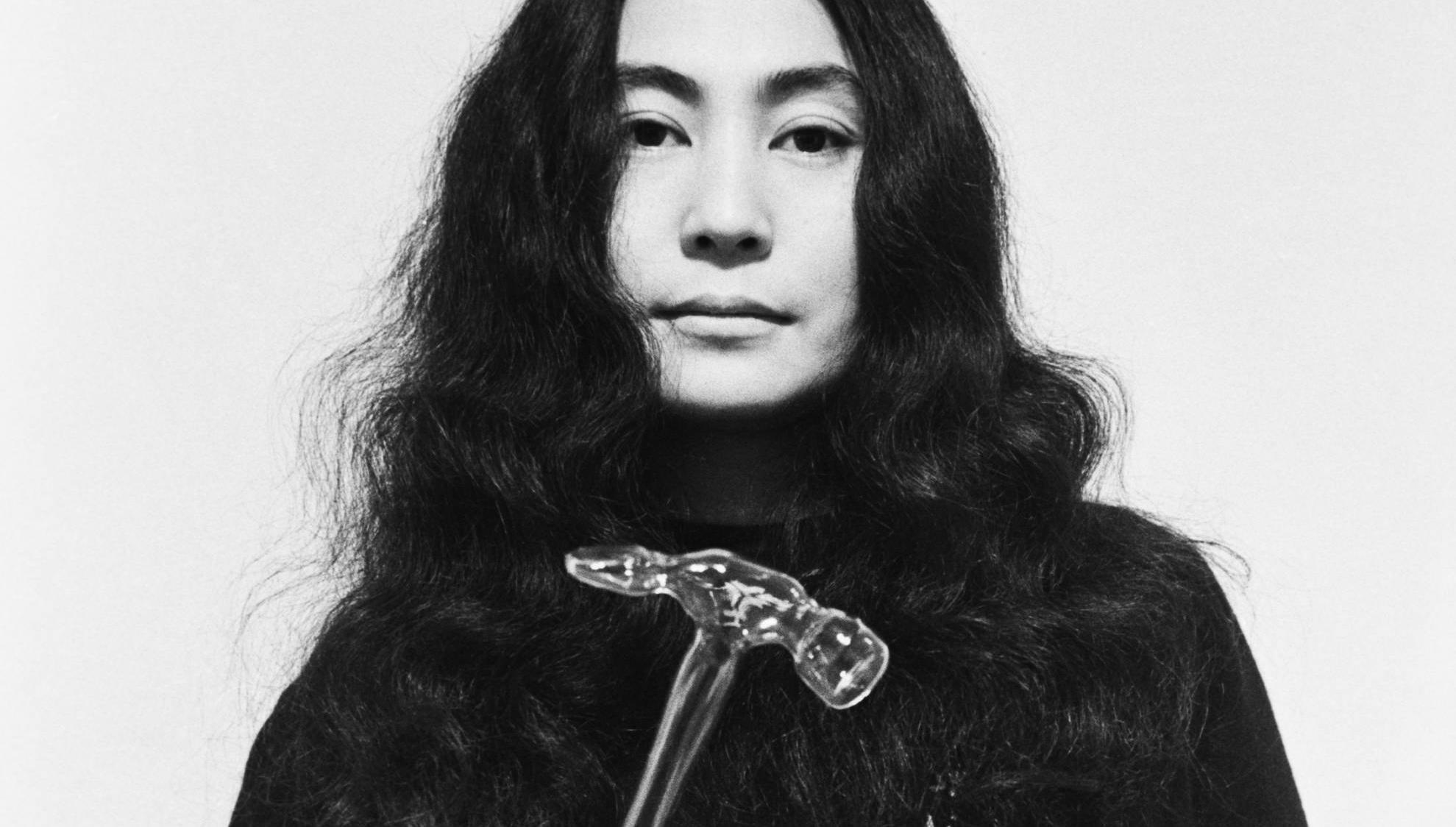
Yoko Ono with Glass Hammer
- YOKO ONO: Music Of The Mind
- Tate Modern, London
- 15 Feb – 1 Sept 2024
It’s not every day that you go to the press opening of a major retrospective at a world-famous gallery and get to draw all over the walls, put your hand through the canvas, hammer nails into canvas, dress up in black fabric bags and roll around on the floor, write messages of peace to hang from specially installed olive trees – and yet here we are, at Yoko Ono’s Music For The Mind at London’s Tate Modern.
Film crews and journalists are earnestly drawing and writing on vast white walls, forgetting we are at work, wholly absorbed in the tasks Yoko has set for us, as we move from room to giant room full of white space and simple instructions.
We become part of Yoko’s work.
We are her materials, her collaborators, transcending the gap between the viewer and the work; everyone, including the Tate staff, is fully engaged.
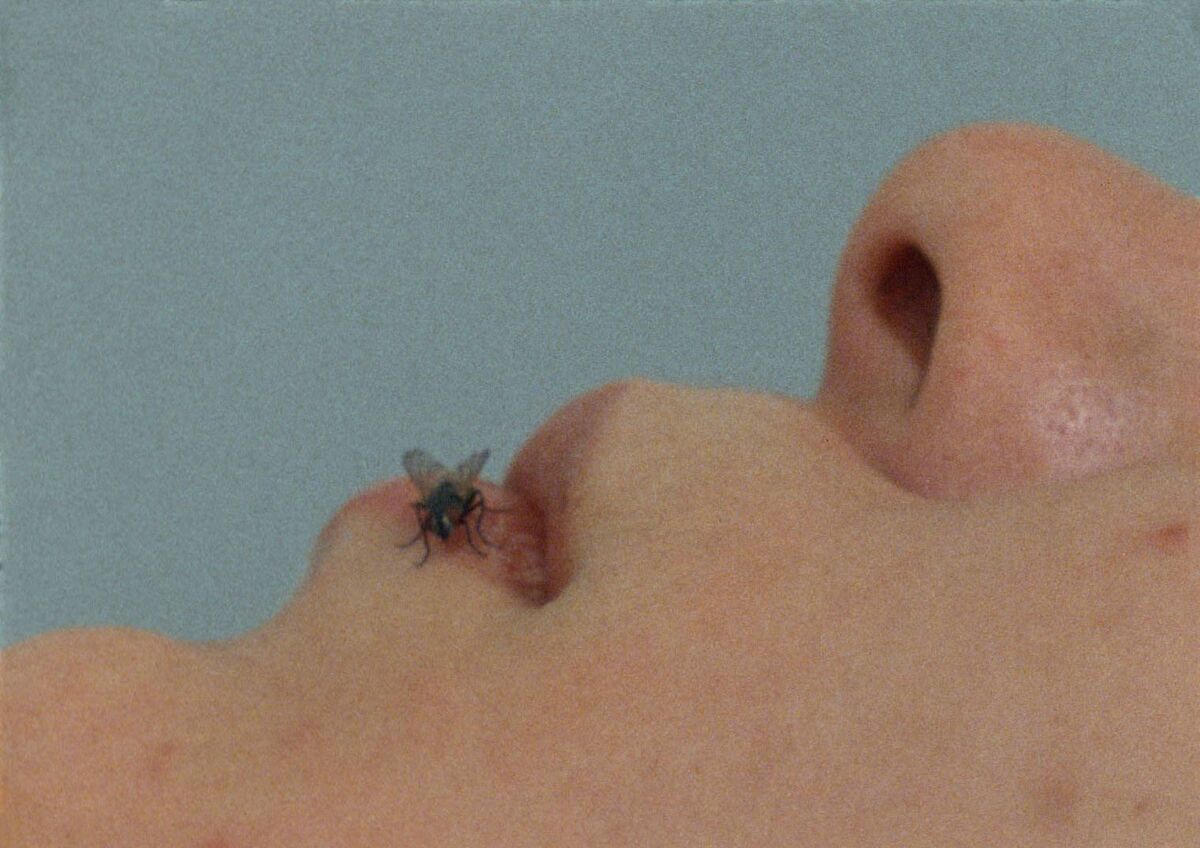
It is a curiously moving and hopeful experience, full of humour – there are flushing toilets, flies, bottoms, poems made of hair, invitations to record the sound of snow falling. Classic Yoko.
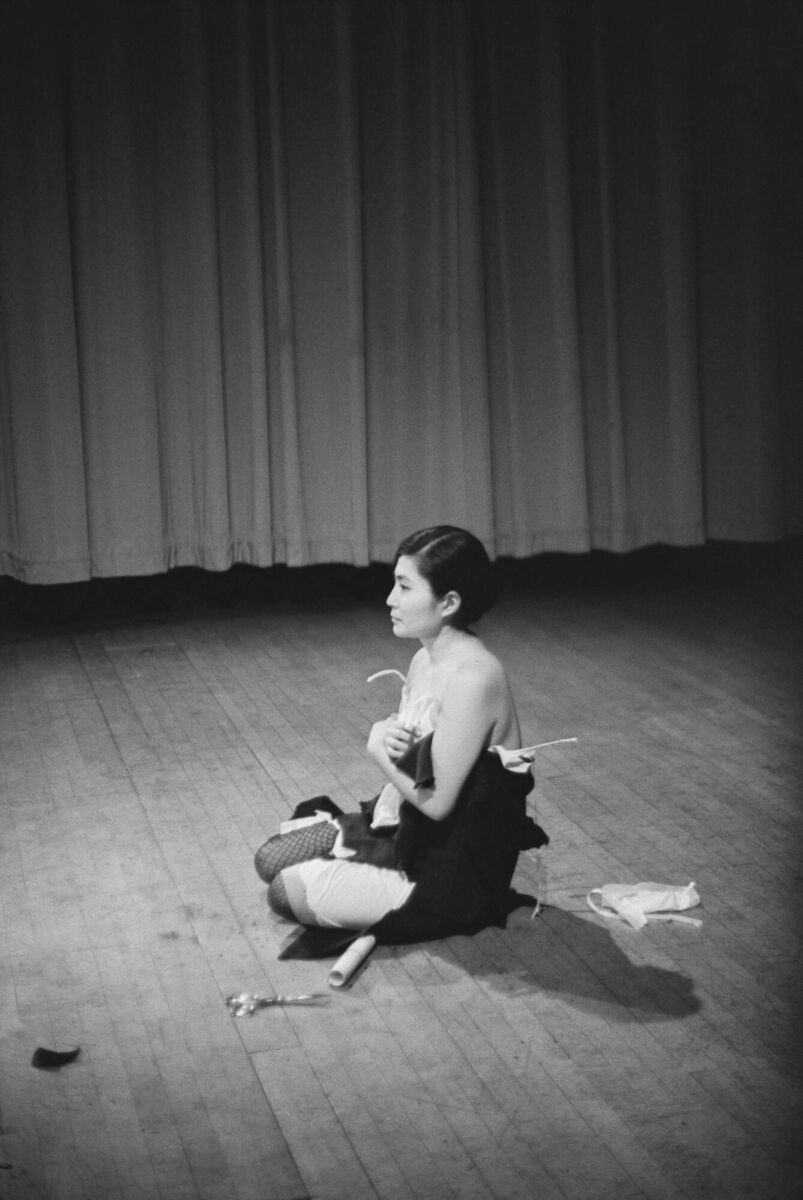
She makes us think. Whether via her participatory work – famously, Grapefruit, her 1960 book of “instruction works” to 2016’s Add Colour (Refugee Boat), originally conceived in 1960, inviting us to colour a small pristine white boat in a white room with blue pens – or her classic performance art like 1964’s Cut Piece, where she sits alone on the floor of a stage in her best suit, and invites audience members to cut her clothes off with a scissors, displaying simultaneous vulnerability and power, quite a long time before Marina Abramovic.
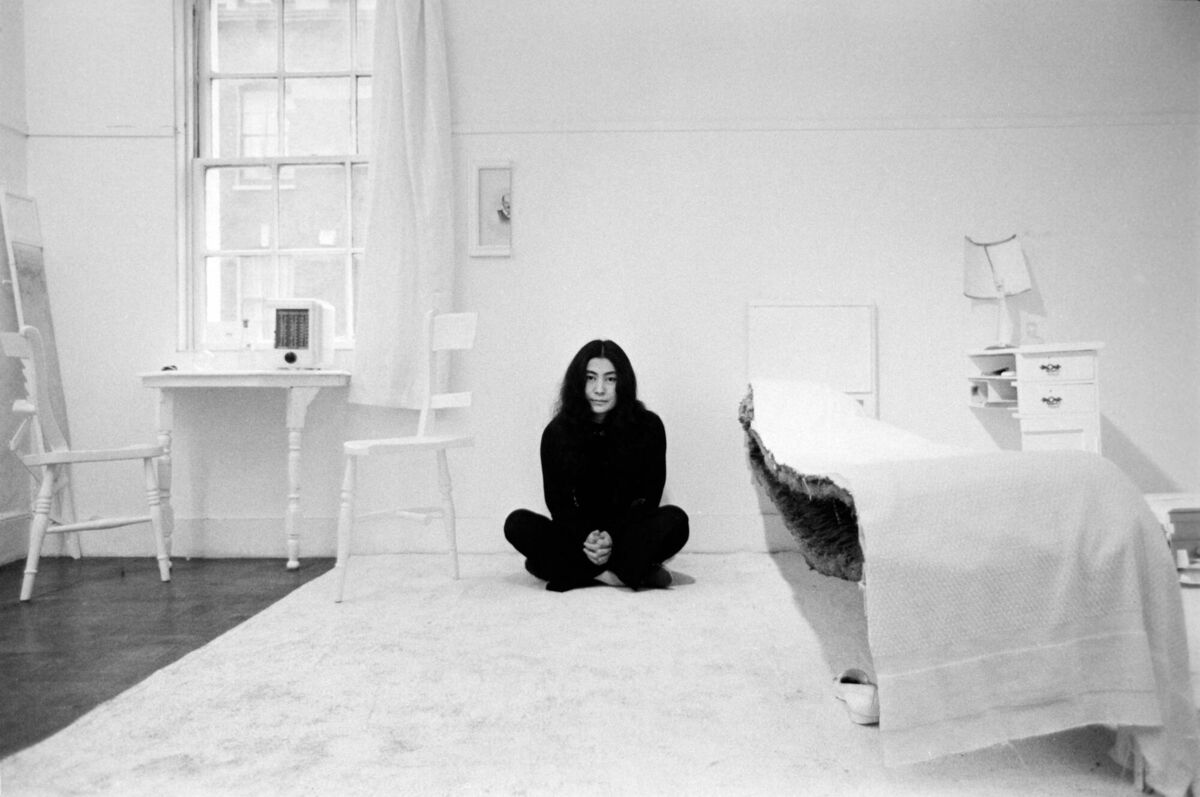
Her 1967 work Half A Room, where the contents of an ordinary room are bisected – shoes, chairs, shelves - predates Damian Hirst’s animal bisections by a quarter of a century. The clarity and simplicity of her work is radical, groundbreaking, singular.
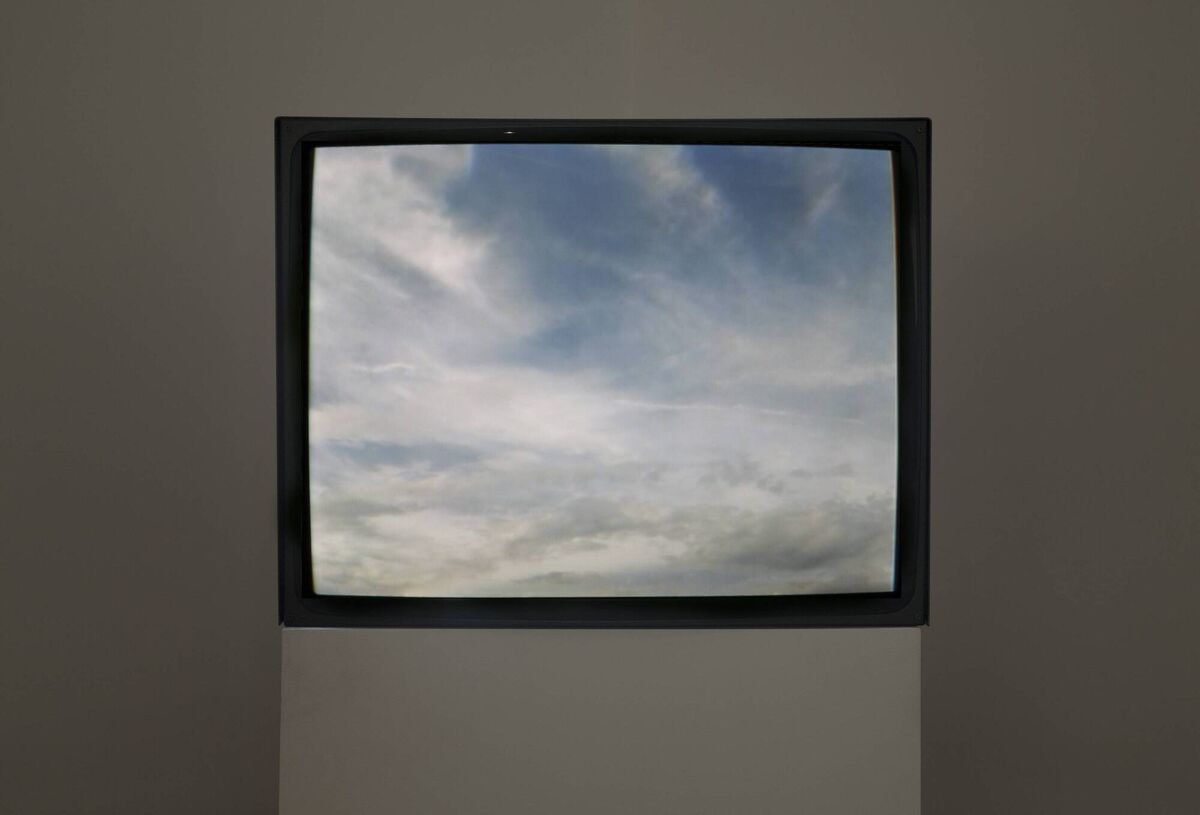
Peace has always been Yoko’s message. Aged 12, when Tokyo was firebombed in 1945, she and her younger brother – the children of elite bankers - were evacuated to the countryside without their parents. The siblings went hungry and had to beg for food. They’d lie on their backs, staring at the sky: “We used our powers of visualisation to survive,” she said. This process of visualisation “was maybe my first piece of art.”
After the war, she became the first female student to be accepted onto the philosophy course at Tokyo’s prestigious Gakushuin University. Moving to New York in 1953 with her parents, she attended the liberal arts college Sarah Lawrence, studying poetry and musical composition (her music career is a whole other thing, having influenced everyone from Sonic Youth to Lady Gaga, as well as co-writing Imagine, collaborating with John Cage and Ornette Coleman, and releasing experimental dance music aged 76).
In 1956 Yoko married her first husband, composer Toshi Ichiyanagi, and she became involved in the avant-garde art scene of 1950s Greenwich Village, causing her parents to disown her. When this marriage ended in 1962, she married jazz musician and film producer Tony Cox – and briefly moved back to Tokyo where their daughter Kyoko was born in 1963.
It was here that Dan Richter, mime artist and author of Sixties memoir The Dream Is Over, first met Yoko, when she was working with Cage on a conceptual piece titled Music For The Mind, before she and Tony Cox relocated to London across the hall from Dan and his wife Jill in Regents Park. They remain lifelong friends.
“She had amazing energy and single-mindedness,” he writes. “She was always working on another project. Everything she did was uniquely hers. Her career was really starting to take off. She was becoming accepted at being in the vanguard of conceptual art.”
“Yoko and I became close friends in 1967, when we lived across the hall from each other in London,” remembers Jill Richter, now 85. “Soon after we met, she arrived with an armful of red wool and a crochet hook – I was pregnant and had to stay in bed – and she taught me how to make dresses and scarves. We spent many hours talking about our children and our lives over the years.”
Everything changed in 1967, when John Lennon turned up to Yoko’s show at London’s Indica Gallery. She’d barely heard of him, and, writes Dan Richter, “wondered aloud if he was really that important.” She described their meeting in a 1967 interview: “When Hammer A Nail painting was exhibited at Indica Gallery, a person came and asked if it was alright to hammer a nail into the painting. I said it was alright if he paid five shillings. Instead of paying five shillings, he asked if it was alright for him to hammer an imaginary nail in. That was John Lennon. I thought, so I’ve met a guy who plays the same game I play.”
Later, Lennon would tell an interviewer, “I learned everything from her. That’s what people don’t understand. She’s the teacher and I’m the pupil.” It was always Yoko who was John’s guru. Inaccurately vilified for breaking up the Beatles, and treated both by the media and Beatles insiders with astonishing misogyny, she helped to liberate Lennon’s thinking; he no longer wanted to be a Beatle. He wanted out.
“They were inseparable,” writes Dan Richter. “It was as though they were breathing each other’s air, thinking each other’s thoughts. John hung on Yoko’s every word…She was not acting like just another Beatles wife.”
She urged Lennon to use his power to promote peace – if he could get millions to tune into words like ‘I want to hold your hand’, he could get millions to tune into words like ‘war is over’. Billboards promoting peace began to appear. Their iconic 1969 honeymoon in Amsterdam – the Bed-In for peace – featured the couple in their pyjamas, surrounded by peace slogans, and accompanied by six-year-old Kyoko.
“I like to fight the establishment by using methods that are so far removed from establishment-type thinking that the established doesn’t know how to fight back,” she said in 1971. In another interview, she added how “Bed-In was theatre. I think what we did had an effect.” It followed on from the couple’s 1969 song Give Peace A Chance, which she believed “opened possibilities to change the world through songs.”
Disaster struck in 1971 when Tony Cox kidnapped Kyoko during an access visit, and went to ground. Dan Richter, now John and Yoko’s assistant and living at Tittenhurst (their Ascot estate where the song Imagine was filmed on that famous white piano) with the two of them and his wife Jill, was involved in all kinds of desperate attempts to get Yoko’s beloved daughter back. They could not, despite their resources, track her down.
Almost unbelievably, Tony Cox kept Kyoko hidden inside an obscure Christian cult in the US, so that she and Yoko were not reunited until Kyoko was 31. One of Yoko’s ongoing projects, begun in 2004 and featured at the current Tate show, is My Mummy Is Beautiful, which invites us to leave a note or a picture about our mothers; awareness of Yoko's loss adds to its poignancy.
In 1975, she became a mother again when she and John had their only child, Sean. Five years later, in December 1980, Yoko and Sean suffered the most catastrophic loss, thanks to a lunatic with a gun outside the Dakota Building in Manhattan, where the couple had been living since 1973. The world’s most famous unknown artist, as John Lennon had called her, was now the world’s most famous widow. She never remarried, but carried on as an artist, ceaselessly campaigning for peace.
Yoko’s sense of self always came from profound self-compassion. “I was kind of alone,” she told an interviewer in 2013. “I wasn’t valued by people…so I started to feel that if no-one else loved me, I had to love myself… I kind of like myself for being that one who survived regardless.”
Last year, after fifty years in Manhattan, Yoko left the Dakota Building for the last time and relocated to the 600-acre Connecticut farm she bought with Lennon in 1978. This is where she is now living out the rest of her days. She has retired from public life, and did not travel to London for the opening of her long-overdue retrospective. Tomorrow – February 18 – will be her 91st birthday.
“She’s such a wise woman,” says Jill Richter. “A beautiful soul. I really miss her, now that we live so far apart. I’m so happy that now she’s getting the recognition she deserves for her art and her vision.”
Happy birthday Yoko Ono, and thanks for always trying to make the world a more peaceful place.