Hats off to Sultan Stevenson in advance of his Cork Jazz Festival gig
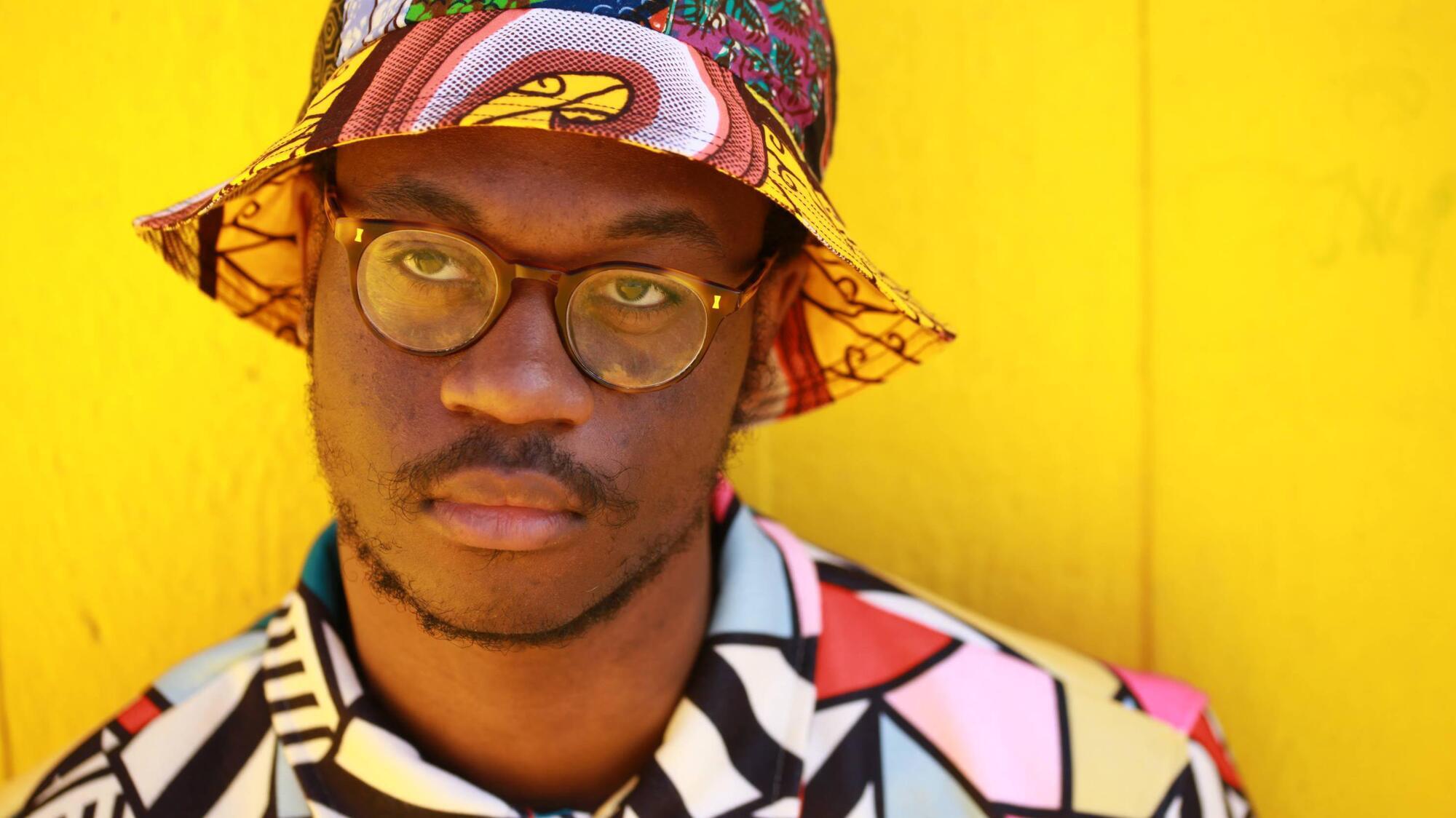
Sultan Stevenson plays in Cork and other centres as part of his Irish tour. Picture: Pat Pascal
Look up the website of pianist Sultan Stevenson, one of British jazz’s most exciting and original new talents, and you will find the usual menu of links to his biography, gigs, news, reviews, interviews and debut album, released in March of this year. What you don’t expect to discover is a heading titled “Hats”.
Featuring the 22-year-old Londoner modelling his own range of bucket hats – in vibrant West African colours and bold geometric patterns – that he himself has created, the webpage explains that in the first Covid lockdown of 2020 Stevenson wanted to find a new and different kind of bucket hat. “After exploring various shops and struggling to find an original and exciting design, I decided to learn how to make my own,” he writes.
His fabrics came from clothes his mother and other relatives were clearing out, he taught himself how to hand sew and use a sewing machine, and he worked on various patterns. Gradually his hats started to take shape. He also got quicker at making them. At one point he had so many that he started to sell them on Etsy.
“I decided to name each hat after jazz pianists, so I began to find ways of linking the patterns and auras of the hats to different pianists I love and who have influenced me,” he says. “There’s a McCoy Tyner hat, one for Geri Allen, plus hats for Herbie Hancock, Thelonious Monk, Alice Coltrane, Bill Evans, Keith Jarrett, Scott Joplin… there’s just so many now in the catalogue. I sometimes joke with some of my musician friends that I bet they can’t name a jazz pianist I have a hat for.”
The bucket hats have not only become Stevenson’s “trademark thing” – he was even spotted unknowingly wearing two at once at a recent gig – but they also have a resonance with his music. The pianist’s compositions display a remarkable creativity, confidence and versatility; it’s as if he has absorbed a great deal of information and is already, at a young age, producing something singular and surprising. Stevenson too is a one-off.

He was born in Dalston and grew up in Tottenham. His mother is from London and his father was born in the Caribbean island of St Vincent, though both families have strong ties to Barbados. Sultan is an Arabic name and has many meanings, including “strength”, “authority” and “ruler”.
“It was my mum who named me,” says Stevenson. “She often jokes that she always knew I would be on stage and have my own artistic voice.”
His parents have both worked in communications, PR and journalism and are big music lovers: his mum sells second-hand vinyl at record fairs and markets; his dad is a serious jazz fan who had been a radio DJ in Barbados and accumulated thousands of CDs. “Growing up, there were CDs in every room in the house, including the bathroom and toilet; you couldn’t escape them,” he says.
At eight Stevenson resolved to play saxophone. “I detested the piano because I thought everyone played it and I wanted to be original,” he says. “But my school didn’t have any saxophones or saxophone teachers. So my dad persuaded me to start with piano lessons. Within 20 minutes I was hooked – all those notes and I could play chords – and I never wanted to go near a saxophone again.”
He took classical lessons and advanced through the grades, but at 13 his father showed him a 1963 video of the John Coltrane Quartet, with McCoy Tyner on piano, playing 'Afro Blue' – and his world changed. “The energy, the intent!” he enthuses.
Soon after, Stevenson began attending Saturday classes at pianist Julian Joseph’s recently formed Jazz Academy. “That was it after that,” he says. “All these amazing musicians were improvising spontaneously and had their own kind of path, but they were all very connected too. I was really, really moved by that.”
By 16 he was benefitting from similar inspiration and encouragement at Tomorrow’s Warriors, the acclaimed jazz education and development organisation that, since it was founded in 1991, has fostered dozens of British jazz stars, including Shabaka Hutchings, Nubya Garcia, Binker Golding, Soweto Kinch and recent Mercury Prize winners Ezra Collective. Stevenson later studied at the prestigious Guildhall School of Music; he graduated this summer with a first-class degree.
This month he plays his debut gigs in Ireland as part of a Music Network tour that includes the Guinness Cork Jazz Festival. Appearing with his young trio of Jacob Gryn on bass and Joel Waters on drums, Stevenson will be joined by estimable tenor saxophonist Denys Baptiste, at one time his teacher and mentor at Tomorrow’s Warriors. “To tour with Denys is massive, an enormous privilege,” he says.
Stevenson will mostly play original music from his album Faithful One, smart and open-ended compositions that have strong melodies, virtuoso soloing, a remarkable variety of dynamics and moods (even within one tune), and swinging grooves, vamps and repeated motifs. “I want to create something that is accessible for jazz fans and non-jazz fans alike,” he has said. “Inclusivity is very important to me.”
As is his Christian faith, which forms a narrative foundation for the music; there are tracks on the album unequivocally titled 'Prayer', 'He Has Made Me Whole', and 'Thank You, Thank You God'.
“The album simulates and explores different facets of the church, the experience of going to church and my relationship to God,” Stevenson explains. “I take a lot of inspiration from Duke Ellington, who was also very interested in this subject and wrote and performed Sacred Music. Not many people have done that, and I really want to continue to explore this intersection of blues, gospel and jazz music.” Amen to that.
- The Sultan Stevenson Trio with Denys Baptiste plays Dublin, Dún Laoghaire, Tralee and Newbridge from 24-29 October (musicnetwork.ie). They appear at Triskel Arts Centre in Cork at 2.30pm on Saturday, October 28 (guinnesscorkjazz.com).

Matthew Halsall (The Everyman, 27 and 28 October): Manchester-based trumpeter, bandleader and record label owner who fuses late 60s/early 70s American “spiritual jazz” with more contemporary beats, samples and sequencing – to heady and winning effect.
Green Room Jazz (Cork Opera House, 27-29 October): A series of gigs in the performance space on Half Moon Street, featuring leading Irish acts Paul Dunlea (with an all-star sextet), Romanian-born folk-jazz vocalist Aleka, and a five-show residency by Cork soulstress Karen Underwood.
Brandee Younger Trio (Triskel, 27 October): Classically trained and in-demand New York harpist whose unique blend of jazz, soul, gospel, Latin and pop is transporting and utterly irresistible.
Amaro Freitas (Triskel, two shows, 28 October): Preternaturally gifted young Brazilian pianist and his trio; phenomenal technique, high-intensity rhythms, joyous music. Expect standing ovations.
Oden Tzur Quartet and Marcin Wasilewski Trio (Triskel, 29 October): A stellar ECM double bill featuring innovative Israeli-born, New York-based tenor sax innovator Tzur (with the great Johnathan Blake on drums) and protean Polish pianist Wasilewski.