Ireland in 50 Albums, No 13: Spring is coming.... Roger Doyle/Operating Theatre

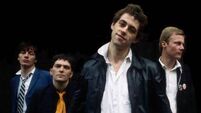
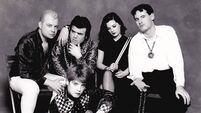
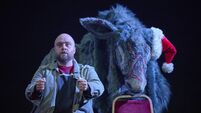
Roger Doyle and Olwen Foueré - the nucleus of Dublin performance group Operating Theatre.
Having undertaken a body of work in contemporary composition in the late 1970s, Dublin musician Roger Doyle was among the first in Ireland to come to terms with the rise of electronic instrumentation and workstations. This pioneering work would later earn him the sobriquet of the ‘Godfather of Irish Electronic Music’.
With an initial interest in composing for stage, he worked alongside equally bold souls in the emerging Project Arts Centre in Dublin - where an encounter with young actor Olwen Foueré would bring about a new collaboration.
“I think I was on their music committee, helping out,” says Doyle. “I got to know the Sheridan brothers - Jim Sheridan ran the Project in those days. I was offered a concert in January 1978, to play a long work of mine called 'Thalia'.
“I thought it'd be great to find a dancer for that, rather than just playing a 30-minute electronic piece to speakers. I asked Jim if he knew any dancers, and he says, ‘yeah, this Olwen Foueré isn't really a dancer, but she's an actress who moves very well. Would you like to meet her?’” Foueré, then 24, met Doyle and when he played his music over the venue’s soundsystem, she started to improvise.
“Basically, when I heard the music, I felt like I recognised something. It was recognition. It was like, ‘I know that planet. It's quite close to mine’,” says Foueré.
The duo formed the nucleus of Operating Theatre - functioning dually as a performance and theatre company, and as a musical project. The first show they worked on was a solo show called The Diamond Body with poet Aidan Mathews, which toured internationally and was even translated into French.
“We also did Sebastian Barry's first-ever play, called The Pentagonal Dream Under Snow, which has been released recently by the Abbey in their Unseen Plays podcast,” says Foueré.
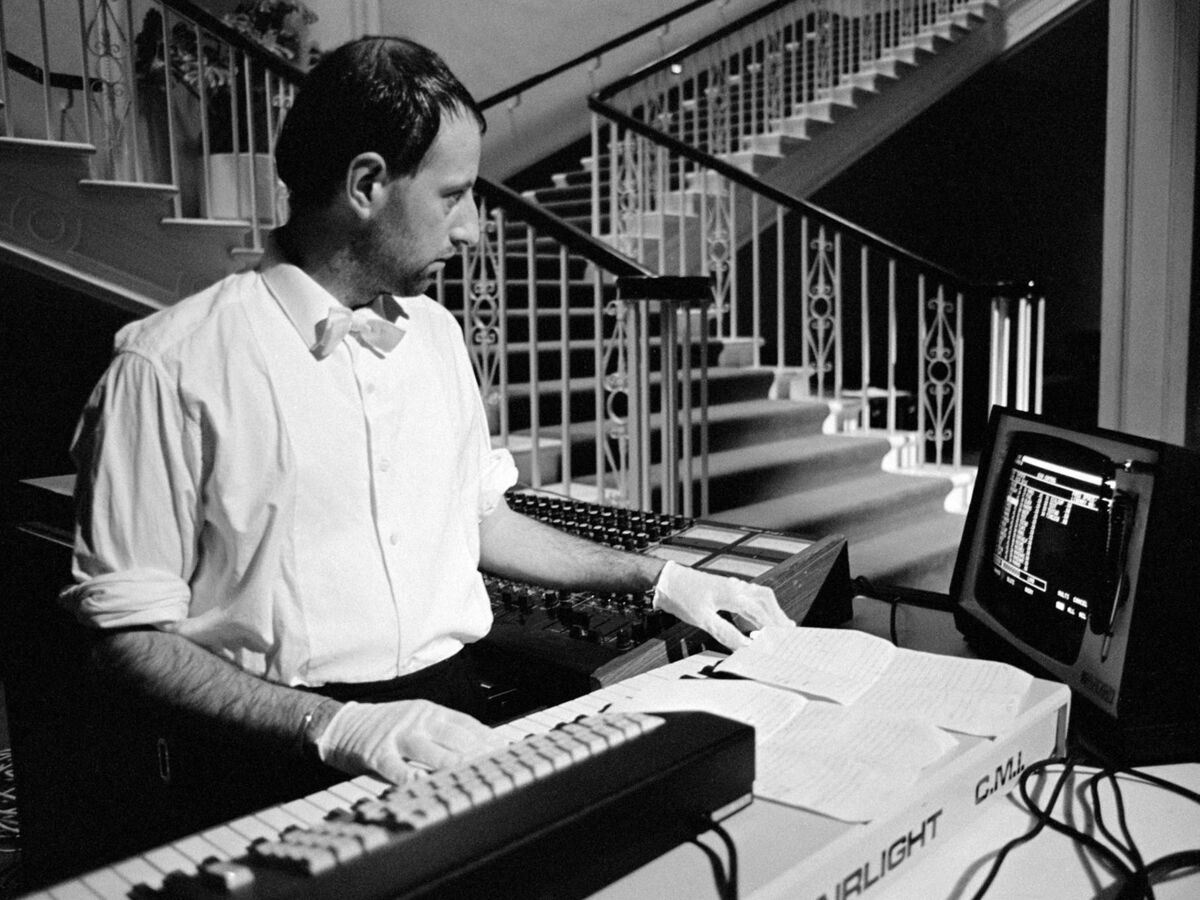
Working with the Fairlight Computer Musical Instrument (CMI) formed the group’s sonic spine. This early synthesiser is credited with popularising the use of samples and was a rare beast in Ireland in that era. A fortuitous meeting in a dole office led to Doyle getting access to the Fairlight.
“For a number of years in my late twenties, I was on the dole,” says Doyle. “In the queue one day, I met Sean Devitt (drummer). Sean says, ‘have you heard about this studio in Bray they're setting up, they're using a Fairlight?’ And I said, ‘what's that?’. He told me it's a Star Trek-type synthesiser, very new and very, very high-tech.
"And I said to him, ‘Jesus, do you know the people? For God's sake, tell them about me’.” Doyle even moved to be near the incredible machine he says the studio owners bought for £24,000. He admits man and machine didn’t always have a smooth relationship.
“I literally flung the manual against the wall, at least twice, in total frustration. The technology was totally new to me. I didn't know what sampling was, for instance,” Doyle explains.
Throughout the early 1980s, Operating Theatre released a string of records with various labels. Doyle’s solo piece ‘Rapid Eye Movements’ was initially released independently under the Operating Theatre moniker, with a pair of singles to follow on Ireland’s CBS imprint. Debut album Miss Mauger was released in 1982, on Kabuki, a UK-based label specialising in Irish artists that also released music by the likes of Microdisney and Five Go Down To The Sea.
A demonstration of the CMI’s capabilities on RTÉ’s Live Arts show in 1983, including the premiere performance of ‘Part of My Makeup’, led to Doyle getting a call from U2 vocalist Bono - desirous of piano lessons, of all things. It was while playing back one of his compositions to Bono during a lesson, that the germ of the group’s next musical step emerged.
“We both lived in Bray, just yards away from each other,” recalls Doyle. “I was over at his place, and I played him the original version of 'Spring is Coming' with no drums or singing. He said 'Jesus, that needs drums. And do you know anyone who could sing over it?' It was terribly exciting to have the Fairlight at Windmill Lane studios, Bono producing, and my friend Elena Lopez joining us.”
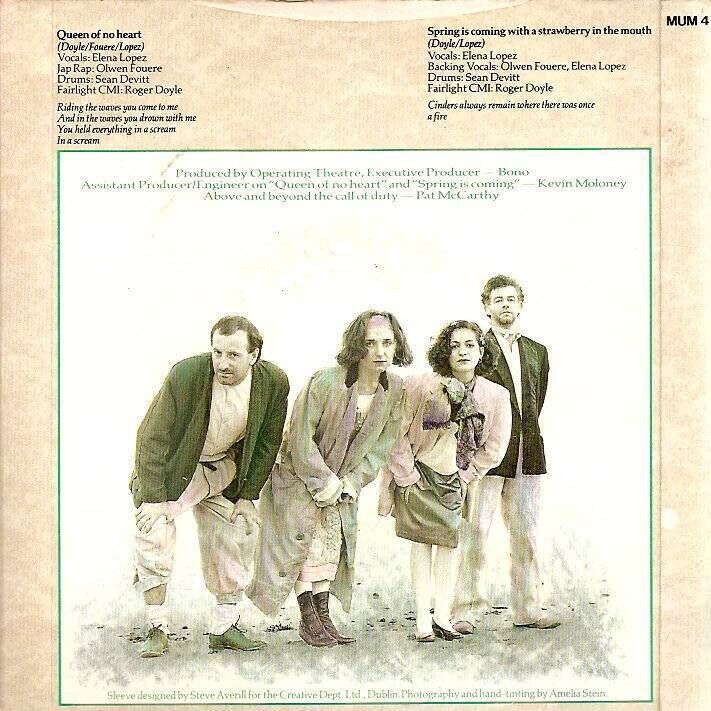
Released in 1986 as a double A-side 7” single, and heading up an expanded 12” EP, ‘Spring is Coming with a Strawberry in the Mouth’ and ‘Queen of No Heart’ saw the light of day via U2’s Mother label. The latter had five tracks that made up its initial release - with Bono at the helm as an executive producer, and making a rare guitar contribution.
“In those days, he was very down to earth, very friendly, easy to work with,” says Doyle. “He coaxed Elena into singing on those tracks. He kept asking her back in to do another take - he worked her hard. I had all the synth tracks done, and Sean Devitt did wonderful drumming.” Another track, ‘Atlantean’, would later appear on the soundtrack to the Bob Quinn film Budawanny.
Mooted as a developmental label, Mother was often credited with giving young Irish bands of the age quality studio time and production. Doyle, however, isn’t happy with the support the label gave his work after release.
“It was very disappointing. I had such expectations of it, obviously, because of the muscle behind [Mother and the U2 machine]. I thought, ‘they don't have to do much to promote this’,” he says.
“They never pushed it. I don't think anyone played it on the radio. I certainly was never interviewed, I don't think there was even any review anywhere. I'd say it was the biggest disappointment of my professional life that it didn't take off.”
While the EP itself may have disappeared without trace upon its release - with Operating Theatre disbanding in 1988 before a second run of work between 1999 and 2008 - a number of factors have informed the re-emergence of Spring is Coming in recent years.

Now a Saoi of the Aosdána artistic circle, Doyle’s legacy is finally being honoured in recent years by the Irish music scene, with his work undergoing a number of reissues across digital and physical formats.
“On Spotify, 'Spring is Coming' has got 500,000 plays, and 'Queen of No Heart' has about a quarter of a million,” marvels Doyle. “It's obviously been on various people's playlists, it keeps going, and it doesn't slow down. It's a pleasant mystery for me - I'm thrilled that it has a life out there.”
“I think it's been great for Roger,” adds Foueré. “For the amount of output and the pioneering work he's done, his recognition is not as big as it could be. For him to have this validation from this generation, from our point of view, it's great because at the time, we felt it was a very pure creative path - we were making work that had to be made, and that was not being made anywhere else.”
- Roger Doyle performs at Clonmel’s Junction Arts Festival on July 1 - including live performances from newest albums ‘Suite of Affections’ Vols. 1 and 2, and the world premiere of new commission ‘In the Dreemplace’, a 30-minute composition for violinist Aoife Ní Bhríain.
- For more info, see: https://www.junctionfestival.com/events/in-the-dreemplace