Colin Davidson, artist: 'I've a deep conviction that victims of the Troubles were really sold out'
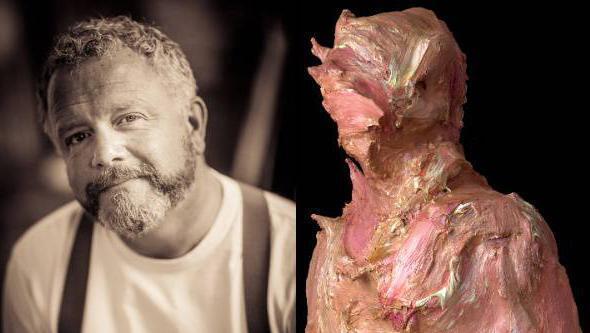
Colin Davidson and one of the figures in his new exhibition at the RHA.
Colin Davidson’s Stranger exhibition at the Royal Hibernian Academy in Dublin features six larger than life-size human figures. Some are recognisably male, and others female, but otherwise there is no clue as to their identity; all are faceless and unclothed. The figures are arranged in a loose circle; they appear to be emerging from the floor, and more surprisingly, to be composed of great globs of paint.
“It’s a new process I’ve developed over the last five years,” says Davidson. “I sort of joke about it and say there wasn't a YouTube tutorial, but really, there’s no one else doing this. I had an idea about 20 years ago; I was very aware of the viscous sculptural quality that oil paint could bring to a painting, and I was thinking about the potential of making paintings in three dimensions and using oil paint to sculpt with rather than clay or wax. I had in my mind that I could create these three-dimensional figures that would not be terribly distinct, but would be more like presences, made from paint.”
Davidson, a native of Bangor, Co Down, is best known for his large portraits in oils of public figures such as Bono, Brad Pitt, Barack Obama and Angela Merkel. But he has, he says, been experimenting with sculpture since his days studying art at the University of Ulster in the 1980s.
“Periodically, I’d play around with clay and wax as part of my studio practice. But until now, it never led me to produce something that would coherently hang together as a body of work. I see these new sculptures as an extension of my painting, which has always had a tactile sculptural surface quality to it. There can be a violence to the way that I apply paint at times, which was really, I suppose, the trigger for the three-dimensional work.”
Davidson’s process begins with him fashioning a maquette, a wire armature about 15 centimetres high, built out with wax and then sculpted around with oil paint.
“I scan that through photogrammetry,” he says, “enlarge it on the computer and then print it out on 3D printers that I have here in the studio, before gluing it all together and then attacking it with acrylic paint. I use acrylics because they will be dry within a week; if I used oils at this thickness, they would take decades to dry.”
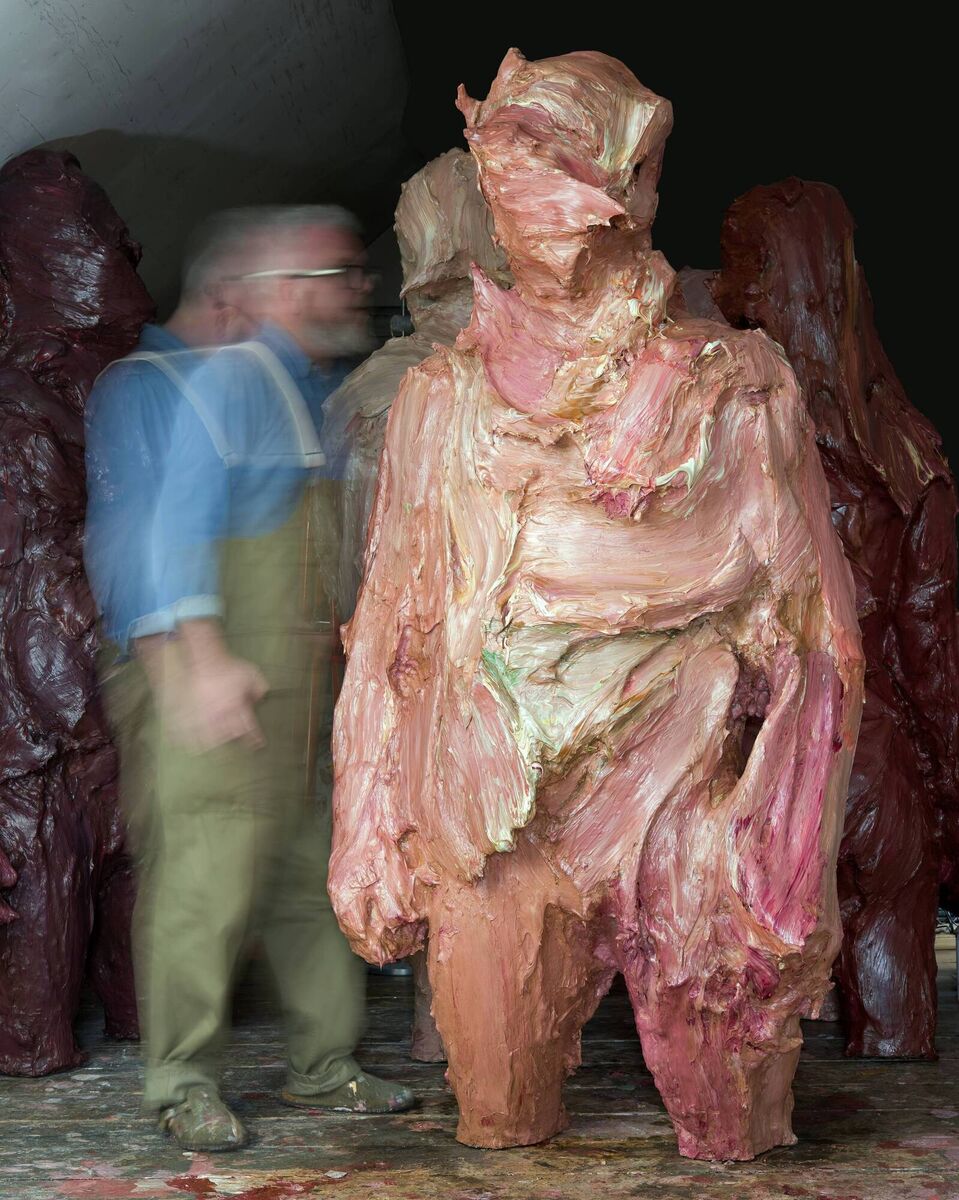
The first sculptures Davidson produced in this vein included instantly recognisable portraits of himself and the singer/songwriter Glen Hansard. They were very much a 3D variation on his paintings, but the pieces at the RHA are something else again.
“I call the exhibition Stranger,” he says, “because I was interested in there being no reference for either myself or for anybody else as to who or what these presences might be. It’s still possible to work out the figures’ gender, but I found myself removing all the references to specific facial features. Beyond that, I wanted to allow the viewer to interpret them in their own way, without me spelling it out. There is a great sense of freedom about that. A sense of letting the paint do its own thing.”
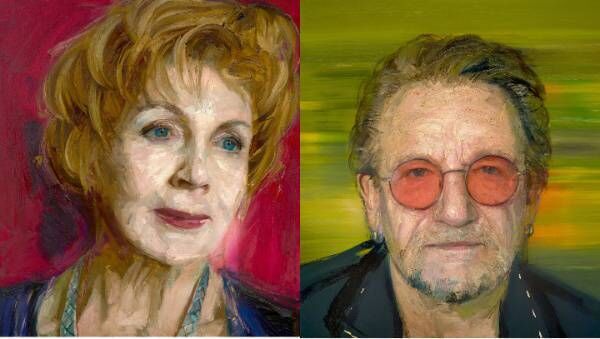
Davidson’s RHA exhibition coincides with the launch of a new book by Merrion Press, The publication features a selection of Davidson’s paintings from throughout his career, and a series of dialogues between the artist and the author; Carruthers is a prominent BBC Northern Ireland journalist and a long-time friend. If the Stranger project points to the possibilities of Davidson’s future as an artist, the book serves as a celebration of his achievements to date; included are portraits of figures as diverse as the late Queen Elizabeth II, Edna O’Brien and Virtue Dixon.
Davidson first met the British monarch in 2012, when she visited the Lyric Theatre in Belfast. By the time she sat for him, in May 2016, she was 90 years old, and they had just two hours together, in the Yellow Drawing Room at Buckingham Palace. The queen had already sat for portraits by the painter Lucien Freud and the photographers Cecil Beaton and Annie Leibovitz, amongst others.
“You're aware of the gravitas of the sitter,” says Davidson, “and of all that’s gone before. But you can't let that put you off making an honest painting. That’s always what I strive for. Hopefully something new will be revealed, but that’s all in the eye of the people who view it.”
Edna O’Brien he remembers as “remarkable, a true Irish great. We kind of clicked. She got what I was about. She understood my process and she ultimately related and responded to the painting in a positive way.”
Davidson’s portrait of Virtue Dixon was part of his Silent Testimony project of 2014/15, for which he painted 18 people who experienced loss in the violence of the Troubles in Northern Ireland.
Dixon’s daughter Ruth was one of 17 people killed in a bomb attack on the Droppin Well public house in Ballykelly on December 6, 1982. She had just turned 24, and one witness would later recall that the DJ was playing Happy Birthday for her at the moment the bomb exploded.
Silent Testimony was, says Davidson, “born out of nothing other than a deep, deep conviction within me that the victims of the Troubles were really sold out. I voted for the Good Friday Agreement, you know, but it had many flaws, as any compromise does. One of the glaring flaws for me was the fact that the victims and survivors were really not mentioned, save for a few lines. And that's where the idea for Silent Testimony came from. The Ulster Museum showed the series first. And then, until earlier this year, it was at the National Portrait Gallery in London. That body of paintings is, to me, my most important project. It changed my life.”
Despite the demands of his international career, Davidson is content to continue living in Bangor. “I do travel quite a lot,” he says, “particularly for portrait sittings and exhibitions. But I was never really tempted to move aware from here. Psychologically, I need the grounding. I need somewhere that is a constant, and this is it.”
One of his major projects for 2026 involves the creation of three public sculptures in bronze, to be arranged along the marina near his home. “They’re being cast in a foundry in Dublin, and we’ll install them later next year. One will be the largest bronze in Ireland, at three metres high. I can't really say much more about them, but I think my inspiration was very much taking into account what Bangor means to me. Bangor is basically a Victorian seaside town at the end of the train line from Belfast, but the redevelopment work that's happening here just now is incredible, it’s breathing new life into the town, and my sculptures will be part of it.”
- Colin Davidson, Stranger is at the Royal Hibernian Academy, Dublin, until January 25
- Further information: rhagallery.ie; colindavidson.com