Ireland in 50 Albums, No 1: Good Year For Trouble, by the Sultans of Ping 
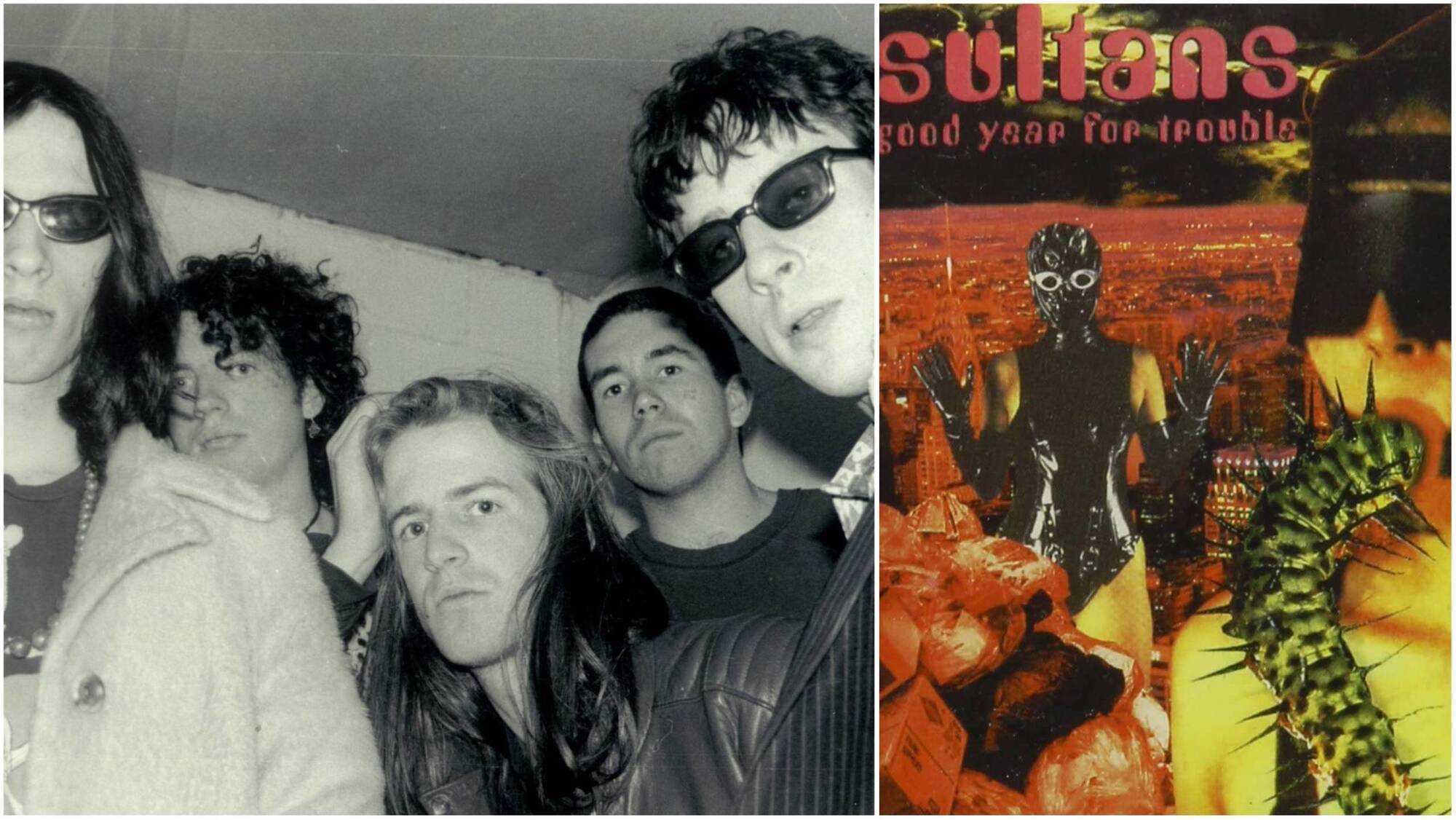
The first instalment of our new series looks at the Cork band's third album, an impressive offering despite its arrival at a time when the group's profile was on a downward slide 
Ireland in 50 Albums, No 1: Good Year For Trouble, by the Sultans of Ping 

Good Year for Trouble by the Sultans of Ping

It's alright to say things can only get better – but by 1996 the lights were going out one by one for Sultans of Ping. 

After years of success, the band were watching their career unravel one stitch at a time, as sales dipped and column inches shrank. And then came the final blow: an American tour that never was.

“A promoter in the US wants to bring us over for two months,” recalls drummer Morty McCarthy “The plan to pay for the tour was half the shows were in Irish bars and Irish clubs. And then the other half were your traditional indie venues.

“But the guy that said, ‘Look, you’re going have to play Where’s Me Jumper? and Stupid Kid. You’re going to have to play the songs people know to get an audience’. And Niall [O’Flaherty, singer] and Pat O’Connell [guitarist] refused. They said ‘No: that’s four or five years ago. We want to play the new record’. And that was one of the reasons the band didn’t keep going.”

Good Year for Trouble, by the Sultans of Ping

Sultans of Ping are today celebrated as one of the greatest Irish groups of the 1990s – and one of Cork’s most important cultural
exports. Their songs brimmed with wit and irascibility, marrying 1990s indie melodies and propulsive punk. 

However, by 1996, there was a sense that they had been eaten alive by Britpop, with its flag waving and its championing of Little Englander boorishness. They would split before the year was out.

Yet rather than slink into the sunset, they went out with a blaze of defiance. In June 1996 the band – following record label
advice they had trimmed their name to The Sultans – released their third album, Good Year For Trouble. 

And it was that LP Niall Flaherty and guitarist O’Connell wanted to put front and centre of that US tour that never was. Looking back, Morty McCarthy still talks about that time with a degree of regret.

“I thought, this is our only option now. We’re going nowhere in the UK. This is an opportunity to start the band again in the US,” he says. “They just didn’t want to compromise. There was a big split around then for sure.”

McCarthy’s frustrations were understandable. But you can also see why O’Flaherty and O’Connell would wish to champion Good Year For Trouble. 

Because while the album is today overshadowed by early Sultans hits such as Where’s Me Jumper and Back In A Tracksuit , Good Year For Trouble – which can be listened to via the group’s Bandcamp page – is worth rediscovering.

This was, in some ways, the Sultans at the height of their powers. It is lean and clean-burning and contains some of their strongest material, such as zinging glam stomper Mescaline and the frenetic Rubberman. And it showcases a different side to the Sultans, in that it strips out the humour that was a feature of their previous long-players, 1993’s Casual Sex in the Cineplex and 1994’s Teenage Drug.

“We were excited about it at the time,” says O’Flaherty, today a senior lecturer in the History of European Political Thought at King’s College London. 

“The way we thought about it was…finally this is the record that we want to be doing. The kind we want to make. On the other hand, it was tough to sell a record like that. We’d won an audience playing more melodic punk pop. This had a bit of a harder edge. 

"In terms of the album itself, we were proud of it.” 

Here is the story of the project

EARLY DAYS

The Sultans formed in Cork in 1988 and created a huge splash with ‘Where’s Me Jumper?’ four years later. Arriving in the terribly serious days of the “shoegaze” movement, when alternative music was dominated by mooching droning outfits such My Bloody Valentine, it spilt over with irreverence. And landed like a playful slap across the face.

They were widely beloved – not least by the then all-powerful British music press. Soon there was hype around a semi-fictional “Corkchester” scene – comprising of the Sultans, the Frank and Walters and emerging groups such as Emperor of Ice Cream.

Niall O'Flaherty, singer with Sultans of Ping

It wasn’t long, though, before publications such as the NME and Melody Maker got bored, looked elsewhere – finally embarking on the orgy of jingoism that was Britpop. And the Sultans were left twisting in the wind slightly.

This, at least, is the commonly-told version of the story. O’Flaherty remembers it differently. If the Sultans were ever music press darling it was for only a fleeting moment, he says. One that ended almost as soon as it had begun.

“The story is probably from our perspective feels a bit different to that,” says O’Flaherty. 

“We came in with a bit of a bang, publicity-wise, for sure. For the main part that didn’t last long at all. Everything we did we built up by touring. We toured and toured and toured and toured. We didn’t feel so much at all ever that we’d been flavour of the month and then we weren’t, in terms of the music press who were very powerful back in the day. 

"They really could make or break you. We never felt we’d been the flavour and then we weren’t. We did feel that times were changing somewhat. And also, if we’d kept making records more like the first record, perhaps things might have been different. That isn’t what we wanted to make.”

MIDDLE YEARS

As O’Flaherty says, the Sultans weren’t interested in churning out facsimiles of ‘Where’s Me Jumper?’ But their unwillingness to compromise came at a price. And by 1996 the decline in their commercial profile was starting to bite.

“Financially we weren’t making any money,” recalls McCarthy, who had by then started working in music merchandising (a career he has continued to this day – he speaks to the Irish Examiner from Prague, where he is touring with Radiohead side-project The Smile).

“We all had to do different things. I was doing the merchandise. Pat started to work in finance. For four or five years we were getting a weekly wage from the Sultans. And when you’re getting money in your pocket you’re thinking, ‘oh this is alright. ’”

As the money dried up, McCarthy feared the worst. 

Sultans of Ping
Sultans of Ping

“It did feel like the end. It was such a quick evolution for the band, from the first album to the third. I think it was too quick for a lot of fans. I don’t think most bands would change their songs that quickly. We didn’t pick up a new audience either. It was tough.”

That isn’t to say they were ready to throw in the towel. The success of the debut, 1993’s Casual Sex in the Cineplex, had given them a great deal of confidence, says O’Flaherty. And they had built on that with Teenage Drug – a brighter brasher cousin of Casual Sex (and the singer’s favourite Sultans LP).

“When we went to make the second album, we stopped saying, ‘What the hell is going on? How the hell have we been signed?’ And we started saying, ‘This is what we do now’. You start to get an idea, maybe this is your career here. A little bit of self-belief comes in. 

"And of course, you’re not in your hometown anymore. You’re on the road every day. Your life experiences are different. You feel the world’s your oyster. You can do whatever you like, more and more. That doesn’t necessarily mean people will go along with you. But it’s how it felt
to us.”

And there were still bright points. Earlier in 1996, they toured Italy with The Ramones. And then came the offer of a lifetime: to open for the
reformed Sex Pistols at the Le Zénith Paris on July 4 1996.

“We don’t know how it happened. We just got a phone call. It was a mystery. Quite bizarre. We were on the way down and then suddenly got
offered this. It was one of the best venues in Paris.”

Playing with the Sex Pistols to 10,000 moshing French people was a departure. And so, in a different way, was Good Year For Trouble.

O’Flaherty, in particular, had started to bridle at the cliche of the Sultans as “wacky” Corkonians. That they were a novelty or comedy band.
Humour had a place in their writing – so did irreverence, anger and a belief in punk’s philosophy of ripping it up and starting again.

“When there’s a little bit of humour to what you do, that humour can come to define you. I remember Irish comedians reviewing us in a magazine and saying, ‘Where’s Me Jumper? was hilariously funny. This record isn’t funny at all’ .

"Well, we’re not stand-up comedians. Anything that could reduce that expectation that you’re going to get another funny one coming up…that is what we were trying to do. And trying to be recognised for the songs.”

One of the ways in which they went about overhauling their sound was with an additional guitarist.

“We wanted to beef it up,” recalls McCarthy. “Niall was for a more rock approach. It was actually one of The Shanks, another Cork band, who said, ‘you know Sammy Stieger from the [Dublin garage-punks] the Golden Horde has moved to London’. I said it to Niall and he said, ‘yeah he’s going to be in the band – just get him’. We were all big fans of the Horde and supported them many times. A perfect fit.”

MAKING THE ALBUM

Good Year For Trouble was recorded at (since shuttered) Blackwing Studios, built inside a deconsecrated church in southwest London. It had been established in 1982 by Eric Radcliffe, a producer from Basildon in Essex who had worked with Vince Clark and Alison Moyet on their Yazoo project.

Blackwing subsequently became a favourite base for Depeche Mode (also from Basildon and Clarke’s former band). It was where Pixies made Trompe Le Monde and Nine Inch Nails recorded segments of their debut, Pretty Hate Machine. The Sultans bunkered down with Steve Lovell, a veteran who had worked with Julian Cope, Flock of Seagulls and who had produced the debut album by Dublin’s A House, On Our Big Fat Merry-Go-Round.

“It was a very good studio,” says Morty. “My Bloody Valentine recorded there. A lot of the shoegaze bands did. Steve Lovell was great to work with. He always got the best out of us. Lifted us up a level. We listened to and respected him. A perfect mentor for us.”

There were external pressures – in particular, as McCarthy says, the financial exigencies. But they left all that outside the studio.

“We did rehearsals for a couple of weeks every day. It could have been 10 or 12 days where we recorded the album. It was a good sound,” says McCarthy. 

A more recent version of Sultans of Ping. The band have two homecoming gigs coming up in Cork. 

“We’d liked the sound. We weren’t adding extra things. It was a rock record and was played and recorded as a rock record. Listening back to it now, most of it holds its own. It’s something to be proud of.”

“The idea was we want to sound as live as possible. We were working hard,” says O’Flaherty. “We were touring hard at the time. We were tight enough to go in and do that. We went in a smashed it out to a large degree.”

O’Flaherty was always the main songwriter. But by 1996 he’d opened up the group somewhat. 

“As we went on, the rest of the band influenced the sound more. They had the confidence to put their ideas forward. And had plenty to contribute. So maybe that side of things changed. Became less dictatorial.”

The fruits of their newly-democratic labours have certainly stood the test of time.

Good Year For Trouble can be listened to on the Sultans of Ping Bandcamp page. The band play Cork Opera House on February 10 and 11

x

More in this section

Scene & Heard

Newsletter

Music, film art, culture, books and more from Munster and beyond.......curated weekly by the Irish Examiner Arts Editor.

Cookie Policy Privacy Policy Brand Safety FAQ Help Contact Us Terms and Conditions

© Examiner Echo Group Limited