Cork In 50 Artworks, No 29: John Burke’s sculpture at Wilton Roundabout
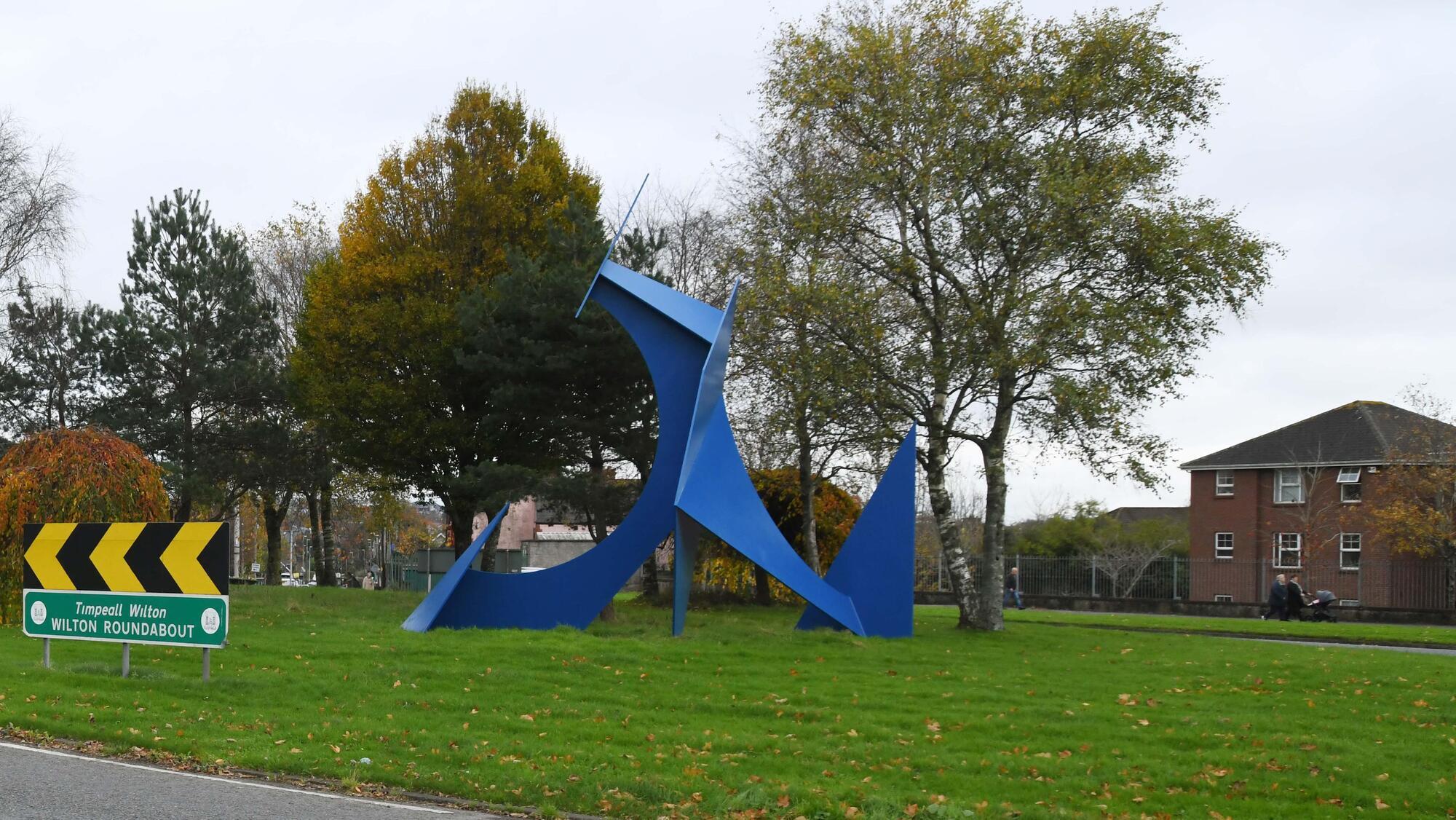
The sculpture by John Burke at Wilton roundabout, Cork. Picture Denis Minihane.
John Burke’s abstract metal sculpture attracted no end of publicity when it was installed at the Wilton Roundabout in Cork in December 1984. The piece – 25 ft high and eight tons in weight - was commissioned by local businessmen Clayton Love and Séamus Gallagher to inaugurate the Cork 800 celebrations the following year.
Painted a distinctive blue, the untitled sculpture was mistaken by many as a location marker for airplanes flying into Cork Airport, a misapprehension that spoke to how little knowledge or appreciation there was of contemporary art in the city at that time.
“John got an awful slagging about it, from people in the pub,” says his friend Frances Lynch. “He didn’t care. If you asked what his work was about, he’d say it was up to yourself what it meant.”
Burke was already well established as an artist by this time. A founding member of Aosdána, he often showed abroad, in cities such as Munich, Brussels and London, and in 1977, he’d had a prestigious exhibition in New York, opened by Justin Keating TD, Minster for Industry and Commerce.
His success had not been a given. Born in Clonmel in 1946, Burke showed little promise in school, and might never have gone on to study art had it not been for the encouragement of an early mentor.
“John was dyslexic,” says Lynch. “But Barry Maloney, his principal at the Technical School in Clonmel, encouraged him to apply to the Crawford Municipal School of Art. He really blossomed in that environment.”
On graduating in 1967, Burke was awarded Student of the Year. He also won a Macauley Fellowship, which funded a course of study at the Royal College of Art in London. There, his teachers included the British artists Anthony Caro and Bryan Kneale, who introduced him to welded steel sculpture.
“John always acknowledged Kneale as a bigger influence than Caro, but he was friends with both,” says art historian and writer Catherine Marshall, who curated an exhibition of Burke’s work at South Tipperary Arts Centre in Clonmel in September 2020.
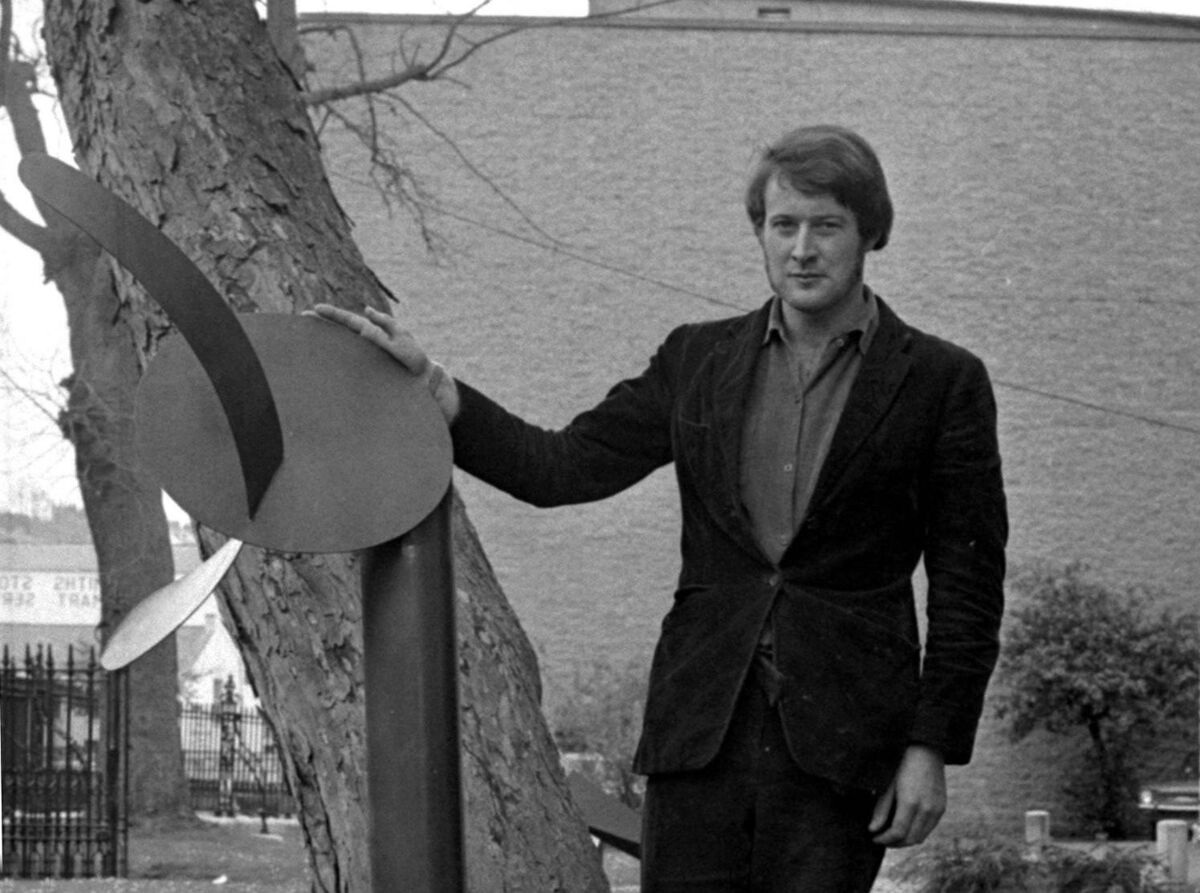
After London, Burke travelled throughout Europe, North Africa and the Middle East, and also spent time in New York. “In America, he became familiar with the work of the abstract sculptor David Smith, who was probably his biggest influence,” says Marshall. “When he came back to Ireland, he was like a breath of fresh air. He was a modernist artist, and led sculpture away from the figurative work that had been in fashion up till then. He worked in metal, and used a lot of colour.”
Burke had his first solo show in Cork in 1973. He was fortunate in that his early career coincided with a boom in building development, and his work found favour with one of the country’s leading architectural practices.
“Scott Tallon Walker were known for designing buildings that were like austere glass boxes, and John’s brightly coloured sculptures worked very well with them. So he benefitted from that association, and won a number of significant commissions.”
One of those was a piece now known as Red Cardinal, which takes pride of place in the courtyard of the Bank of Ireland on Baggot Street, Dublin. It is arguably Burke’s best-known sculpture, though the name he originally gave it was Zip Fastener.
Burke remained in Cork for the rest of his life, and was heavily involved in a number of local initiatives; he helped found the Triskel Arts Centre, and was one of the organisers of the groundbreaking SADE exhibition of contemporary art in the Crawford Art Gallery.
In the late 1970s, he also taught sculpture at the Crawford College of Art. “He was a great educator,” says Marshall, “and a huge influence on people like Eilis O’Connell, Maud Cotter and Vivienne Roche, all of whom are still working away in Cork, and John Gibbons, who has gone on to have an international career as a sculptor.”
Burke eventually left teaching, to set up a studio at Bowen’s on the Lee Road, but he was still on the staff when Lynch first met him, while she was studying painting at the Crawford.
Later, as she established herself in business in the antiques trade, Lynch began collecting his sculptures. “I was John’s patron,” she says. “These days, I am the guardian of his artistic legacy, and the only person who can authenticate his work.” Lynch lent several pieces for the exhibition at Clonmel, including a number of his Black Forest series, which had never been shown before.
Catherine Marshall, curator of the retrospective exhibition told the Irish Examiner at the time: "In the 1970s, Cork was Ireland's leading industrial city with the dockyard at Verolme, Fords, Dunlops and Irish Steel. John connected all of that in a radical way. Sculpture everywhere in the world up to the 1960s was made from carved marble or cast bronze - quite precious material.
"John didn't invent (steel sculpture). He picked it up from big figures in the New York art world where he had an exhibition in the early 1970s. From studying in London, Burke came back to Ireland with this totally new aesthetic which is about making art out of things that were accessible to ordinary people; scrap metal found in dockyards, garages and farmyards. It was very different from the preciousness of fine art."
One consequence of the retrospective was that Limerick Institute of Technology restored a Burke sculpture it owns on a roundabout on the outskirts of Clonmel. Marshall expressed concern at the time about the state of Burke’s sculpture at Wilton Roundabout, and is delighted to learn that Cork City Council have also just recently restored it.
“But I do think they should look at relocating the piece as well,” she says. “There’s far more traffic now than when it was first installed, and there’s also a lot of growth around it. I do think people should have the opportunity to see it in a pristine condition.”
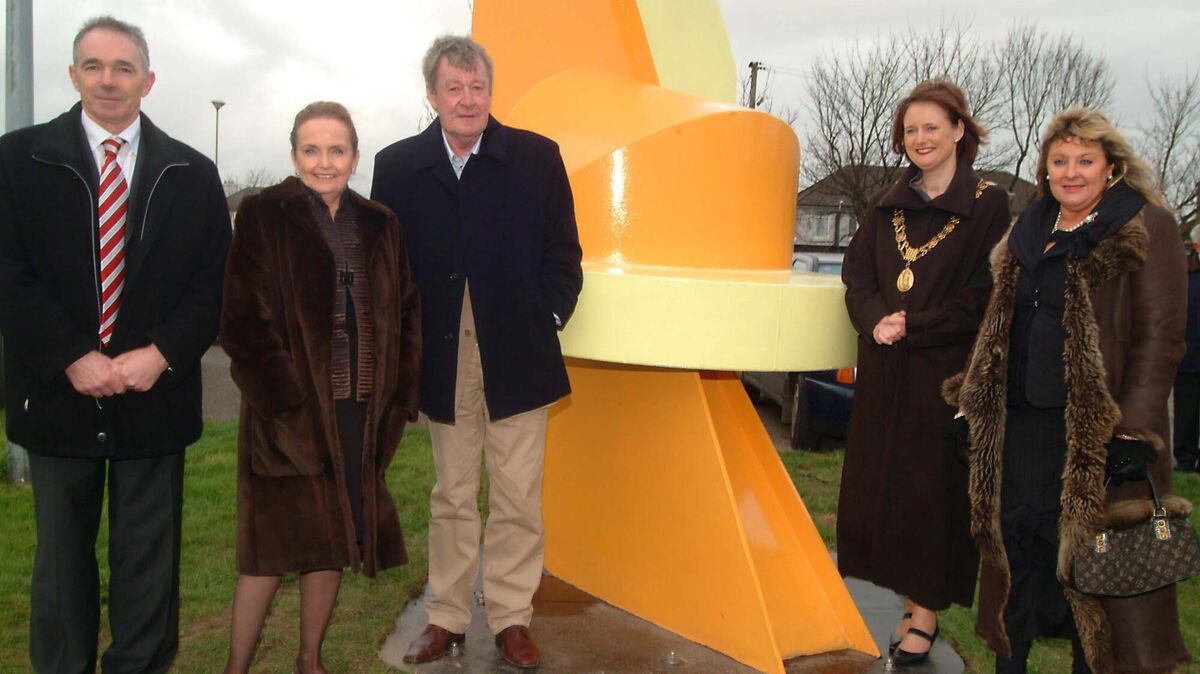
The last significant work Burke completed was Firefly, which Lynch commissioned to celebrate Cork’s tenure as European Capital Culture in 2005. It was installed on the grounds of Cork University Hospital the following year.
“The idea behind the piece was that it was to be put outside the new maternity hospital. It was John’s intention that it would be the first piece of art the newborn babies would encounter when they came into the world.”
Burke died of cancer on 11th December 2006, months after the sculpture’s unveiling. Lynch arranged his funeral, honouring his wish to be buried in a standing position at Ard na Gaoithe cemetery in Watergrasshill, facing the Knockmealdown and Galtee Mountains of his native Co Tipperary.