Cork in 50 Artworks, No 11: Two Working Men, at County Hall on Carrigrohane Rd
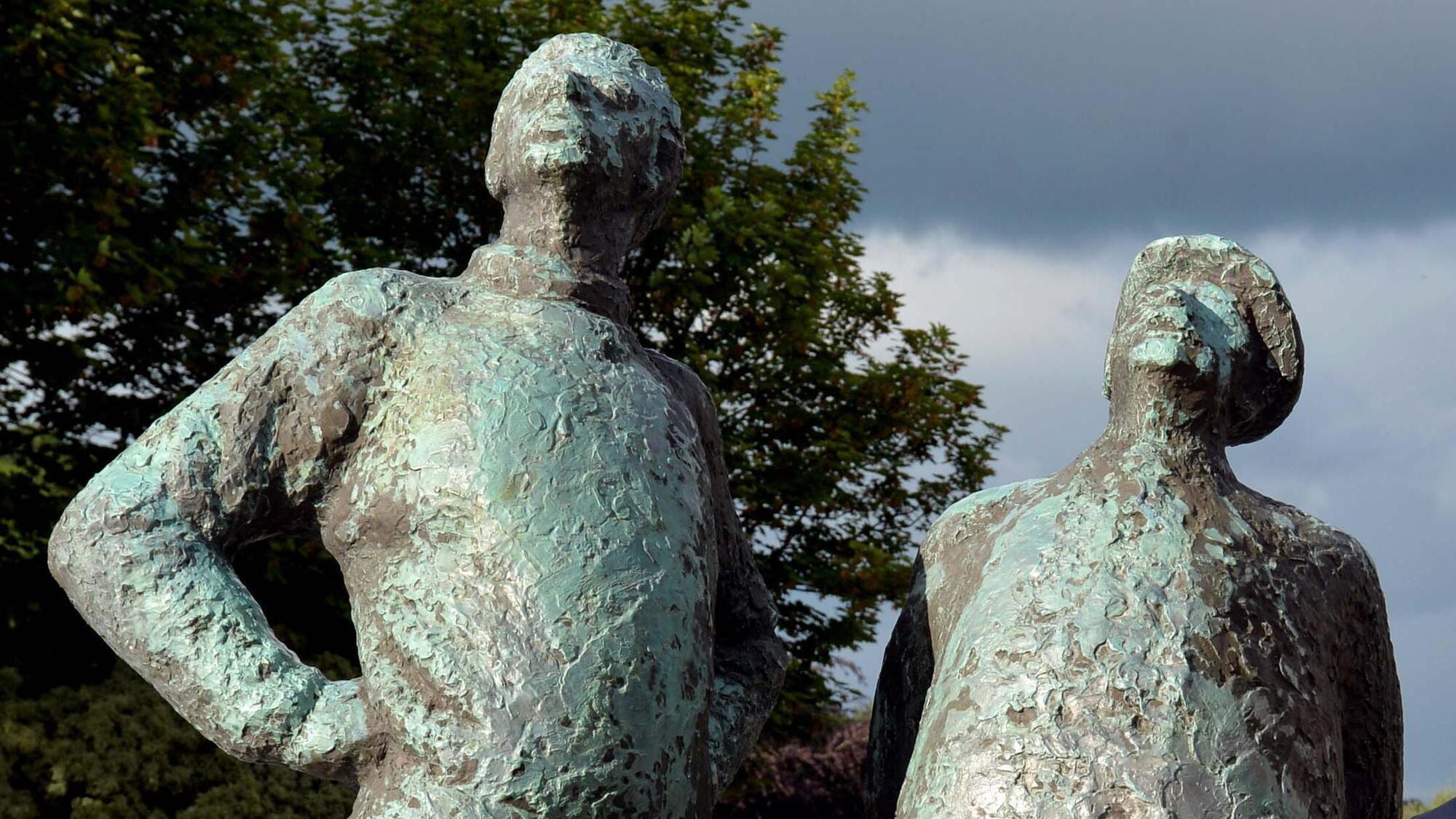
Two Working Men, aka Cha and Miah, at Cork County Hall. Picture: Denis Minihane
It might be so well embedded in local lore that it’s known affectionately as Cha and Miah, but one of Cork city’s most distinctive landmark sculptures was actually never meant for Cork.
To locals, the cast bronze sculpture is called 'Cha and Miah', but is actually titled Two Working Men. It depicts two figures, one older and one younger, gazing upwards. Situated as they are outside Cork County Hall, for nearly four decades, they were marvelling at the sight of Ireland’s tallest building, until the title went to another Cork landmark, the Elysian.
But when sculptor Oisín Kelly originally made the piece, it was designed to provide commentary on a different high rise: that of Dublin’s Liberty Hall.
The sculpture was commissioned by the ITGWU (Irish Transport and General Worker’s Union), which was founded in 1909 by James Larkin. Kelly would later go on to make the statue of Larkin on O’Connell street, and several other important Dublin landmarks, including the Children of Lir at the Garden of Remembrance.
But Dublin Corporation refused planning permission to the ITGWU for Two Working Men on the site on which it was originally planned, on the grounds that they were “traffic hazards”.
The Cork branch of the ITGWU arranged the loan of Kelly’s sculpture to the Cork Sculpture Park Committee, and from 1969 to 1971 it resided in Fitzgerald’s Park, where the duo's upward gaze was rather aimless.
In 1971, the figures were moved to County Hall, the better to accentuate the building’s height. Officially, they were still “on loan” from the ITGWU.
The very same year, RTÉ began airing Hall’s Pictorial Weekly, the cutting edge of political satire at the time: sketches featuring Cha and Miah, played respectively by Frank Duggan and the late Michael Twomey, were a hit, with their uniquely Cork outlook and turn of phrase.
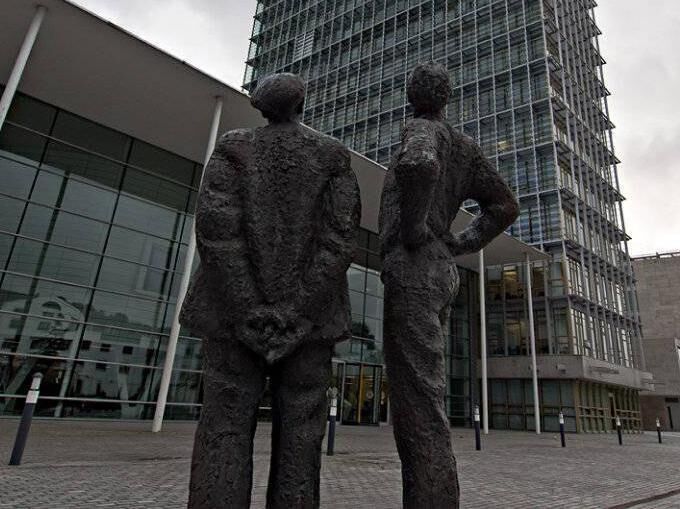
For Cork County Council Arts Officer Ian McDonagh, the connection between the sculpture and the characters of Cha and Miah is partly a matter of physical resemblance.
“The connection is certainly there, in the minds of Cork people,” Mc Donagh says. “Obviously, of the two actors, one was taller and one was shorter.”
But McDonagh sees a symbolic reason for the height difference between older and younger man in the piece, a parallel he believes Kelly was deliberately drawing between the lofty ambitions of the emerging modern Ireland and the lofty ambitions that lead to the country acquiring its first high rise buildings in the sixties.
“I think Kelly was attempting to reflect something of the new modern Ireland of the 1960s,” McDonagh says. “He designed the sculpture to relate to a tall building, and Liberty Hall in Dublin and County Hall in Cork were the first examples of High Rise in Ireland. This was the Ireland of Lemass and TK Whittaker; outward looking, ambitious and confident.
“The older man perhaps represents the qualities of an older Ireland. He’s a craftsman, proud of his skills. But the younger figure represents youth and energy. He stands beside the older man, but is turned slightly away. Like he’s looking for new challenges and opportunities.”
The city’s 2019 boundary extension means that technically, County Hall is now well within city bounds, which begin to the west, in the outskirts of Ballincollig. But for many years, for county-dwellers from the west travelling to the city, County Hall, with the familiar figures of 'Cha and Miah', formed the natural boundary between city and county.
For McDonagh, they are a much-loved artwork that lives in the minds and hearts of Cork people, but also an important piece of history in terms of public art.
“Oisín Kelly is arguably the finest Irish monumental sculptor of the 20th century so I think we’re very fortunate to have it,” he says. “This is the most substantial piece of his in Cork, although there is a smaller piece in Fitzgerald’s Park.”
The ITGWU, which itself would cease to exist and be subsumed into SIPTU in 1990, arranged the official donation of the sculpture to the people of Cork in 1977; until that time, it had technically been on loan while workarounds were considered to the Dublin planning issue. Apart from a two-year period in the Noughties when renovations temporarily saw them taken down, Cha and Miah, or Two Working Men, have made County Hall their home ever since.
“The ITGWU were glad to have a permanent home for them in Cork, and at that stage, they had very much become associated with County Hall, so Dublin’s loss was our gain,” McDonagh says.